Check Out This Post!

Harmon Killebrew On David Letterman!?

With the appearance of Joe Mauer last week on Jimmy Fallon, I was reminded of another episode of a famous Twin who appeared on late ni...

Showing posts with label Sam Mele. Show all posts

Saturday, May 6, 2017

Farewell, Sam Mele

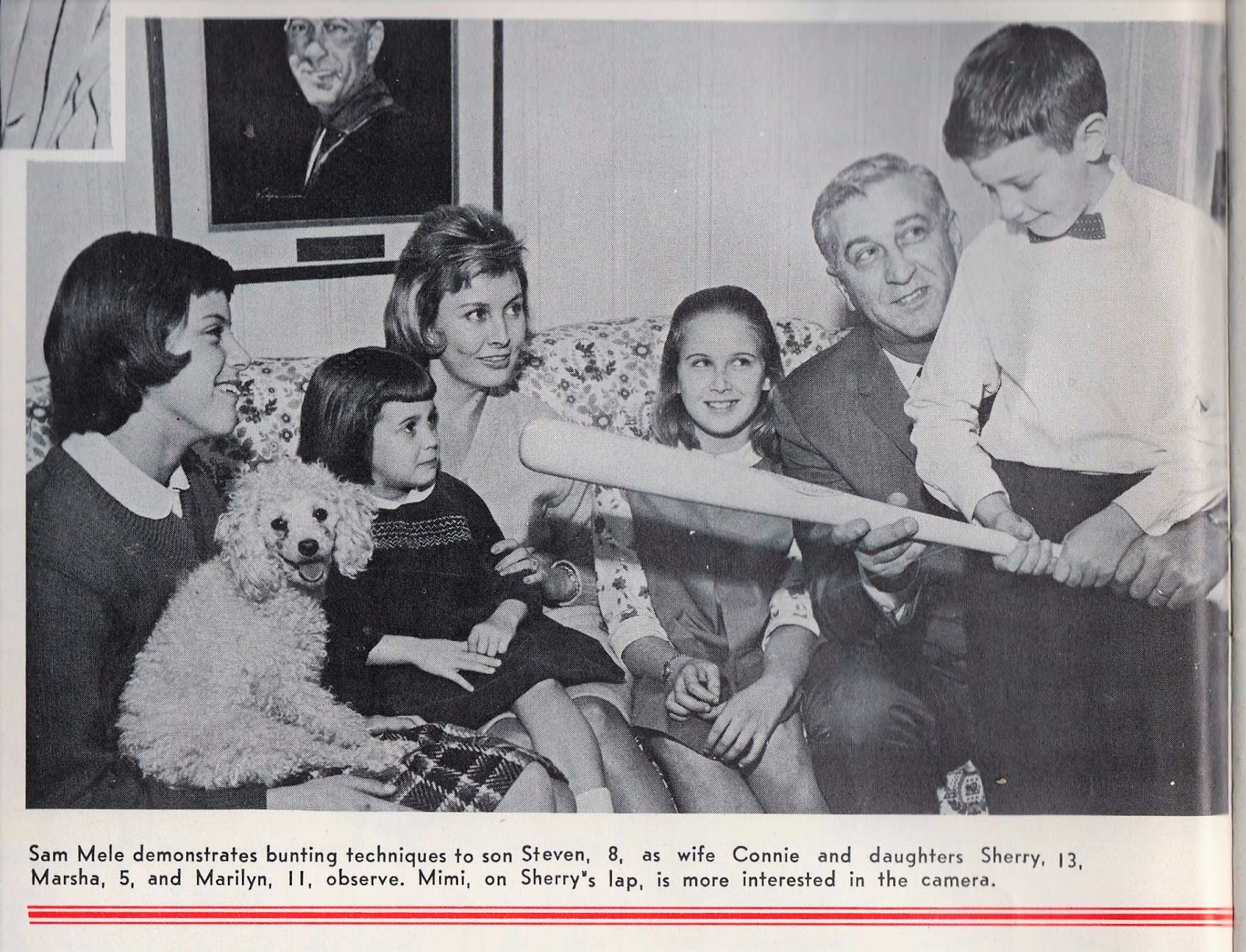
From 1966 Minnesota Twins Yearbook

Sam Mele, the second man to ever manage the Twins, died this week. He passed away at his home on Monday, May 1, in Quincy, MA., at the age of 95. He was a solid hitter and outfielder as a player, before coaching stints with the Senators and Twins previous to his becoming their manager.

He was there to lead the very first era of team glory, and was the first Minnesota Twins manager to guide his team to the post-season. The Twins were the first to break the Yankee chain of domination, euphorically winning the 1965 American League Championship, before losing to the Los Angeles Dodgers in the seventh game of the World Series.


Managerial Stats Table
RkYearAgeTmLgWLW-L%TiesGFinishW-L%post
1196139Minnesota TwinsAL2nd of 425.286077
2196139Minnesota TwinsAL4th of 44549.4791957
3196240Minnesota TwinsAL9171.56211632
4196341Minnesota TwinsAL9170.56501613
5196442Minnesota TwinsAL7983.48811636
6196543Minnesota TwinsAL10260.63001621.429AL Pennant
7196644Minnesota TwinsAL8973.54901622
8196745Minnesota TwinsAL1st of 22525.5000502
7 years524436.54639633.8.4291 Pennant

Provided by Baseball-Reference.comView Original Table
Generated 5/6/2017.

He would seem to have been the ideal man to guide a young team, not only because he was relatively young (39) when he took over the managerial reins from Cookie Lavegetto in June, 1961, but also because he was patient and yet authoritative - a man who would stand by young players like Zoilo Versalles and still not put up with distractions.  No example better illustrates this than his handling of "Zee," who was far from a finished product when Mele took over in '61. Zoilo had a tendency towards inconsistency and volatility in his emotions. At one point, he and the manager had a tense confrontation in the dugout before a game, which escalated to the point that Mele him fined several hundred dollars (read up on that at the newspaper clip link following this paragraph). But once the air cleared, Mele put the outburst behind, and reinstated Versalles as the starting shortstop. Zoilo went on to become the American League MVP in 1965. It follows that Mele would deserve some credit for that success.

He is also known for a passionate, fiery, on-field demeanor, and goes down in Twins lore for an incident on July 18,1965 (Box), when he charged umpire Bill Valentine at Metropolitan Stadium, during a game versus the California Angels. You can view details of this at the Austin (MN) Daily Herald, July 19, 1965, and here at The Lake Charles (LA) American, July 19, 1965.


1966 Minnesota Twins Yearbook - click for larger view

"Let me help you adjust your tie"
More to his basic nature, however, he was apparently a strong, loyal family man, devoted to his wife and children, and well regarded in baseball circles. I find it significant that his first team, the Boston Red Sox, brought him back as a scout almost immediately in 1967 after Twins Owner Calvin Griffith fired him (see Monroe (LA) Morning News of June 10, 1967). He spent the next 25 years with Boston as a scout, before retiring in 1992.

1964 Minnesota Twins Yearbook - Click on photo for larger view

The Twins sent out a press release on Monday, stating:

“The Minnesota Twins are deeply saddened by the loss of Sam Mele,” the team said in a statement. “The former skipper was an important figure in Twins baseball history. The beloved Mele, not only led the 1965 Twins to the American League pennant, but also helped establish the importance of Major League Baseball across the Upper Midwest.”

So long, everybody!” -  Herb Carneal

Sam Mele

Sam Mele managed the Minnesota Twins to the American League pennant in 1965, but just a year and a half later was fired by the team. Subsequently, his former team rallied to finish the 1967 season tied with the Tigers, just one game out of first place in the American League.

Monday, August 26, 2013

The 1st Camera Day, 1962: Day Of The Jack Kralick No-Hitter

By sheer coincidence, the Twins 1962 Camera Day landed on the very day (8/26/62, BBref Box) the franchise's first Minnesota no-hitter (post link!) was pitched, by Jack Kralick. Through the goodness of Twin Cities blogger Michael Haas (@digitalHaas, Alright Hamilton!), we have this beautiful set of photos from that historic day. They were shot by his grandfather, who attended the game that day along with Michael's mother and grandmother. We also get a sampling of Michael's thoughts at the end of this post, lending context to the photos. 1962 Twins team members Jim Kaat, Zoilo Versalles, Vic Power, Don Mincher, Dick Stigman, Ruben Gomez, Rich Rollins, Johnny Goryl, Hal Naragon, Marty Martinez, Coach Floyd Baker, and Manager Sam Mele are all present in this collection.

What is so great to me is how relatively shiny and new Metropolitan Stadium was - it was only in it's seventh season of existence, and its second as home to the Twins. The right field view is beautiful, encompassing the scoreboard, crowd, and bullpen areas. Especially nice is the Rollins / Valdivielso photo, with the first base foul territory and upper deck mezzanine in the background.

          [ NOTE: HELPS TO SINGLE CLICK PHOTO, ENLARGE FOR DETAIL! ]
My first inclination before posting these photos was to couple them with archival newspaper reports of the famous game by Kralick. After some thought, however, I felt they deserved a post of their own.  A separate blog entry will follow this week, concentrating on the original "Black Jack's" efforts.


[below: player with Rich Rollins (R) is Ruben Gomez, and not Jose Valdivielso as noted. To correct)


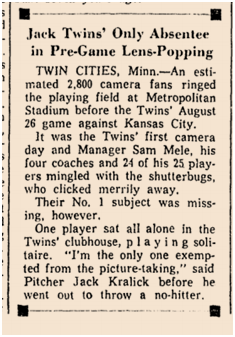
Ironically, Jack Kralick was nowhere to be found on the field for interested fans. The Sporting News Sept. 8, 1962 edition gave this explanation (see PDF of TSN page for extra context from that game) :


My Questions For Michael Haas: Behind The 1962 Camera Day Photos

ClassicTwins: I've always wanted to know about that blog title: "Alright Hamilton." How did that come about? How would you summarize the blog?

Michael: Oh, it's just a line from the movie "Fast Times At Ridgemont High," uttered by Sean Penn's character. I didn't put much thought into the title, obviously. Actually, we were a pretty legitimate blog in the pre-Twitter days. Myself and a few others tried to document the Twins fan experience and random off-topic things. You can see the archives at alright-hamilton.blogspot.com. The alright-Hamilton.tumbler.com is where I post random media very sporadically. I wish I could get back into the writing daily, but I just lost the momentum. Someday.

ClassicTwins: I get that "momentum" thing. Tell me about the photos, Michael. What’s the history behind them?


Michael: My Aunt digitized these old slides and gave some framed prints to my Mom for Christmas. My Grandpa was likely the photographer. My mom, 12 years old, is visible in the Athletics’ dugout on the left, and that’s my Grandma in the blue dress.


ClassicTwins: Very cool, a piece of family history with your grandparents and mom at the game, the photos literally a snap shot of a small part of their lives at the time. Could you give any information regarding the type of Twins or baseball fans they were – avid, casual, or otherwise? Did they make regular outings during the summers to Met Stadium to see the Twins? Do you know if they had any favorites among the players or coaching staff?


Michael: I would describe my grandparents as casual fans. I don’t remember them having much to say about the Twins while I was growing up in the 90’s. However, they must have been pretty close with the team because my Grandpa worked as an usher at Met Stadium. I’d guess my mom was the big fan of the family. I think she has a Bob Allison autographed picture around somewhere. And I know she still has her ticket stubs from games 1 and 2 of the 1965 World Series she saw as a 15 year old. I have no idea why she didn’t go to 6 and 7.

ClassicTwins: Bob Allison – perhaps the “Mr. Photogenic” of all the Twins ‘60’s guys. Does the photo set give you any particular feelings, i.e. “I wish I could have seen Earl Battey play in person,” or “Did the Twins REALLY have Harmon play left field a lot when they had Vic Power around to play first?” Or anything at all that you wonder about from that period in Twins history?


Michael: Well, the things that strike me most is the ballpark and the uniforms. I had no idea the Athletics had changed their primary colors to orange and black during their brief stay in Kansas City. It’s also interesting to see the way Metropolitan Stadium evolved over the years as they added seating. What’s most amazing to me is the fan access to the players and the field. Can you imagine what it would be like, as a 12-year-old, to stand on tobacco juice and sunflower seed shells in the dugout with the players? It would be fun to know what was going through their heads.


ClassicTwins: Great observation! I like word-pictures! So, how would you rate yourself as a fan? What was your favorite player growing up as a kid? Or now?


Michael: I’m a big Twins fan, but I’m a reasonable one. I don’t let their stinky performance affect my mental health, or anything like that. I grew up in the era of the ‘M’ hat and Kirby Puckett. I don’t actually remember either World Series title, but in every picture of me as a kid, I’m wearing a “World Series Champ” hat.


ClassicTwins Are there any particular games you’ve attended that stand out in memory?


Michael: The best two games in recent memory that I’ve attended were game 163 in 2009 and the Jim Thome walk-off bomb against Thornton and the White Sox in 2010. Every fan remembers those two games.


ClassicTwins: What do you think about Target Field (what a dump, right?)?


Michael: I like Target Field a lot. We’re four years in and it still feels brand new. In fact, I’m still learning about the best views, best seats for the money, and most excellent and secret parking spots. The only thing I dislike about modern stadiums is the separation between seating areas. They put a moat in Target Field to close off the padded seats from the regulars, and they place almost all the memorabilia in exclusive seating areas. But that’s the nature of the modern sports palace - - gotta make sure the corporations feel special.


ClassicTwins: I have no doubt many Twins fans share that idea! I loved my single visit to the Legends Club area, swanky, but I wish it would be easier to just glide through there, in particular, and see the fantastic museum-like exhibits. Great stuff, Michael! Anything else pertinent you’d like to add about “1962 Camera Day At The Met”?


Michael: That’s really all I got. But it sounds like you’ve done further research on the game and roster than I, so anything you want to add about that era would be really cool. You could just add my twitter handle I guess. Thanks a bunch. I really think the Twins have a cool circle of fans on the internet, and you’re one of them.


ClassicTwins: You show yourself a man of great judgment. 
10-4 on that handle: @digitalhaas.

Thanks again, Michael and Win! Twins! (okay, that IS how the song is properly titled!).


***

What a great thing it was, having our Mr. Haas's permission to go ahead with these gems!
As the great Twins announcer finished every broadcast, I also say:
"So long, everybody!" - Herb Carneal

Tuesday, April 2, 2013

A Maestro At First: Trading For Vic Power, April 2, 1962


LAST UPDATED: June 26, 2017 - Originally published 4/2/13 


In-season trades are rare occurrences for the Minnesota Twins. And even rarer are those that actually impacted the fortunes positively for the home nine. For Twins fans born around and after 1987, used to low-risk / low-dollar acquisitions* that numb the mind (see "Chris Speier, 1984, Bret Boone, 2005), the in-season pickups of Shannon Stewart (2003) and Kendrys Morales (2014) stood out as the exceptions. They captured the imaginations of Twins fans in terms of their audacity and potential, even if their outcome didn't exactly live up to the hype.
*Trade, waiver, and free-agent acquisitions are thrown into the same kettle for the purposes of this post

But rarities like these haven't always been the case in Twins Territory.


The Twins in the 1960s had at their disposal an astute gaggle of bird dog scouts, and long-time employees like Director of Minor League Operations man Sherry Robertson to assist President Calvin Griffith and his merry band of nepotists and drinking cronies in upgrading the Major League roster. They did this nearly every season in those early years. Which brings us to today's subject, the first major trade in Twins history.

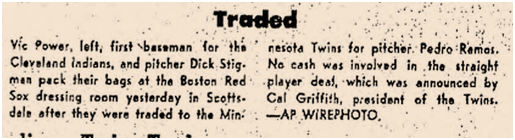
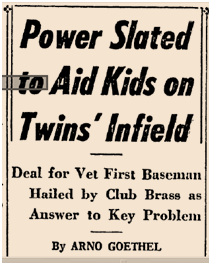
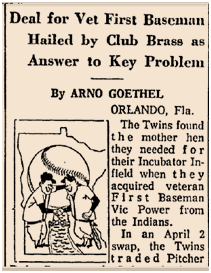
Vic Power was traded along with young reliever Dick Stigman to the Twins from the Cleveland Indians for right hander Pedro Ramos 53 years ago this week, on April 2, 1962. This happened as the team was winding down the '62 spring training schedule, and seemed to address the needs of both teams. At the time, parting with the talented Ramos, a fixture in the '61 starting rotation, was a significant event. He was their second starter, after staff ace Camilo Pascual, and is the trivia answer to "What Twins pitcher is credited with the first regular season win in team history?Jim Kaat was just coming into his own that season, and would win 18 games. They also had the enigmatic lefty Jack Kralick in house. In Stigman, the Twins were glad to get a promising, young arm. But the "sexy" part of this transaction was obvious...


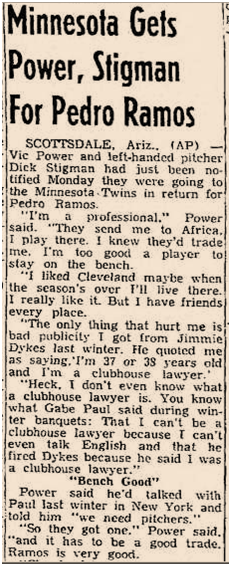
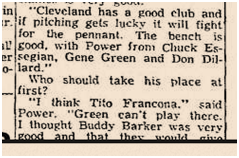
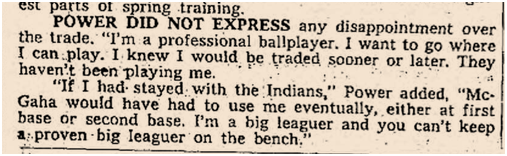
The news piece below from the 4/3/62 Jefferson City Daily summed up the trade, besides giving a very detailed, honest set of responses from Power himself (born Victor Power Pellot). Power was the key acquisition for the Twins , and at age 33, was joining his third organization. The Twins organization, going back TEN YEARS to their Washington Senator days (Google news item link) had coveted Power as a player. In another lifetime, as a Yankee in the early 1950s, he was in line to become the first black player for that organization. But the Bronx Bombers instead tapped Elston Howard for that role, for reasons that are now obvious. Some very transparent racism can be inferred from the Yankee brass responses, in The Sporting News piece linked here, from August 19, 1953


He had a reputation for marching to the beat of his own drummer, and was not necessarily the "company man" preferred by management. He was flashy in his dress, as well as the automobiles he drove. He was glib and candid, much to the consternation of his employees. He was conspicuous for enjoying the company of white women. And, maybe worst of all, he [GASP] made putouts at first with a sweeping, one-handed stab - unorthodoxy and panache frowned upon by the baseball lords of the day. 

Each of the above infractions were decided liabilities for dark-skinned players who desired stable employment before Civil Rights legislation came into effect.


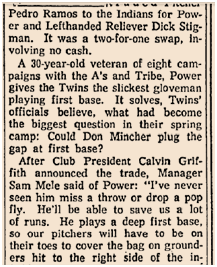
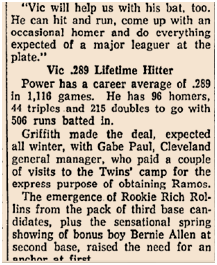
Twins Manager Sam Mele, on the other hand, stated the case for acquiring Power (to whom I devoted a "Remembering Vic Power" post some time back) in this piece:


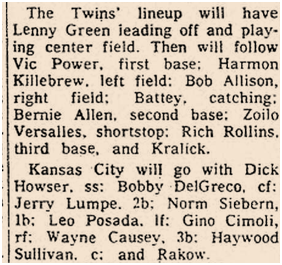
There was a youth movement (Brainerd Daily Dispatch, 4/2/62) underway at The Met. Besides now having the green-as-a-pea kids third baseman Rich Rollins and second baseman Bernie Allen on the roster to start the season, Minnesota also had the mercurial Zoilo Versalles returning at short. Manager Sam Mele went on in the article to say "Power should be a steadying influence on the kids. They won't have to worry about making perfect throws. If it's within Power's reach, he'll come up with the ball." Griffith's concerns about his infield defense were legit, as the team ranked 8th (ten team AL) in defense in 1961; in Power, he now had his "Mother Hen" to corral those youthful slings to first. 

Power himself had a little extra to add in this account, which sums up the pride and inner confidence he held for his talents:


The Brainerd Daily Dispatch revealed the Twins new mindset for what would constitute their daily lineup to begin the 1962 season. Anybody surprised at who's slotted for left field, replacing Jim Lemon? Some big, ox-strong kid, name of Harmon Killebrew:


The trade would indeed benefit the Twins in their infield defense that year, besides elevating their place in the standings. They went on to post a 91-71 record, second in the league, moving them a step closer to respectability. Power would win his fifth Gold Glove Award, and rate 21st in the 1962 MVP voting. He would also play a pivotal role in the first Twins no-hitter by Jack Kralick (story at link) on August 26 that year. 

But that was just another day at the office for Victor Pellot Power. For his part, he seemed to enjoy his time in Minnesota, judging by his comments in a Baltimore Afro-American piece from March 31, 1964.

More insight about Power and his role as a MLB trailblazer can be gleaned at this very cool Baseball Hall Of Fame article.  
As the old professional at the mic, Herb Carneal, would end his broadcasts, I also say:
"So long, everybody!"


No, please don't go there....ohhhhhhh(!)....okay...
....what man wouldn't be proud of that assertion?