Check Out This Post!

Harmon Killebrew On David Letterman!?

With the appearance of Joe Mauer last week on Jimmy Fallon, I was reminded of another episode of a famous Twin who appeared on late ni...

Showing posts with label Kent Hrbek. Show all posts

Sunday, May 21, 2017

Kent Hrbek Beats The Yankees In Debut, Aug. 24, 1981

It's Herbie's birthday today. And it seemed like a good time to look back on a happy memory.


The tall, gangly kid had quite an auspicious debut on August 24, 1981 (The Sporting News report), hitting one over Reggie Jackson's head into the Yankee's bullpen in the 12th inning. It was Kent Hrbek's first home run, hit while wearing number 26 in his first game up from A ball. Home run number one was a line drive off  future teammate George Frazier, whose reaction is like one who just stepped on a rattler.


This clip is also interesting for what doesn't happen...a silent treatment 
followed by the outbreak of hugs, backslaps, which you see today for
a rookie's first home run. Or the orgasm of joy for a walk-off.
Nope, other than Darrell Jackson giving Herbie a light tap on 
the shoulder, everyone's obeying the unwritten code, not
 displaying too much joy...there was still another half inning to play..

It was an unlikely 3-2 Twins win over the eventual American League champs. But better - it was a glimmer of better times to come for Minnesota. Kent Hrbek was just the start of the run of talented players that would compose the roster of the 1987 World Series Champions. It really held the air of promise, this night, of fun times to come. Of course, we had no idea how badly the Tigers would whip our guys' fannies for the next five years. But that adversity just made the future success that much sweeter.

So long, everybody! - Herb Carneal

Saturday, May 31, 2014

Bizzarre Fielding Video: The Metrodome's First Triple Play May 29, 1982


  • Six men in a box. Nettles retreats to 1st as Gaetti
    is arriving with ball. Lenny Faedo (12) wonders just what his
    role is in the play, while Ron Washington points at Murcer.

  • For you kids at home, score this one as a 1-2-5-3-1 triple play. "Holy Cow!," as Yankees announcer Phil Rizzuto exclaimed (though Twins oldies like to credit Halsey Hall (sound file) with originating the phrase).

    The crazy play as seen in the video occurred on May 29, 1982 at the brand new H.H.H. Metrodome (humorously cynical Deadspin review). Minnesota and the Yankees were scoreless in the 2nd inning, with righthander Terry Felton on the mound for Minnesota. The weekend series against New York was the fourth homestand for the Twins at the new facility. They were in the midst of an inglorious 14-game losing streak.

    Baserunning Comedy


    The Yankees had put runners on first (Graig Nettles) and second (Bobby Murcer) with no outs. Roy Smalley then struck out on a wide 3-2 pitch from Terry Felton, with Murcer attempting to steal third base. Rifle-armed Sal Butera (right photo) threw to Gary Gaetti so far ahead of baserunning Bobby that he tried returning to second. Problem was, former Twin Nettles was standing on the bag by then (ooops!) as part of the hit and run play. He retreated back to first. 

  • Gaetti uselessly tagged Murcer after the rundown before throwing to Kent Hrbek to catch Nettles...then, Murcer, the smart ballplayer of many great years, inexplicably went back to third! Hrbek threw to Felton at third to complete the triple play, with zany left fielder Mickey Hatcher backing up the bag. None of this would ultimately matter, as the Yankees pulled off a 6-4 win with two runs in the ninth.


Trivial Trivia

Felton (see Michael Rand 2010 story update) was 0-8 coming into the game, and got a no-decision after Brad Havens came in to blow the lead in the sixth inning. He would lose another 5 to finish his career with an 0-16 record.


Bobby Murcer (left, BD photo)was the last of the 1960’s Mickey Mantle New York Yankees remaining on the roster. He, in fact, had been tabbed as the heir apparent to the Mick - always a “great” thing that, heaping expectations on a young player. The Oklahoman was good enough to earn 3 straight top-ten MVP finishes early in his career. He had been traded even up to the Giants for Bobby Bonds in the 70’s, and had also been a Cub; New York brought him back in 1979 as a part-time player.


Craig Nettles, playing the role of Fred Astaire in his sashay back to first, would go on to several more fine seasons. He was profiled earlier at this blog (“The One That Got Away.”). Former Twin Roy Smalley had been a Yankee for less than two months, while Butch Wynegar was in pinstripes for just over two weeks after six seasons as a Twin. Of the three, only Roy would again know the joys of playing regularly on the Dome's carpeted cement pile, the lucky guy, after his 1985 trade back to the Twins.

The young Twins of 1982 represented a completely different era from the teams that had occupied Met Stadium from 1961 to 1981. Even in losing, they were thoroughly entertaining. One could see the talent in the young Gaettis, Brunanskys, Laudners, etc., and the smoke wafting out of the runway of the dugout (pregame heaters) but one knew that growing pains would be the rule for some time out. Kent Hrbek was already the star of the team, building a case (link to stats coming into that game) for inclusion on the '82 All-Star team.

"So long, everybody!" - Herb Carneal

Tuesday, November 5, 2013

Sweet Swingers: Harmon Killebrew GIF

Sweet swings from The Killer: Harmon Killebrew    


A few general impressions...

This was Killebrew yet in his prime.
The top frame is attractive for the imagined mayhem. You never see ball meet bat, nor the trajectory of the pitch, or whom Harmon is batting against. But you can well infer it's bad medicine for whomever's chuckin. Just another sunny day for the fans at Metropolitan Stadium, with The Killer providing the thrills. 

These give just a quick take on the violence of the basic, Killebrew homerun cut. As if he was hacking down a maple. I recall Bloomingtonite Kent Hrbek sitting at a panel of others (Jack Morris, Paul Molitor, Jim Grant) three years ago when Killebrew passed away, and saying that Harmon was like the mythical Paul Bunyan for him as a kid.

Appropriate he would choose an icon central in Minnesota lumbering history in describing the area's favorite "ax-man" of the diamond. For a really great view of that swing, you should pick up the great Red Sox commemorative 1967 DVD, which features the oldest known preserved, full-length, color MLB game on record. Harmon homers for number 44 of the season in game 161(box), and it is the true, typical vicious swing for which he was known.

The second frame gives a bit more context of  "The Fat Kid," at work (see book excerpt below) as Jim Bouton referred to him. In fact, when I first saw the pitcher in the road blue, yellow piping, I immediately thought "Oh...Seattle Pilots, 1969!," but then noticed Harmon's jersey didn't have the MLB 1969 Centennial logo on his right arm sleeve (see photo ABOVE, BELOW), which would date the image from the 1970/71 seasons - which means the opponent was not the Pilots, but their children, the newly transplanted Milwaukee Brewers.


I had said this was Harmon in his prime. A Few stats from BBRef: keep in mind, ye not impressed -  this period was still part and parcel of the pitching rich late-60's. A special player! As a public service OPS & OPS+ are linked to a definition for old dudes like me who've time-traveled in from the '60s, other times unknown, and were fed mostly RBI, jacks, doubles and triples on the backs of their Topps baseball cards :

Year
G ▴ PA AB R HR RBI BB SO BA OBP SLG OPS OPS+ TB
1970
157
665
527
96
41
113
128
84
.271
.411
.546
.957
159
288
1969
162
709
555
106
49
140
145
84
.276
.427
.584
1.011
177
324
Generated 11/5/2013.   BOLD TYPE = LEAGUE LEADING TOTALS

Killerologists will recall he finished third in the MVP voting in 1970, and took home the heavy hardware in 1969, the only such time he was honored. It will be worth my while to post some more gifs of this subject. Yes, there are a few in the pipeline, and the world awaits.

It's the least I can do for the player who taught me it was okay to eat Old Dutch chips in the dugout during a game.

To sign off in typical Herb Carneal Fashion:
"So long everybody!"

Saturday, October 12, 2013

Euphoria Squared: The Great Metrodome Victory Celebration, Oct. 12, 1987 VIDEOS

The Twins 9-5 victory over the Detroit Tigers to win the 1987 ALCS was unprecedented not only for ending the team's 17 year absence from post-season play, but just as much for that game's aftermath. The outpouring of fan joy that greeted the team as it set foot on the springy Metrodome surface that evening was truly an occasion never before seen in Minnesota.

It was a hastily organized "Welcome Home" at the H.H.H. Metrodome for team players, coaches, trainers, and execs fresh off landing at Minneapolis-St. Paul Airport. It was a Monday night, a school night, and event organizers weren't expecting much better than a polite turnout - Minnesotans aren't like New Yorkers, news flash. They're famous for keeping the kiddies home, early to bed, feed the cats, put on the nightcap...you get the idea.

 For Minnesota fans so long accustomed to ignominious defeat in four Superbowls, and being the butt of flyover land jokes, or of ill-fated closers (let's not mention the name "Ron Davis,") the return of the AL Champs from Detroit was an excuse to let loose the emotional floodgates and "Party Like It's 1999."

I well remember waking up every morning after a Twins win late in the season, my head a-swirl with giddiness about what seemed to be happening, breathing it all in, and yet not wanting to let go of my disbelief...yes, giddiness, euphoria...it was like being at a month-long Grateful Dead or Pink Floyd concert.

With that as context, you can hold back on your urge to have Viking Alan Page materialize and blindside the whistle-blowing Twins players' wives, or muzzle over-eager television sports reporters. God knows I had to.

Can someone tell me where Juan Berenguer got the idea for this get-up?

Listen closely at the 4:00 minute mark of the second vid. John Rooney correctly reminds fans that Bert Blyleven predicted an '87 pennant. He's 100 percent spot-on; I heard him say it live at the Dome, after the '86 season-ending game; it was a fan appreciation ceremony, with player speeches. My brother Kevin and I turned to each other - and laughed out loud. Sure, Bert, whatever!


What this evocative group of videos helps me remember is the fun of a completely unexpected pennant race. It was seeing grizzled veterans* like Steve Carlton, Joe Niekro, Don BaylorBert Blyleven and Roy Smalley mesh seamlessly with the Class of '82 players like Kent Hrbek, Tom Brunansky, Gary Gaetti, Tim Laudner, Randy Bush (and later) Greg Gagne, Kirby Puckett, Frank Viola, Dan Gladden, Jeff Reardon, et. al., to create an improbable, crazy-quilt patchwork of a playoff contender. This was all 1-2 years ahead of the timetable, in the estimation of youthful Vice President Of Player Personnel, Andy McPhail. Blueprints? Who needs blueprints?

*Could have included Rod Carew, discussion in '86 The Sporting News article


If you actually made it to the second and third videos, consider yourselves "real" men and women, in the stout-hearted Norseman sense. By all means, you now should be able to weather AND enjoy this vintage '87 newspaper account about that great evening in downtown Minneapolis.

I enjoy how the giant baseball behind Kent Hrbek's head make's it look as if he's wearing a sombrero. Which only would have been fitting, as it WAS a huge fiesta for 55,000 people. That alone should make you want to go to the link...so, check out the Google docs version of this report, and click on "+" for a larger view.

Hope you enjoyed Herb Carneal in the above videos! May as well let him have the last word:

"So long, everybody!"

Wednesday, December 21, 2011

Twins Jerseys On The Red Carpet: A Pictorial Time Capsule


2 above photos: Billy Gardner models prototype 1/17/61
He was the first player ever seen in the uniform of the Minnesota Twins.
This model was scrapped in favor of a modified script before spring 
training (see press photo with Don Lee, below).

SOMETHING OLD, SOMETHING NEW
SOMETHING BORROWED, SOMETHING (POWDER) BLUE!

Clean, economical, and razor-sharp detail grace the Twins 1960's throwback home jersey and new road 2010 version.  Our fine, young diamond gladiators Denard Span and Scott "Joe Don" Baker did the new duds proud on Nov. 9, 2009, at the Mall Of America in Bloomington. One complaint...would it kill ya to show just a bit of old school stirrup?? This aint bedtime, fellas.
Starsky and Hutch, revisited. Kent Hrbek and Tom Brunansky were the "Men about town" one fine, spring day in '87. The jog to the top of a Minneapolis apartment building, capturing the lovely vistas of Minneapolis' skyline and HHH Muffindome , looks as if it's turned Kent (aka: "Shamu") a mite dewy with perspiration. Bruno's apparently gone misty in memory over his victorious '85 Homerun Derby. Perhaps a Butch and Sundance comparison would have been more fitting!


Of course, it's easy to forget we Twins fans first spied young Kirby Puckett in the powder blue road uni, in a televised game at "The Big A" in Anaheim (as it was called then) versus the Angels on May 8, 1984. Actually, some of us preferred to have the image of those threads erased from our memory, to be honest. There is also this nice, candid of him sporting the home batting practice jersey, in about that same year.

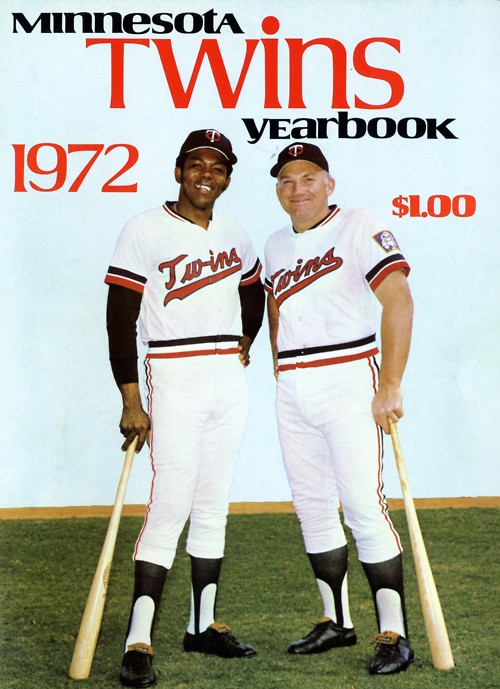
Cesar Tovar (right, below)looks downright apprehensive in the 1972 road uni. Maybe he's not relishing a batting duel against knuckleballin' Wilbur Wood of the Chicago Stinking White Sox, as this photo was shot at old Comiskey Park (photo link). The Topps '72 card of Harmon in handsome pinstripes, the last of him in that model, captures him in a typical threatening-but-strangely-benign pose. That was just before Topps' photographers descended on spring training camp in Orlando to capture the Twins new prisoners of polyester. Perhaps Cesar just felt clownish, especially with that ridiculously large Minnie & Paul sleeve patch!


     Lotsa stirrups and shoe polish! Harmon Killebrew in 
polyester double knits was never as imposing OR 
    stately as he was in the 1960's original retro jersey. 
     Lithe and lean Tony Oliva cut a dashing cover model
when the Twins ditched  the pinstripes in ''72.
Justin Morneau models the 1980's throwback with joyous aplomb in
November, 2008. It was to be worn during various home dates during 
the Metrodome's final season in '09.The original had an expandable
waistband, and was a pullover jersey (well, beginning in '73 anyhow). 

  102 losses in '82? You'd be bummed being associated in any way with that too.

And now for some actual, Paleozoic Twins history: before the first season in '61, new Twins pitcher Don Lee has just been given the very first world-release sneak peak at the Twins road jersey on Feb. 18, 1961(for the "Minneapolis Twins," (as described in the photo caption-see link "Naming Of The Twins"). Team owner Calvin Griffith: "Repeat after me...it's a $2 laundering fee!" Go to this Google Docs link to see another similar photo, with a group of Twins admiring the new togs.

Go to link at Google Docs to up size for below:


As Herb Carneal concluded every Twins broadcast: "So long everybody!" - TT

Thursday, December 8, 2011

Tony Oliva: Traveling The Rutted Road To Glory

[NOTE: try clicking on photos, get larger size]
"Oliva's got real quick hands, like Stan Musial, and he's got bat control like Willie Mays. Tony always gets a piece of the ball - like nobody I've ever seen." 
- White Sox Manager Eddie Stanky, Baseball Digest, Aug. 1966.
The National Baseball Hall Of Fame announced on Monday the voting result of its Veteran's Committee, in honoring the "Golden Era" stars of the 1947-72 period. Long-overdue recognition finally awarded Ron Santo. The former Cubs third baseman was among the greatest players of the modern era, and his choice was entirely fitting. I join the chorus of others wishing he had been elected long before he passed away just over one year ago.

Q: Who was the best hitter you ever faced?
"Tony Oliva. Because, he could hit any pitch, anywhere. He did not have a weakness." - Hall of Famer Jim "Catfish" Hunter, Baseball Digest, Aug., 1992

Pre-injury, Tony Oliva was a 
multithreat, all-round player.
He was widely regarded as
a prodigy in his first, spectacular
seasons.
As I am a long-time, ardent fan of both Jim Kaat and Tony Oliva, I had already concluded that the result would not be to my liking well before the voting took place. Understand, my initial infatuation with baseball is due, in no small part, to the fabulous Twins teams of the late 1960's, when I was a tyke. These teams had rosters filled with lyrical, alliterative names like Rich Reese, "Pepe" Tovar, Leo Cardenas, Rod Carew, Jim Perry, and, of course, the late, great, Harmon Killebrew. These names, especially when rendered over the radio by announcing great Herb Carneal (1965 All Star Game audio link), were as much a part of my childhood summers as the buzzing cicadas, Dairy Queen shops and cornfields surrounding my small town in south-central Minnesota. The drive from my home to Met Stadium in suburban Bloomington, Minnesota was a short one, maybe 35, 40 minutes. I looked forward to pregame batting practice in that erector-set of a ballpark. It used to be farmland, cornfields too. Once inside the ballpark, you'd see the expanse of green, with those Twins players looking like giants, or mythical gods to my small eyes. I marveled at Oliva taking batting practice in his prime, before knee injuries and age took their toll. He could spray the ball anywhere. The first game I can recall attending was actually a Met Stadium doubleheader against the defending champion Detroit Tigers (July 29, 1969, BBRef Box) in which Tony, The Killer and Carew each hit homers. A nice way to start as a fan, I think you'd agree...

"He was as good as any hitter of his time...Better."
- Lou Piniella, Hall Of Fame Press Release, Nov. 29, 2011


 I knew that the Hall's voting board probably realized its oversight in not selecting Santo, or Gil Hodges long ago. The "Old Timers" Committee was revamped in 2001 to help correct situations such as this. I had already digested the opinions of Aaron Gleeman from a 2005 post, in which he basically dismantles the notion of Oliva as a viable candidate from purely a statistical standpoint. A truly admirable piece of writing, and analysis - there's a reason why Aaron's baseball opinions are so respected. His conclusion: many others with stats similar to Oliva's are NOT in the Hall, and others - in his view, Dick Allen - are more deserving. When you make adjustments to Allen's length of career to approximate Olivas (total at bats, games played), as Gleeman did, you definitely get the impression that Allen was the better, more valuable player.


Sept. 1, 1969 (BBRef box), : was there ever a more perfect image of extension & balance?
Joe DiMaggio revisited! Closer to the current era, Adrian Gonzalez and Don Mattingly come to mind
as being similar, complete hitters, and also because they hit left handed.
Ahem! While not trying to place myself in the position of arguing the candidacy of Oliva over Allen, I do not find it a stretch to say that Oliva was, indeed, the better player over their first 8 seasons (which ran concurrent, starting in 1964, when they each won the Rookie of The Year Awards in their respective leagues). Oliva, at the plate, running the bases, tracking flyballs, throwing out baserunners, being a buoyant presence in the clubhouse, made the Twins a better team than did the divisive Allen for his Phillies, Cardinals, Dodgers, White Sox, the Phillies again, Athletics...am I forgetting any there? In any event, you get the point. Dick "Don't Call Me Richie" Allen was a great, albeit flawed performer. Even though he was Elizabeth Taylor* in cleats, jumping from team to team...

*or Madonna, Christina Aguilera, Jennifer Anniston, for you younger kids, on the Nocturnal All-Star Team of  Love
"...The guy I watched was Tony-O...When I got to the big leagues, people assumed that Harmon Killebrew must have been my favorite player as a kid. But I always focused on watching Tony swing the bat and hit the ball to all fields."
- former Twins first baseman Kent Hrbek, Tales From The Minnesota Twins Dugout, 2007
Scroll to the :20 second mark to see Oliva
inside-outing a pitch to left ca. 1969

Bear in mind also that this was the period of great rightfielders  like Henry Aaron, Roberto Clemente, Frank Robinson...pretty easy to get lost in the shuffle. Then add to this picture the fact that Oliva played in small market Minneapolis-St.Paul. Barry Larkin also has the same dilemma as a Hall of Fame candidate, playing his whole career in Cincinnati. Gleeman's picture is incomplete, as he apparently never saw Oliva in his prime. You can make the numbers say what you want - they do matter. But you are remiss in not weighing the opinion of people who saw and played against him. His contemporaries. That should be factored for any other eligible candidate, for that matter. Their word has to count for something. For without the anecdotal, eyewitness comments of his peers, you only get a sterile, one-dimensional, statistical view of the player. I think their comments in boldtype speak volumes.

Minneapolis Star Tribune photo: Opening Night,
Oakland vs Twins April 6, 1973

Put it this way: do you see similar comments in print about Ron Santo being "the best third baseman"? Or best hitter, baserunner, fielder, etc.? Not really. At least, not that I'm aware of...this isn't to say Santo wasn't a great player. You'll notice they were saying those things for and about Tony...and I'm merely stating that Oliva deserves a nod of respect, or consideration when people speak of the elite players of his time, though the excellence of his play is fading from the collective memory; the legion of sportswriters, scouts, and players who witnessed Oliva in his time are replaced by a new generation unfamiliar with him, and puzzled by the buzz over a fellow with "only" 220 homers and .304 lifetime average.

Check Tony's first, excellent years in the table. Pitchers in the 1960's were throwing downhill off a 15-inch high mound (10" today). That was just crazy! No wonder nobody was scoring or going yard very much! It was a notorious pitching-dominated era, as countless others have pointed out. He yet compiled a marvelous power/speed profile during a challenging period:
Ask yourself: had Tony's two second-place MVP finishes been firsts instead, what would that have done for his HOF chances? BOLDFACE numbers denote league-leading totals.
MinnPost's Steve Aschburner's take  on the "Cuban Cruncher," as Linkugel and Pappas refer to him below, makes an intriguing point. He correctly stated that Oliva bested Bill Mazeroski, Orlando Cepeda, Bruce Sutter and Jim Rice consistently (often decisively) in the voting by the Hall Of Fame committee during his initial candidacy years (1982-1996). Ironically, each has leapfrogged Tony, and have been inducted in the years since he went off the main ballot. His argument, if I may paraphrase it, appears to be "if them, why not Tony?"

Batting against the White Sox, 1971, Met Stadium
"Oliva, not [Jose] Canseco , is the greatest Cuban hitter who ever lived."
-Camilo Pascual, who scouted and signed Canseco for the Oakland Athletics, in "The New Face of Baseball: The 100-Year Rise And Triumph of Latinos."

While interesting, I find problems with Aschburner's logic: it can be used to justify a lot of bad or illogical choices. I think players like Tony, Roger Maris, Don Mattingly, and Garry Templeton were Hall of Fame talents who've been given scrutiny by voters in recent years, and who lit up their leagues for an abbreviated time. And therein is the distinction I draw. At some point, we have to pay attention to the Hall's 10 year minimum standard of high calibre play. If we are to have this hallowed museum where we profess to honor only the greats, only the people that fit the criterion, then we have to follow through. Tony and these guys don't fit in.

No, it's not what people want to hear and read. Not me. Not Steve Aschburner. Certainly not Tony; while being at his core a high-spirited, kind man, he has also expressed frustration with the voting process. He wants acknowledgement as being one of the greatest players of all time, which is natural. Who can blame him? Players tend to be less inclined to use strict HOF guidelines to gauge their worth. Again, all the quotes I'm supplying attest to his talent. He brought the goods, the numbers, the greatness...but it was for only eight years, if we are being honest with ourselves. While we could quibble over including his 1973 season to tack on another year for consideration (when he came back after recuping for most of '72), even that year is nowhere near Tony's performance of his 1964-1971 period.

1970: with daughter Anita, Fathers - Kids game at Metropolitan Stadium.
Minnie Mendoza (center) and Jim Kaat (left, head on hands) are visible.
"He was one of the best hitters I ever saw. And it was not only what he hit, but when. He always seemed to be getting big hits."
- former big leaguer/current Chicago Stinking White Sox broadcaster Ken Harrelson,
 Nov. 29, 2011 Hall of Fame Press Release (check link to Denard Span's comments, You Tube).

I'm reminded of Ted Williams quoting Whitey Ford who asked:
"You mean, Tony Oliva's not in the Hall of Fame yet?"

So, were left with this: Tony and Jim Kaat will have to wait another three years before they can come up again in rotation for the voters to consider. Perhaps Oliva will have to make peace, as will his fans, with the prospect that he will have even less backing the next time, in 2014, and will remain on the outside looking in. He'll be graceful, no doubt. And we'll do well to make do, remembering the excitement, joy, and memory of our very own, Tony-O.

As our Hall of Fame Broadcaster Herb Carneal ended his postgame, I say to you:

Calvin Griffith's comments, The Sporting News, Feb. 26, 1966