Check Out This Post!

Harmon Killebrew On David Letterman!?

With the appearance of Joe Mauer last week on Jimmy Fallon, I was reminded of another episode of a famous Twin who appeared on late ni...

Showing posts with label Gary Gaetti. Show all posts

Saturday, May 31, 2014

Bizzarre Fielding Video: The Metrodome's First Triple Play May 29, 1982


  • Six men in a box. Nettles retreats to 1st as Gaetti
    is arriving with ball. Lenny Faedo (12) wonders just what his
    role is in the play, while Ron Washington points at Murcer.

  • For you kids at home, score this one as a 1-2-5-3-1 triple play. "Holy Cow!," as Yankees announcer Phil Rizzuto exclaimed (though Twins oldies like to credit Halsey Hall (sound file) with originating the phrase).

    The crazy play as seen in the video occurred on May 29, 1982 at the brand new H.H.H. Metrodome (humorously cynical Deadspin review). Minnesota and the Yankees were scoreless in the 2nd inning, with righthander Terry Felton on the mound for Minnesota. The weekend series against New York was the fourth homestand for the Twins at the new facility. They were in the midst of an inglorious 14-game losing streak.

    Baserunning Comedy


    The Yankees had put runners on first (Graig Nettles) and second (Bobby Murcer) with no outs. Roy Smalley then struck out on a wide 3-2 pitch from Terry Felton, with Murcer attempting to steal third base. Rifle-armed Sal Butera (right photo) threw to Gary Gaetti so far ahead of baserunning Bobby that he tried returning to second. Problem was, former Twin Nettles was standing on the bag by then (ooops!) as part of the hit and run play. He retreated back to first. 

  • Gaetti uselessly tagged Murcer after the rundown before throwing to Kent Hrbek to catch Nettles...then, Murcer, the smart ballplayer of many great years, inexplicably went back to third! Hrbek threw to Felton at third to complete the triple play, with zany left fielder Mickey Hatcher backing up the bag. None of this would ultimately matter, as the Yankees pulled off a 6-4 win with two runs in the ninth.


Trivial Trivia

Felton (see Michael Rand 2010 story update) was 0-8 coming into the game, and got a no-decision after Brad Havens came in to blow the lead in the sixth inning. He would lose another 5 to finish his career with an 0-16 record.


Bobby Murcer (left, BD photo)was the last of the 1960’s Mickey Mantle New York Yankees remaining on the roster. He, in fact, had been tabbed as the heir apparent to the Mick - always a “great” thing that, heaping expectations on a young player. The Oklahoman was good enough to earn 3 straight top-ten MVP finishes early in his career. He had been traded even up to the Giants for Bobby Bonds in the 70’s, and had also been a Cub; New York brought him back in 1979 as a part-time player.


Craig Nettles, playing the role of Fred Astaire in his sashay back to first, would go on to several more fine seasons. He was profiled earlier at this blog (“The One That Got Away.”). Former Twin Roy Smalley had been a Yankee for less than two months, while Butch Wynegar was in pinstripes for just over two weeks after six seasons as a Twin. Of the three, only Roy would again know the joys of playing regularly on the Dome's carpeted cement pile, the lucky guy, after his 1985 trade back to the Twins.

The young Twins of 1982 represented a completely different era from the teams that had occupied Met Stadium from 1961 to 1981. Even in losing, they were thoroughly entertaining. One could see the talent in the young Gaettis, Brunanskys, Laudners, etc., and the smoke wafting out of the runway of the dugout (pregame heaters) but one knew that growing pains would be the rule for some time out. Kent Hrbek was already the star of the team, building a case (link to stats coming into that game) for inclusion on the '82 All-Star team.

"So long, everybody!" - Herb Carneal

Sunday, April 27, 2014

Game Of The Week: First Home Opener In Minnesota Twins History, April 21, 1961


Twins center fielder Lenny Green, up against chain link fence. Later, a concrete 
grandstand would replace cheap bleachers, and the makeshift planking for steps.


The Met parking lot - the former cornfield was only partially 
filled for that very first game in The Land of 10,000 Lakes.

The first Major League Baseball game in Minnesota history took place just four days after the U.S.-led Bay of Pigs invasion of Cuba. On the day of the game, President Kennedy was receiving communiques from Chairman Khrushchev, with ominous warnings against future interventions in Latin America. Also portentious that week was the Kennedy Administration's promise to the government of Laos to send about 300 U.S.military advisers into combat zones to help turn back communist insurgents in that country and others in the region; a ceasefire was in effect in Laos (Salt Lake Tribune) while the politicos assessed strategy. JFK this week also sent a private memorandum to Vice-President Johnson asking "Is there any space program that promises dramatic results that would represent a victory against the Soviets?" This would be the kick start for the greatest engineering, technical, and scientific undertaking in history - the Apollo program.

(Clover Leaf Twins card, 1961)

Don Mincher is the trivia answer to the
question "Who hit the first Twins regular-season 
home run at Metropolitan Stadium?" For the other 
Twins ballparks, Gary Gaetti (1982, the H.H.H. 
Metrodome) and Jason Kubel (2010, Target Field)  will do. 

Alas, the only sure win that week for Washington was secured by it's brand new American League entry. The Senators's invasion of Twins territory produced a 5-3 win that was decided in the ninth inning (BBRef). It was a sterling, close affair, with standout efforts by Minnesota's Lenny Green, Don Mincher, Camilo Pascual, Senators's slugger Dale Long, Washington starter Joe McClain, and reliever Dave Sisler. The latter escaped a bases-loaded, one out situation against Minnesota in the final frame. 

First, however, it was preceded by a gala welcome home for the Twins players and representatives:


Brainerd Daily Dispatch, April 19, 1961

The parade on Wednesday was joyful...


ABOVE: Don Mincher (left, crewcut) and Ron Henry, in Welcome Home Parade


The University Of Minnesota Marching Band arrives from center field for lineup
 introductions...and stayed lined up in the infield for the National Anthem. Note lack 
of seating in the foul territory behind first base. Construction of seating came to   
a halt when the game commenced, and would resume after the last out.


Note: signature walk-up path not yet constructed, from dugout to homeplate 

The Met as it looked on April 21, 1961 (BBRef), with Camilo Pascual on the mound; watching near the home team dugout were dignitaries such as  AL President Joe Cronin, MLB Commisioner Ford Frick, former NL President Will Harridge, Minnesota governor Elmer L. Andersen, and the mayors of Minneapolis of St. Paul (but not Bloomington Mayor Gordon Miklethun - the home ballpark in the city's limits apparently didn't confer upon him any special status!). Go to The Sporting News of May 3, 1961, and you'll read a rather pessimistic summary by George Moses of the Associated Press. You might think he took his lead from AL club owners still unhappy with Twins owner Calvin Griffith's push to move the franchise out of the nation's capitol. If Moses had taken the time to get the Minnesota fan's perspective (accessible in this account in the Winona (MN) Daily News of April 22, the tone would been much truer to the reality at the ballpark that day. Jim Wallace of the Brainerd Daily Dispatch ("It Wasn't That Bad") also had a nice rebuttal in his column the next day.


FIRST PITCH!
Winona (Minn.) Daily News 4/22/61


That the game only attracted 24,606 was a curious circumstance, however, given the lead-in hoopla. The forecast for that day was for temps in the 50s, with clear skies. It ended up an an overcast day, 63 D., but with no rain. So - what was up? A contributing factor may have been the absence from the starting lineup of Harmon Killebrew, who had pulled his left hamstring muscle running out a grounder in the Saturday, April 15 game at Baltimore (Twins game #4 in the '61 schedule). It was thought he would miss three weeks, but he rested for only two, reappearing in the April 29 game versus the Angels.


Minnesotan's may well have taken the attitude that without a big fly in the offing from Killebrew , the effort just wasn't worth it. Otherwise, I would posit that, despite the joy evident from acquiring a big-league team, rank and file Minnesotans just didn't have it in their mindset to take time off from work in that era, or to pull their kids out of school just to see what we now regard as history. Part of a region's character, you might say. Nevertheless, the opening ceremony was a fun spectacle, as this historic video makes clear


The Metropolitan Stadium scoreboard during Senator 
Willie Tasby's ninth inning at bat  on that April 21, 1961.


Enable audio - hover cursor near lower R-hand corner - click speaker icon

The Sporting News, May 3, 1961

Pascual pitched 8 innings that day, giving up three runs with 3 walks and 4 strikeouts (he would lead the league in that figure, 221). After giving up a long ball to first baseman Dale Long in the first, he appeared to right the ship. When Lenny Green homered to what would later become the right field bullpen to tie the game at 3, the Twins looked poised for a 9th inning rally. It wasn't to be. Washington pushed across 2 in their half of the ninth off trusty, "Old Blue" Ray Moore. Green was also the first Twins player to score in a home game, jogging home unfettered on Mincher's fourth inning bomb over the center field fence.


There are 8,000 things worth commenting upon in this short piece. But, the one I
most enjoyed was the narrator's pronunciation of "Minna-SO-tah" at the very end.
As if he was hip to the fact we have 10,000 Norwegians per acre in these parts.

Yes, a disappointing start, with nary a stampede through the turnstiles - but it wasn't a disaster. The Twins would win the next two games and the series that weekend, Sunday's game being a 1-0 shut out for Jack Kralick. Minnesota would eventually reach that coveted 30,000 attendance figure in game number 34 - a doubleheader on May 21 (BBRef, the 20th & 21 home games) versus Cleveland. Overall, they drew 1,256,723 for the 1961 season, third-most in the AL (of ten teams). Minnesota would go on to become a perennial home attendance leader in the American League, in fact, for the decade of the 1960's.

As Herb Carneal would phrase it: "So long, everybody!"

Friday, September 30, 2011

Game Of The Week: When Doves and Gary Gaetti Cried - Fri., Sept. 28, 1984

Post Last Updated:  September 28, 2016

The tickets you see below were printed in anticipation of the Twins reaching the postseason in 1984. You can forgive the Twins Ticket Office for giddiness in their anticipation of a turnstile windfall. The club was only a game and a half out of first place that year when it began the final series of the year against the Indians on Thursday, Sept. 27, in Cleveland. By winning 3 of the 4, the Twins would tie the Royals. A sweep would assure them the Western Division championship, to be matched against the eventual World Series-winning Detroit Tigers.


I shall stab at thee from hell, Jamie Quirk.
1978 Issue - a K.C. Royals farm team
Al Williams thought bubble:
"So you think pitching to 
Senor Pat Tabler with the 
bases loaded is scary, amigo? 
 I was a Freedom Fighter.
And you disgust me."
The 1984 Twins roster included Kent Hrbek, Gary Gaetti, Tom Brunansky, Mickey Hatcher, Tim Tuefel, Dave Engel, Randy Bush, Ron Washington and his skinny roommate, rookie Kirby Puckett. The men on the mound were Mike "The Tall Man" Smithson, John Butcher, Frankie Viola, Ken Schrom, "Freedom Fighter" Al Williams (so-named for his stint with the insurgent militia in Nicaragua) and the closer who seemed to come from a Twain novel, Ron Davis. You can see some very fine vids with these '80's Twins and other Minneapolis personalities at TC Media Now. After the national anthem, these Twins' Metrodome entrances were prefaced by smoke coming out of the tunnel (some last, quick drags), doing a few stretches, and tossing the ball around the infield before the first pitch. Paragons of American virtue, no, but a talented bunch just learning how to win.


The Twins learned the hard way what every farmer & Confucius knows:
"Don't count your chickens until they're hatched." I suspect it would have been
one hell of an accomplishment to get past the Detroit Tigers in the League 
Championship Series. Detroilet flushed everyone that season.

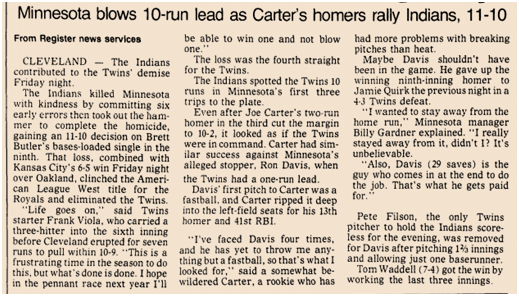
Unfortunately, their date with Cleveland that September has become the series that will live in infamy for Twins fans.  The youthful squad imploded by losing all four games, with Davis tagged the loser of  two.  The most galling was the game-ending walk-off home run the wacky Davis allowed to pinch hitting journeyman, Jaime Quirk in the first game, on Thursday, Sept. 27. Quirk's home run was his only hit AND second RBI of the year (look it up)!! Exhibit "B" from that weekend - and our game of focus -  was the horrendous 11-10 loss the next day, Friday, Sept. 28 (box at BBRef) in which they lost after first cruising to a 10-0 lead in the early going for Sweet Music Viola.  But the purple rain of wretched fate seemed to descend upon the Twins at Cleveland Stadium in that dreadful 6th, which they entered leading 10-2.


New story/Photo above Santa Ana Orange County Register


The Tribe chased Viola with 4 runs before Rick Lysander spelled him, setting up the Julio Franco at-bat. It was a grounder to Gaetti - and with success smiling him in the face, The Rat flinched. He threw the ball in the dirt to Hrbek at first, allowing Jerry Willard to score the 5th run of the inning. Then two more plated before Pete Filson put the tourniquet on matters, inducing a pop fly to Hrbek.  7 runs, 6 hits, 1 error, and 1 seething Twin. Gary Gaetti famously remarked later: "It's hard to throw with both hands around your throat." The hyper-passionate third baseman would get his day of redemption - but this was not it. Davis would come on to give up the tying run on a homer by Joe Carter in the 8th(number two for the day), and he stayed in long enough to walk what would turn out to be the eventual winning run in the 9th, pushed across by a Brett Butler single off Ed Hodge. The Twins were thus eliminated with two games left to play. They then lost on Saturday and Sunday, by scores of 6-4 and 7-4. Season over. 


It was an abysmal ending, a cruel kick to the gut. Or to other sensitive regions. A perfect circumstance, when you factor that "The Karate Kid" was in the top ten of highest grossing films in theatres that weekend (neck and neck with a film from a certain, purplish Minnesota rocker who inspired this post's title)! 
Gardner's bringing in Davis again? 
You can't be serious!"


Truthfully, lots of Twins choked, bombed, folded and fizzled in that loss, maybe the ugliest in the team's history! That 11-10 blown loss was a seminal date in the history of this future-world champion team; the next one on the calendar would be the first game Tom Kelly ever skippered for the Twins (9/12/86); another to follow would be the trading away of the albatross that was Davis (8/13/86) to the Cubs; still another would be the addition of Jeff Reardon and Dan Gladden before the beginning of the 1987 season. The Twins organization in 1984 could take pride in Harmon Killebrew, newly elected to the National Baseball Hall of Fame. The ownership turnover that summer of Calvin Griffith to Carl Pohlad offered a new beginning. And then there was that oddly-shaped rookie center fielder who had begun to capture the imagination of Twins fans...


Lest one forgets, the 1984 Cleveland roster was stocked with some pretty fine, young talent. Any team that had Joe Carter, Mel Hall, Andre Thornton, Twin-Killer Pat Tabler, Rick Sutcliffe, Julio Franco and Brett Butler as emerging players, along with vets Bert Blyleven and Mike Hargrove was, indeed, NOT the Little Sisters of the Poor. The much maligned Davis' blown saves 13 (game logs) dwarfed the next closest candidate of Twins Pitching Goats, Matt Capps (game logs) and his mere 9 in 2011. Just to dredge up some long suppressed memories for you long-time Twins fans...


Brett Butler and Joe Carter, ca. 1984
The Twins would gain a measure of revenge on Joe Carter, but it would take a while. He was neutralized by the Twins pitching staff in the 1991 ALCS, and the team would taste the champagne of two championship celebrations before Carter would reach the promised land in 1992 and '93 with the Toronto Blue Jays. Meanwhile, Gary Gaetti's highlight reel (see You Tube) would be epic three seasons later.  


As Herb Carneal would say: "...And the count rides along." - TT

Friday, December 17, 2010

Ghosts of Twins Team Photos Past: The 1981 Spring TrainingTeam Picture!


Ah-ha, so the Twins Twinkler is not AWOL. Can't believe...this is my 1st December post! The rigors of snow removal, and participating in Christmas Choirs (which - SUPER BUMMER! -  never included the Win! Twins! theme song in performance) have sadly reduced my time for nurturing our little museum of Twins past.

OK, now pay attention to the prose, not the ho's!

Hopefully, this amounts to a nice exercise in beginning scanner use 101. This photo has to be counted as interesting, and telling at the same time.  Where's Hrbek? Where's Gaetti? Discoursing in the men's room on the relative merits of Jaclyn Smith versus Morgan Fairchild? Negative, as they didn't even have invites to spring training. Frank Viola wouldn't be drafted by the Twins until June 8 in the 2nd round (the 11th pick of the '81 amateur draft), Kirby Puckett wouldn't be drafted until January of '82 (in the 1st round, 3rd pick of the amateur draft), while Randy Bush was still in AA at the Twins minor league Orlando affiliate.
Back off, she-vixen.


The team leaders were Gary Ward, John Castino, Roy Smalley, Butch Wynegar, Ron Washington and 1969 World Series hero, Jerry Koosman (BTW: thank you Jerry, for lending your lovely daughter to our Patron Service Staff at Canterbury Downs, circa 1987. Good genes really stand out!).
Growlin' Gary Ward: in a sea of smiling faces, he retains his penitentiary face!
Among the reasons he was my favoite Twin. He was the Twins answer to
Don Baylor as a clubhouse enforcer long before Baylor became a Twin in '87.


"Forget ladies, I bring the Bombs, si?"
Bombo Rivera, 1979 Topps Card
You had guys on the way out ( the enigmatic Landreaux, who would surface later that fall with the eventual World Champ Dodgers), Glenn Adams, Bombo Rivera - all guys who had played for a few '70s edition Twins, plus coaches who had played or been on the Twins playing roster in the 1960's (pitching coach Podres, Manager Johnny Goryl, his successor, Billy "Shotgun" Gardner).  Recall too that Johnny Pods guru'd Sweet Music in his use of the circle change up. Those damn Brooklyn boys always stick together!


So, all in all, a '60's coaching staff, with a roster of mostly '70's guys buttressing (buttressing? Isn't that illegal in several states?) a core group of young '80's guys who would come up after the rosters expanded (Tim Laudner and Smalley are the only players who would make it to 1987, not counting coach Rick Stelmaszek). Stelmaszek, just beginning his time that spring with the Twins and now a four-decade guy, is the longest tenured member of the organization - if you completely ignore the existence of Jim Rantz


'Sall for now.  Hope you enjoyed the trip.
May Your Taters Fly Far!
TT