Check Out This Post!

Harmon Killebrew On David Letterman!?

With the appearance of Joe Mauer last week on Jimmy Fallon, I was reminded of another episode of a famous Twin who appeared on late ni...

Showing posts with label Jack Kralick. Show all posts

Saturday, April 15, 2017

Ervin Santana's 4/15/17 Gem Ranks High On AT Twins List

Who says there's no pitching in today's MLB?

Today's lovely 6-0, 1 hit, 1 walk, 8 strikeout, nine inning shutout  win against the Chicago White Sox by Ervin Santana vaults him to a nice spot near the top of the Twins All-Time Top 116 single game pitching performances, as measured by his 92 Game Score. It tied him with several other greats in Twins history, namely Johan Santana, Jim Kaat, Dave GoltzGerry Arrigo and Milton, again. Game Score is a 1980s Bill James creation, as explained in my "Brief & Damn Near Worthless Sabrmetrics Guide. In brief, it awards points for strikeouts, innings pitched, and outs recorded, while subtracting points for hits, walks, and earned runs allowed.

It really helps distinguish the wonderfully dominating starts that characterize elite pitchers from those outings of pitchers that needed a fair amount of fielding luck and walks and hits to get through nine innings.

Eric Milton is #1 on our list, whose 1999 no-hitter versus the Angels  (You Tube) was above all other starts in team history in terms of quality and economy. It was fast. It was dominating. And It was clean, like Santana's was today. He faced 28 batters. Santana, 29. Milton punched out 13 in his gem, which clocked in at 2:28. Santana, again, k'd 8 in a zippy 2:26, by comparison. Pretty comparable, right? The main seperator between them was the five extra strikeouts, and one hit allowed by Santana.


It's probably worth noting that Bert Blyleven has pitched 5 of the TOP 25 Game Score games in team history, more than any other hurler. You should also note that Santana's game today rates higher than no-hit games pitched by Jack Kralick in 1962 (#34 on our list), Scott Erickson in 1994 (#48), and Francisco Liriano in 2011.

Photo: Jim Mones, AP
Part of the fun of lists like these is that they give Twins fans, old and young, an opportunity to recall the great games they remember seeng in person, or on radio or TV. Anyone born as early as the 1980s remembers watching Scott Baker's no-hit bid against KC in 2007 (#7), or Andrew Albers's 2013 2-hitter versus the Tribe (#116), for example. I obviously fit into the "prehistoric duffer" category, as I can readily recall the 1973 Joe Decker 15 strikeout game (#14), or the Dave Goltz 11 inning 2-1, complete game win in 1977 (#20). Feel free to post your favorite game reminiscences from those you see in the list!  

NO HIT PITCHERS IN RED CAPS, others referenced appear in BLUE.
-I'm adding box score links to the dates, check back sometime to check 'em out-

Rk             Player          Date Opp   Rslt   IP H R BB SO GSc
1         ERIC MILTON    1999-09-11 ANA  W 7-0  9.0 0 0  2 13  98
2       Bert Blyleven    1975-08-27 MIL  W 1-0 11.0 6 0  1 13  97
3        Dave Boswell    1966-07-30 BAL  W 7-0  9.0 1 0  1 11  95
4         Jim Merritt 1967-05-30(2) NYY  W 3-0  9.0 2 0  0 11  94
5       Bert Blyleven    1986-08-01 OAK W 10-1  9.0 2 1  1 15  93
6        Kevin Tapani    1992-06-24 CAL W 11-0  9.0 2 0  0 10  93
7         Scott Baker 2007-08-31(2) KCR  W 5-0  9.0 1 0  1  9  93
NEW!      Ervin Santana  2017-04-15 CHI  W 6-0  9.0 1 0  1  8  92
8 Johan Santana 2004-07-06 KCR W 4-0 9.0 3 0 2 13 92 9 Jim Kaat 1967-09-18 KCA W 2-0 10.0 6 0 0 12 92 10 Eric Milton 2002-08-01 CHW W 6-0 9.0 3 0 0 11 92 11 Dave Goltz 1976-08-31(1) MIL W 4-0 9.0 2 0 2 11 92 12 Dave Goltz 1977-08-23 BOS W 7-0 9.0 1 0 3 10 92 13 Gerry Arrigo 1964-06-26(1) CHW W 2-0 9.0 1 0 1 8 92 14 Joe Decker 1973-06-26 CHW W 4-0 9.0 4 0 3 15 91 15 Camilo Pascual 1961-07-19(1) LAA W 6-0 9.0 5 0 1 15 91 16 Jim Merritt 1966-07-21 WSA W 1-0 9.0 3 0 2 12 91 17 Dean Chance 1968-06-19 WSA W 4-0 9.0 3 0 0 10 91 18 Frank Viola 1986-10-05 CHW W 3-0 9.0 2 0 1 9 91 19 Ervin Santana 2016-07-06 OAK W 4-0 9.0 2 0 0 8 91 20 Dave Goltz 1977-07-25 OAK W 2-1 11.0 8 1 1 14 90 21 Bert Blyleven 1973-09-14 CHW W 6-0 9.0 4 0 1 12 90 22 Camilo Pascual 1963-09-18 DET W 10-0 9.0 2 0 3 10 90 23 Bert Blyleven 1973-09-26 OAK W 4-1 9.0 1 1 1 8 90 24 Bert Blyleven 1973-05-24 KCR W 2-0 9.0 1 0 2 7 90 25 Jim Perry 1970-09-25 KCR W 1-0 9.0 2 0 0 7 90 26 Mudcat Grant 1965-09-25(1) WSA W 5-0 9.0 1 0 2 7 90 27 Dave Boswell 1968-05-29 CLE W 1-0 9.0 3 0 2 10 89 28 Jim Kaat 1962-04-22 LAA W 5-0 9.0 4 0 0 10 89 29 Johan Santana 2005-08-12 OAK W 1-0 9.0 3 0 1 9 89 30 Kevin Slowey 2008-06-29 MIL W 5-0 9.0 3 0 0 8 89 31 Brad Radke 2005-05-05 CLE W 9-0 9.0 3 0 0 8 89 32 Scott Erickson 1991-05-01 BOS W 1-0 9.0 2 0 1 7 89 33 Jim Merritt 1967-09-21 KCA W 4-0 9.0 2 0 0 6 89 34 JACK KRALICK 1962-08-26 KCA W 1-0 9.0 0 0 1 3 89 35 Bert Blyleven 1974-05-24 TEX W 9-0 9.0 5 0 0 11 88 36 Dick Woodson 1972-08-01 TEX W 3-0 9.0 3 0 3 10 88 37 Bert Blyleven 1972-05-03 MIL W 7-0 9.0 4 0 1 10 88 38 Johan Santana 2005-06-08 ARI W 10-0 9.0 4 0 0 9 88 39 Bert Blyleven 1986-07-13 NYY W 5-0 9.0 3 0 1 8 88 40 Dave Goltz 1976-09-09 TEX W 6-0 9.0 3 0 1 8 88 41 Jim Kaat 1973-07-01 CAL W 2-1 9.0 1 1 0 7 88 42 Dean Chance 1968-09-23 CAL W 3-0 9.0 3 0 0 7 88 43 Jim Kaat 1962-06-23 LAA W 5-0 9.0 3 0 0 7 88 44 Bill Krueger 1992-06-30 CAL W 2-0 9.0 2 0 1 6 88 45 Scott Erickson 1991-06-24 NYY W 5-0 9.0 2 0 1 6 88 46 Geoff Zahn 1980-06-06 TOR W 5-0 9.0 1 0 3 6 88 47 Scott Baker 2009-08-14 CLE W 11-0 9.0 2 0 0 5 88 48 SCOTT ERICKSON 1994-04-27 MIL W 6-0 9.0 0 0 4 5 88 49 Gary Serum 1978-08-19 TOR W 5-0 9.0 2 0 0 5 88 50 Bert Blyleven 1974-08-30 BOS W 3-2 9.0 4 2 2 14 87 51 Camilo Pascual 1963-07-23 CLE L 2-3 12.2 7 3 2 11 87 52 Brad Radke 1997-07-20 OAK W 1-0 9.0 5 0 0 10 87 53 Joe Decker 1973-08-24 MIL W 3-0 9.0 4 0 2 10 87 54 Jim Kaat 1966-09-25 DET W 1-0 9.0 4 0 1 9 87 55 Dick Stigman 1963-05-29 WSA W 10-1 9.0 2 1 3 9 87 56 Dave Goltz 1976-09-25 CAL W 6-0 9.0 2 0 4 8 87 57 Dean Chance 1968-04-10 WSA W 2-0 9.0 4 0 0 8 87 58 Dean Chance 1967-05-11 KCA W 8-0 9.0 1 0 6 8 87 59 Camilo Pascual 1963-05-25 CHW W 6-0 9.0 2 0 4 8 87 60 Eric Milton 1999-07-31 ANA W 8-0 9.0 3 0 1 7 87 61 Darrell Jackson 1978-07-07(2) OAK W 1-0 9.0 3 0 1 7 87 62 Jim Perry 1970-08-07 OAK W 2-1 11.0 5 1 3 7 87 63 Camilo Pascual 1962-09-30 BAL W 1-0 9.0 3 0 1 7 87 64 Camilo Pascual 1961-09-23(2) WSA W 10-0 9.0 2 0 3 7 87 65 Scott Diamond 2012-07-27 CLE W 11-0 9.0 3 0 0 6 87 66 Joe Mays 2002-08-16 BOS W 5-0 9.0 2 0 2 6 87 67 Dave Goltz 1974-10-01 TEX W 6-0 9.0 2 0 1 5 87 68 Dick Stigman 1964-07-03 NYY W 1-0 10.0 4 0 2 5 87 69 Dave Boswell 1969-09-19 SEP W 2-1 9.0 5 1 1 14 86 70 Jim Kaat 1968-09-02 BOS W 5-1 9.0 3 1 2 11 86 71 Camilo Pascual 1962-07-13 WSA W 4-0 9.0 4 0 3 10 86 72 Kevin Tapani 1990-05-06 MIL W 4-0 9.0 5 0 0 9 86 73 Jim Perry 1970-09-01(1) MIL W 4-0 9.0 5 0 0 9 86 74 Camilo Pascual 1961-08-29 NYY W 3-0 9.0 4 0 2 9 86 75 Camilo Pascual 1961-05-20 KCA W 2-0 9.0 5 0 0 9 86 76 Brad Radke 1998-06-09 CHC W 8-0 9.0 4 0 1 8 86 77 Bert Blyleven 1970-08-26 BOS W 7-0 9.0 4 0 1 8 86 78 Bert Blyleven 1970-06-27 CHW W 9-1 9.0 2 1 1 8 86 79 DEAN CHANCE 1967-08-25(2) CLE W 2-1 9.0 0 1 5 8 86 80 Brad Radke 2001-06-12 HOU W 7-0 9.0 4 0 0 7 86 81 Jerry Koosman 1979-09-04 KCR W 5-1 9.0 2 1 0 7 86 82 Bert Blyleven 1973-06-16 DET W 5-0 9.0 4 0 0 7 86 83 Jim Kaat 1966-08-27 CHW W 1-0 9.0 3 0 2 7 86 84 Camilo Pascual 1961-05-15 CHW W 5-0 9.0 4 0 0 7 86 85 Frank Viola 1984-05-19 BOS W 7-0 9.0 3 0 1 6 86 86 Geoff Zahn 1977-07-10 SEA W 15-0 9.0 3 0 1 6 86 87 Luis Tiant 1970-04-26 DET W 6-0 9.0 3 0 1 6 86 88 Camilo Pascual 1961-08-23 CHW W 4-0 9.0 2 0 3 6 86 89 Dick Woodson 1972-09-06 TEX W 2-0 9.0 2 0 2 5 86 90 Jim Perry 1966-07-19(2) WSA W 4-0 9.0 2 0 2 5 86 91 Scott Erickson 1992-07-24(1) BOS W 5-0 9.0 1 0 2 3 86 92 Dean Chance 1967-07-02(1) WSA W 4-1 9.0 5 1 0 12 85 93 Jim Kaat 1963-07-24(2) CLE W 5-0 9.0 6 0 1 11 85 94 Dean Chance 1967-06-01 BOS W 4-0 9.0 5 0 2 10 85 95 Jim Perry 1966-08-16 CAL W 8-1 9.0 3 1 4 10 85 96 Jim Kaat 1961-09-14(2) LAA W 3-1 9.0 3 1 2 10 85 97 Brad Radke 1997-09-21 MIL W 2-1 10.0 6 1 0 9 85 98 Jim Perry 1966-06-26(2) DET W 7-1 9.0 3 1 3 9 85 99 Kyle Lohse 2002-08-20 CHW W 5-0 9.0 4 0 2 8 85 100 Bert Blyleven 1985-08-17 SEA W 2-0 9.0 3 0 4 8 85 101 Bert Blyleven 1972-09-22 CAL W 1-0 9.0 5 0 0 8 85 102 Tom Hall 1969-08-24 NYY W 1-0 9.0 4 0 2 8 85 103 Dean Chance 1968-08-03 DET W 4-0 9.0 4 0 2 8 85 104 Joe Mays 1999-07-17 CHC W 8-0 9.0 3 0 3 7 85 105 Dick Woodson 1973-05-13 KCR W 5-0 9.0 3 0 3 7 85 106 Jim Merritt 1968-06-04 NYY W 3-0 9.0 4 0 1 7 85 107 Jim Perry 1968-04-13 NYY W 6-0 9.0 4 0 1 7 85 108 Bert Blyleven 1986-08-11 CAL W 2-0 9.0 3 0 2 6 85 109 Tom Hall 1969-04-18 CAL W 6-0 9.0 2 0 4 6 85 110 Camilo Pascual 1963-05-10 KCA W 2-0 9.0 3 0 2 6 85 111 Bert Blyleven 1973-06-08 BAL W 2-0 9.0 2 0 3 5 85 112 Jack Kralick 1963-04-25 WSA W 3-0 9.0 3 0 1 5 85 113 Dick Stigman 1963-04-18 LAA W 3-0 9.0 3 0 1 5 85 114 Jim Kaat 1962-07-19 CLE W 8-0 9.0 3 0 1 5 85 115 Pedro Ramos 1961-04-11 NYY W 6-0 9.0 3 0 1 5 85 116 Andrew Albers 2013-08-12 CLE W 3-0 9.0 2 0 0 2 85
Provided by Baseball-Reference.com: View Play Index Tool Used
Generated 4/15/2017.

To generate this list at Baseball Reference, I began at 85 as my absolute bottom benchmark score. Any game lower than this failed to make the list, like Francisco Liriano's 83 in his 2011 no-hitter. I vividly recall saying in my "25 Best Pitched Twins Games" * post that that game wasn't even close to  being the best pitched game of his career, and being chastised as being ridiculous by one friend ("A no-hitter HAS to be the best game he's ever thrown!"). Because throwing a no-hitter is the be-all/end-all criterion, and nothing else matters, I guess. Walk 11 or 12 guys, strike out 3, and have your fielders catch 4 "At-em" balls? No matter!

* A post that now looks hopelessly arbitrary, unscientific, and very subjective today, as there's no rank order, and I was going completely off of memory. Of course, I didn't have the benefit of the "BBRef Play Index" to guide me 6 years ago!

But owing to Liriano's 6 walks and a mere 2 strikeouts in that effort, I stand by my earlier idea. I think most people would agree a game that is as clean as Santana's was today, nice to watch and tinged with an artistic flair, is qualitatively better. I don't care if I see a 10 walk, 4 strikeout, 12-inning complete game no-hitter tomorrow, I'll still maintain a "clean," economical pitching effort with 2 hits allowed gets the nod.

"So long, everybody!" - Herb Carneal

Monday, June 9, 2014

Earl Battey 1961 Baseball Digest Feature


Do yourself a favor and check out this link to June 1961 Baseball Digest at my Google Docs with a superb Earl Battey article. Battey was the first Twins player ever to appear on the cover of that magazine, as the Twins first season had just begun in Minnesota just a few weeks earlier.A great piece on the first, great catcher of the Twins, who was named the top catcher on the Twins 40th Anniversary in 2000.

It's from a fantastic, mint edition which I just recently bought off Amazon. I rather fancy it as a historical document, partly because it was published just a month or so into the beginning of the first expansion era in baseball. Besides that, it really is telling as an illustration of sports journalism, circa 1961.

To wit: I truly doubt that any major sports publication today, or any magazine really, would give a damn what I thought about anything, much less pay me for ideas submitted:


[Blurb at left from "Greatest Catches" story - see table of contents in the Google scanned Table Of Contents - I wouldn't mind the money, if the offer from Baseball Digest is still valid..]

You'll notice the date stamp, "MAY 4 - 1961" on the back page, probably denoting when it was received by the store of sale. The story references the Twins first game on April 11, 1961 (BBRef box), which means the interview for the June issue was conducted very shortly after that game before it went to press.

Battey really shows himself to be an incredibly well-spoken young guy (he was 26 in 1961). I mean, this story is really chock full of intelligent, cogent, and insightful responses. The BD staff writer, Charles Dexter, included quite a few long, thoughtful quotes which made it seem at times as if Battey himself wrote the article in the first person.

My favorite sections were his insights into Twins pitchers like Camilo Pascual, Jack Kralick and Pedro Ramos, and how they comported themselves in the lockerroom. I'm only a little surprised not seeing any references to Jim Kaat. Probably indicates where the big lefty was in the staff's pecking order as the season was beginning.

An ironic section on page 15 mentions that Earl had John Roseboro as a neighbor in Compton, California at the time. Of course, all good Twins fans know that Roseboro eventually replaced Earl as the Twins everyday catcher, in 1968, after Earl and Ron Perranoski came in the Versalles/Grant trade. You can read about Earl's post-career at this SABR bio article from 2009.

I included the table of contents in the scan, plus the revised Twins and Yankees rosters as of '61 May, in addition to those for the first two expansion teams in MLB history, the California Angels and the new Washington Senators. I kid you not! If you see any articles you would like pdf scans to read, just let me know. I can try to email you a copy.

There are some nice pluses in the magazine.
See if you can recognize some of the names
of the Twins coaches (or others)
in the chart below! Yeah, just a tad jumbo, but it wasn't 
displaying well at large size!


NOTE: Check out the back side of the magazine at the end of the scan: a full-color advertisement. Rather cool!

You can get a short sample of the older Earl, at this
You Tube video from 1986 I posted a while ago. You get
some idea of the understated, but warm manner
of the man. Fairly engrossing, if I might say so.

I conclude in my best Herb Carneal-ese: "So long everybody!"

Sunday, April 27, 2014

Game Of The Week: First Home Opener In Minnesota Twins History, April 21, 1961


Twins center fielder Lenny Green, up against chain link fence. Later, a concrete 
grandstand would replace cheap bleachers, and the makeshift planking for steps.


The Met parking lot - the former cornfield was only partially 
filled for that very first game in The Land of 10,000 Lakes.

The first Major League Baseball game in Minnesota history took place just four days after the U.S.-led Bay of Pigs invasion of Cuba. On the day of the game, President Kennedy was receiving communiques from Chairman Khrushchev, with ominous warnings against future interventions in Latin America. Also portentious that week was the Kennedy Administration's promise to the government of Laos to send about 300 U.S.military advisers into combat zones to help turn back communist insurgents in that country and others in the region; a ceasefire was in effect in Laos (Salt Lake Tribune) while the politicos assessed strategy. JFK this week also sent a private memorandum to Vice-President Johnson asking "Is there any space program that promises dramatic results that would represent a victory against the Soviets?" This would be the kick start for the greatest engineering, technical, and scientific undertaking in history - the Apollo program.

(Clover Leaf Twins card, 1961)

Don Mincher is the trivia answer to the
question "Who hit the first Twins regular-season 
home run at Metropolitan Stadium?" For the other 
Twins ballparks, Gary Gaetti (1982, the H.H.H. 
Metrodome) and Jason Kubel (2010, Target Field)  will do. 

Alas, the only sure win that week for Washington was secured by it's brand new American League entry. The Senators's invasion of Twins territory produced a 5-3 win that was decided in the ninth inning (BBRef). It was a sterling, close affair, with standout efforts by Minnesota's Lenny Green, Don Mincher, Camilo Pascual, Senators's slugger Dale Long, Washington starter Joe McClain, and reliever Dave Sisler. The latter escaped a bases-loaded, one out situation against Minnesota in the final frame. 

First, however, it was preceded by a gala welcome home for the Twins players and representatives:


Brainerd Daily Dispatch, April 19, 1961

The parade on Wednesday was joyful...


ABOVE: Don Mincher (left, crewcut) and Ron Henry, in Welcome Home Parade


The University Of Minnesota Marching Band arrives from center field for lineup
 introductions...and stayed lined up in the infield for the National Anthem. Note lack 
of seating in the foul territory behind first base. Construction of seating came to   
a halt when the game commenced, and would resume after the last out.


Note: signature walk-up path not yet constructed, from dugout to homeplate 

The Met as it looked on April 21, 1961 (BBRef), with Camilo Pascual on the mound; watching near the home team dugout were dignitaries such as  AL President Joe Cronin, MLB Commisioner Ford Frick, former NL President Will Harridge, Minnesota governor Elmer L. Andersen, and the mayors of Minneapolis of St. Paul (but not Bloomington Mayor Gordon Miklethun - the home ballpark in the city's limits apparently didn't confer upon him any special status!). Go to The Sporting News of May 3, 1961, and you'll read a rather pessimistic summary by George Moses of the Associated Press. You might think he took his lead from AL club owners still unhappy with Twins owner Calvin Griffith's push to move the franchise out of the nation's capitol. If Moses had taken the time to get the Minnesota fan's perspective (accessible in this account in the Winona (MN) Daily News of April 22, the tone would been much truer to the reality at the ballpark that day. Jim Wallace of the Brainerd Daily Dispatch ("It Wasn't That Bad") also had a nice rebuttal in his column the next day.


FIRST PITCH!
Winona (Minn.) Daily News 4/22/61


That the game only attracted 24,606 was a curious circumstance, however, given the lead-in hoopla. The forecast for that day was for temps in the 50s, with clear skies. It ended up an an overcast day, 63 D., but with no rain. So - what was up? A contributing factor may have been the absence from the starting lineup of Harmon Killebrew, who had pulled his left hamstring muscle running out a grounder in the Saturday, April 15 game at Baltimore (Twins game #4 in the '61 schedule). It was thought he would miss three weeks, but he rested for only two, reappearing in the April 29 game versus the Angels.


Minnesotan's may well have taken the attitude that without a big fly in the offing from Killebrew , the effort just wasn't worth it. Otherwise, I would posit that, despite the joy evident from acquiring a big-league team, rank and file Minnesotans just didn't have it in their mindset to take time off from work in that era, or to pull their kids out of school just to see what we now regard as history. Part of a region's character, you might say. Nevertheless, the opening ceremony was a fun spectacle, as this historic video makes clear


The Metropolitan Stadium scoreboard during Senator 
Willie Tasby's ninth inning at bat  on that April 21, 1961.


Enable audio - hover cursor near lower R-hand corner - click speaker icon

The Sporting News, May 3, 1961

Pascual pitched 8 innings that day, giving up three runs with 3 walks and 4 strikeouts (he would lead the league in that figure, 221). After giving up a long ball to first baseman Dale Long in the first, he appeared to right the ship. When Lenny Green homered to what would later become the right field bullpen to tie the game at 3, the Twins looked poised for a 9th inning rally. It wasn't to be. Washington pushed across 2 in their half of the ninth off trusty, "Old Blue" Ray Moore. Green was also the first Twins player to score in a home game, jogging home unfettered on Mincher's fourth inning bomb over the center field fence.


There are 8,000 things worth commenting upon in this short piece. But, the one I
most enjoyed was the narrator's pronunciation of "Minna-SO-tah" at the very end.
As if he was hip to the fact we have 10,000 Norwegians per acre in these parts.

Yes, a disappointing start, with nary a stampede through the turnstiles - but it wasn't a disaster. The Twins would win the next two games and the series that weekend, Sunday's game being a 1-0 shut out for Jack Kralick. Minnesota would eventually reach that coveted 30,000 attendance figure in game number 34 - a doubleheader on May 21 (BBRef, the 20th & 21 home games) versus Cleveland. Overall, they drew 1,256,723 for the 1961 season, third-most in the AL (of ten teams). Minnesota would go on to become a perennial home attendance leader in the American League, in fact, for the decade of the 1960's.

As Herb Carneal would phrase it: "So long, everybody!"

Wednesday, September 4, 2013

Jack Kralick & The First Twins No-Hitter, August 26, 1962

This post is the companion piece to "1962 Camera Day." It is one of my more enjoyable posts personally, and I hope you can take something away from it as well!
* * *

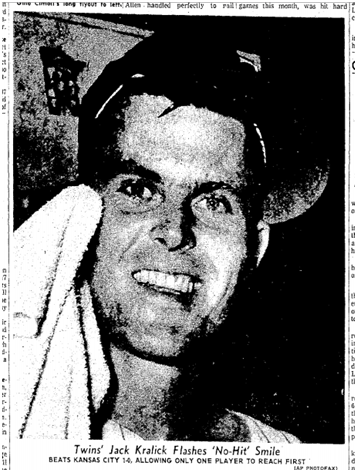
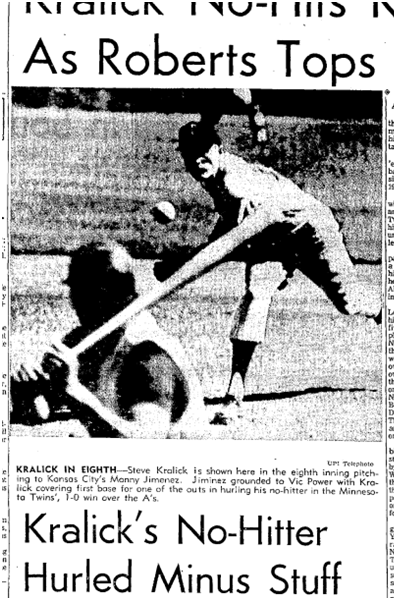
Here is my favorite photo from the whole endeavor: a picture and a piece from The Sporting News, detailing Jack Kralick's 1-0 no-hitter versus the Kansas City Athletics:


The entire Sporting News Story of "Jittery" Jack's gem can be found in PDF form here in page one and here in page 2. Make sure you read the bottom of page one, to view the description of the Allison catch to save the no-hitter. Below is his line as seen at BBReference:


Pitching IP H R ER BB SO HR ERA BF GSc IR IS WPA aLI RE24
Jack Kralick, W (10-8) 9 0 0 0 1 3 0 4.02 28 89 0.736 1.22 4.6
Team Totals 9 0 0 0 1 3 0 0.00 28 89 0.736 1.22 4.6
Provided by Baseball-Reference.com: View Original Table
Generated 9/4/2013.

Some box scores (see the August 26, 1962 near-perfect game link) flow so well that they give you a good sense of the game's rhythm. Dare I say it - this game is very eye-catching in print (or on the screen, as it were) - not as pretty as say, 1960's pin up favorites Mamie Van Doren or Brigitte Bardot, but still damn pretty in the numeric, aesthetic sense. You might not believe me, especially if you clinked on the last two links, but I'm thinking ground ball hound Tommy John when I view the innings that must have flown by frustratingly quick for the Athletics batters. We all get our kicks in different manners.

The economy and effectiveness of Jack Kralick's performance are apparent - a very worthy and signature performance for the Minnesota Twins first no-hitter in Minnesota. The time of game was a 1:57, and as Kralick and Kansas City starter Bill Fischer were tossing so many 1-2-3 innings, it had to be a challenge for the stations broadcasting the contest to fit in their ads and promos. Damn!! Not enough time to advert the Thunderbird Motel, right across the parking lot on Cedar Avenue!! 

Playing into the rapid pace of this game was the fact that the K.C. batters were actually swinging away, typical of 1960's hitters - this was over  thirty years before money ball, after all. In their average lineup in '62, only Norm Siebern demonstrated above-average plate discipline, earning 110 walks; the next-highest total, 54, belonged to Ed Charles (who would go on to achieve cult hero status with the Amazin' Mets in 1969.

It was Charles who nearly ended the no-hit bid in the fourth inning,with his opposite-field drive that forced Bob Allison to reach above the right field fence in front of the bullpen (description, PDF page one above). There went the one, serious threat.

Besides Allison, also important to Kralick's success was having, quite possibly, the best defensive first baseman in modern baseball history backing him, Vic Power. As opposed to shortstop Zoilo Versalles, who was credited with handling the baseball ONCE, on a fourth inning 6-3 groundout by Bobby Del Greco (just preceding Charles's threatening flyball), Power was involved in plays resulting in 17 of the 27 outs in the ballgame. This was spectacularly achieving the goal the Twins management had in mind to stabilize the Twins infield by trading for Power (discussed in the post "A Maestro At First: Trading For Vic Power, April 2, 1962"). See the chart below for the full rundown:

[BELOW] Plays involving Twins first baseman Power,
 inning play occurred, fielder designated on 
play (pitcher 1, catcher 2, etc.)

Groundout-unassistedthird out-1st inn
Groundout: 1-3second out-2nd inn
Groundout: 1-3third out-2nd inn
Groundout: 5-3first out-3rd inn
Groundout: 4-3third out-3rd inn
Groundout: 6-3first out-4th inn
Groundout:3-1third out-4th inn
Groundout: 4-3second out-5th inn
Groundout: 3-1third out-5th inn
Foul fly: unassistedsecond out-6th inn
Groundout: 5-3first out-7th inn
Groundout: 1-3third out-7th inn
Groundout: 4-3first out-8th inn
Groundout: 1-3third out-8th inn
Groundout: 4-3first out-9th inn
Foul fly: unassistedsecond out-9th inn
Foul fly: unassistedthird out-9th inn


It was obvious to both Battey and Kralick that he didn't have control of his curveball early in the contest, as seen in the Winona Daily News PDF. My pet theory is that Kralick focused much better, bereft of his "yellow hammer," so that he was even more on point spotting his sinking fastball and slider. Of course, none of this would have meant anything without Lenny Green's sacrifice fly, driving home Bernie Allen in the 7th inning.


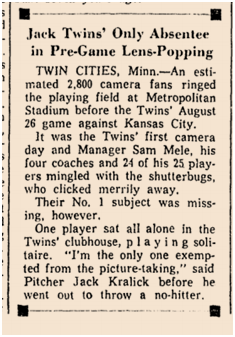
As noted in the previous post "'62 Twins Camera Day," Kralick had been absent from the fan photo-taking activities, pregame. In keeping with his "lone wolf" persona...


This game somewhat parallels the Francisco Liriano no-hitter on May 3, 2011:  the same score, & each were thought to be either sub-par or VERY sub-par in their performance of late prior to their classics. 


Hope you enjoyed this look at the first great pitching performance in Minnesota Twins history!!

As the great broadcaster ended his post-game shows, I also say:

Monday, August 26, 2013

The 1st Camera Day, 1962: Day Of The Jack Kralick No-Hitter

By sheer coincidence, the Twins 1962 Camera Day landed on the very day (8/26/62, BBref Box) the franchise's first Minnesota no-hitter (post link!) was pitched, by Jack Kralick. Through the goodness of Twin Cities blogger Michael Haas (@digitalHaas, Alright Hamilton!), we have this beautiful set of photos from that historic day. They were shot by his grandfather, who attended the game that day along with Michael's mother and grandmother. We also get a sampling of Michael's thoughts at the end of this post, lending context to the photos. 1962 Twins team members Jim Kaat, Zoilo Versalles, Vic Power, Don Mincher, Dick Stigman, Ruben Gomez, Rich Rollins, Johnny Goryl, Hal Naragon, Marty Martinez, Coach Floyd Baker, and Manager Sam Mele are all present in this collection.

What is so great to me is how relatively shiny and new Metropolitan Stadium was - it was only in it's seventh season of existence, and its second as home to the Twins. The right field view is beautiful, encompassing the scoreboard, crowd, and bullpen areas. Especially nice is the Rollins / Valdivielso photo, with the first base foul territory and upper deck mezzanine in the background.

          [ NOTE: HELPS TO SINGLE CLICK PHOTO, ENLARGE FOR DETAIL! ]
My first inclination before posting these photos was to couple them with archival newspaper reports of the famous game by Kralick. After some thought, however, I felt they deserved a post of their own.  A separate blog entry will follow this week, concentrating on the original "Black Jack's" efforts.


[below: player with Rich Rollins (R) is Ruben Gomez, and not Jose Valdivielso as noted. To correct)


Ironically, Jack Kralick was nowhere to be found on the field for interested fans. The Sporting News Sept. 8, 1962 edition gave this explanation (see PDF of TSN page for extra context from that game) :


My Questions For Michael Haas: Behind The 1962 Camera Day Photos

ClassicTwins: I've always wanted to know about that blog title: "Alright Hamilton." How did that come about? How would you summarize the blog?

Michael: Oh, it's just a line from the movie "Fast Times At Ridgemont High," uttered by Sean Penn's character. I didn't put much thought into the title, obviously. Actually, we were a pretty legitimate blog in the pre-Twitter days. Myself and a few others tried to document the Twins fan experience and random off-topic things. You can see the archives at alright-hamilton.blogspot.com. The alright-Hamilton.tumbler.com is where I post random media very sporadically. I wish I could get back into the writing daily, but I just lost the momentum. Someday.

ClassicTwins: I get that "momentum" thing. Tell me about the photos, Michael. What’s the history behind them?


Michael: My Aunt digitized these old slides and gave some framed prints to my Mom for Christmas. My Grandpa was likely the photographer. My mom, 12 years old, is visible in the Athletics’ dugout on the left, and that’s my Grandma in the blue dress.


ClassicTwins: Very cool, a piece of family history with your grandparents and mom at the game, the photos literally a snap shot of a small part of their lives at the time. Could you give any information regarding the type of Twins or baseball fans they were – avid, casual, or otherwise? Did they make regular outings during the summers to Met Stadium to see the Twins? Do you know if they had any favorites among the players or coaching staff?


Michael: I would describe my grandparents as casual fans. I don’t remember them having much to say about the Twins while I was growing up in the 90’s. However, they must have been pretty close with the team because my Grandpa worked as an usher at Met Stadium. I’d guess my mom was the big fan of the family. I think she has a Bob Allison autographed picture around somewhere. And I know she still has her ticket stubs from games 1 and 2 of the 1965 World Series she saw as a 15 year old. I have no idea why she didn’t go to 6 and 7.

ClassicTwins: Bob Allison – perhaps the “Mr. Photogenic” of all the Twins ‘60’s guys. Does the photo set give you any particular feelings, i.e. “I wish I could have seen Earl Battey play in person,” or “Did the Twins REALLY have Harmon play left field a lot when they had Vic Power around to play first?” Or anything at all that you wonder about from that period in Twins history?


Michael: Well, the things that strike me most is the ballpark and the uniforms. I had no idea the Athletics had changed their primary colors to orange and black during their brief stay in Kansas City. It’s also interesting to see the way Metropolitan Stadium evolved over the years as they added seating. What’s most amazing to me is the fan access to the players and the field. Can you imagine what it would be like, as a 12-year-old, to stand on tobacco juice and sunflower seed shells in the dugout with the players? It would be fun to know what was going through their heads.


ClassicTwins: Great observation! I like word-pictures! So, how would you rate yourself as a fan? What was your favorite player growing up as a kid? Or now?


Michael: I’m a big Twins fan, but I’m a reasonable one. I don’t let their stinky performance affect my mental health, or anything like that. I grew up in the era of the ‘M’ hat and Kirby Puckett. I don’t actually remember either World Series title, but in every picture of me as a kid, I’m wearing a “World Series Champ” hat.


ClassicTwins Are there any particular games you’ve attended that stand out in memory?


Michael: The best two games in recent memory that I’ve attended were game 163 in 2009 and the Jim Thome walk-off bomb against Thornton and the White Sox in 2010. Every fan remembers those two games.


ClassicTwins: What do you think about Target Field (what a dump, right?)?


Michael: I like Target Field a lot. We’re four years in and it still feels brand new. In fact, I’m still learning about the best views, best seats for the money, and most excellent and secret parking spots. The only thing I dislike about modern stadiums is the separation between seating areas. They put a moat in Target Field to close off the padded seats from the regulars, and they place almost all the memorabilia in exclusive seating areas. But that’s the nature of the modern sports palace - - gotta make sure the corporations feel special.


ClassicTwins: I have no doubt many Twins fans share that idea! I loved my single visit to the Legends Club area, swanky, but I wish it would be easier to just glide through there, in particular, and see the fantastic museum-like exhibits. Great stuff, Michael! Anything else pertinent you’d like to add about “1962 Camera Day At The Met”?


Michael: That’s really all I got. But it sounds like you’ve done further research on the game and roster than I, so anything you want to add about that era would be really cool. You could just add my twitter handle I guess. Thanks a bunch. I really think the Twins have a cool circle of fans on the internet, and you’re one of them.


ClassicTwins: You show yourself a man of great judgment. 
10-4 on that handle: @digitalhaas.

Thanks again, Michael and Win! Twins! (okay, that IS how the song is properly titled!).


***

What a great thing it was, having our Mr. Haas's permission to go ahead with these gems!
As the great Twins announcer finished every broadcast, I also say:
"So long, everybody!" - Herb Carneal