Check Out This Post!

Harmon Killebrew On David Letterman!?

With the appearance of Joe Mauer last week on Jimmy Fallon, I was reminded of another episode of a famous Twin who appeared on late ni...

Showing posts with label Bernie Allen. Show all posts

Wednesday, September 4, 2013

Jack Kralick & The First Twins No-Hitter, August 26, 1962

This post is the companion piece to "1962 Camera Day." It is one of my more enjoyable posts personally, and I hope you can take something away from it as well!
* * *

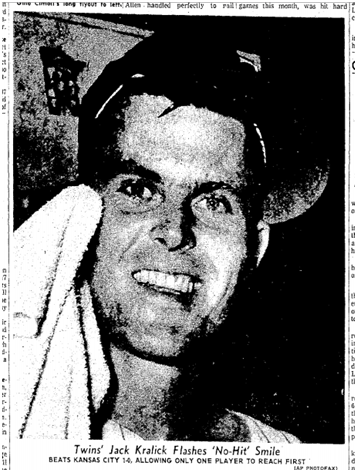
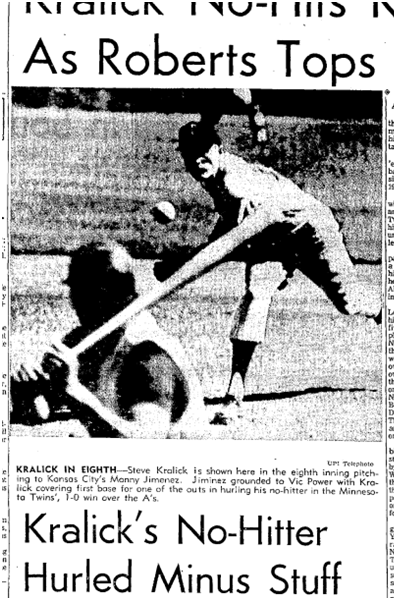
Here is my favorite photo from the whole endeavor: a picture and a piece from The Sporting News, detailing Jack Kralick's 1-0 no-hitter versus the Kansas City Athletics:


The entire Sporting News Story of "Jittery" Jack's gem can be found in PDF form here in page one and here in page 2. Make sure you read the bottom of page one, to view the description of the Allison catch to save the no-hitter. Below is his line as seen at BBReference:


Pitching IP H R ER BB SO HR ERA BF GSc IR IS WPA aLI RE24
Jack Kralick, W (10-8) 9 0 0 0 1 3 0 4.02 28 89 0.736 1.22 4.6
Team Totals 9 0 0 0 1 3 0 0.00 28 89 0.736 1.22 4.6
Provided by Baseball-Reference.com: View Original Table
Generated 9/4/2013.

Some box scores (see the August 26, 1962 near-perfect game link) flow so well that they give you a good sense of the game's rhythm. Dare I say it - this game is very eye-catching in print (or on the screen, as it were) - not as pretty as say, 1960's pin up favorites Mamie Van Doren or Brigitte Bardot, but still damn pretty in the numeric, aesthetic sense. You might not believe me, especially if you clinked on the last two links, but I'm thinking ground ball hound Tommy John when I view the innings that must have flown by frustratingly quick for the Athletics batters. We all get our kicks in different manners.

The economy and effectiveness of Jack Kralick's performance are apparent - a very worthy and signature performance for the Minnesota Twins first no-hitter in Minnesota. The time of game was a 1:57, and as Kralick and Kansas City starter Bill Fischer were tossing so many 1-2-3 innings, it had to be a challenge for the stations broadcasting the contest to fit in their ads and promos. Damn!! Not enough time to advert the Thunderbird Motel, right across the parking lot on Cedar Avenue!! 

Playing into the rapid pace of this game was the fact that the K.C. batters were actually swinging away, typical of 1960's hitters - this was over  thirty years before money ball, after all. In their average lineup in '62, only Norm Siebern demonstrated above-average plate discipline, earning 110 walks; the next-highest total, 54, belonged to Ed Charles (who would go on to achieve cult hero status with the Amazin' Mets in 1969.

It was Charles who nearly ended the no-hit bid in the fourth inning,with his opposite-field drive that forced Bob Allison to reach above the right field fence in front of the bullpen (description, PDF page one above). There went the one, serious threat.

Besides Allison, also important to Kralick's success was having, quite possibly, the best defensive first baseman in modern baseball history backing him, Vic Power. As opposed to shortstop Zoilo Versalles, who was credited with handling the baseball ONCE, on a fourth inning 6-3 groundout by Bobby Del Greco (just preceding Charles's threatening flyball), Power was involved in plays resulting in 17 of the 27 outs in the ballgame. This was spectacularly achieving the goal the Twins management had in mind to stabilize the Twins infield by trading for Power (discussed in the post "A Maestro At First: Trading For Vic Power, April 2, 1962"). See the chart below for the full rundown:

[BELOW] Plays involving Twins first baseman Power,
 inning play occurred, fielder designated on 
play (pitcher 1, catcher 2, etc.)

Groundout-unassistedthird out-1st inn
Groundout: 1-3second out-2nd inn
Groundout: 1-3third out-2nd inn
Groundout: 5-3first out-3rd inn
Groundout: 4-3third out-3rd inn
Groundout: 6-3first out-4th inn
Groundout:3-1third out-4th inn
Groundout: 4-3second out-5th inn
Groundout: 3-1third out-5th inn
Foul fly: unassistedsecond out-6th inn
Groundout: 5-3first out-7th inn
Groundout: 1-3third out-7th inn
Groundout: 4-3first out-8th inn
Groundout: 1-3third out-8th inn
Groundout: 4-3first out-9th inn
Foul fly: unassistedsecond out-9th inn
Foul fly: unassistedthird out-9th inn


It was obvious to both Battey and Kralick that he didn't have control of his curveball early in the contest, as seen in the Winona Daily News PDF. My pet theory is that Kralick focused much better, bereft of his "yellow hammer," so that he was even more on point spotting his sinking fastball and slider. Of course, none of this would have meant anything without Lenny Green's sacrifice fly, driving home Bernie Allen in the 7th inning.


As noted in the previous post "'62 Twins Camera Day," Kralick had been absent from the fan photo-taking activities, pregame. In keeping with his "lone wolf" persona...
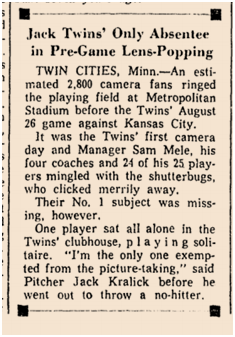

This game somewhat parallels the Francisco Liriano no-hitter on May 3, 2011:  the same score, & each were thought to be either sub-par or VERY sub-par in their performance of late prior to their classics. 


Hope you enjoyed this look at the first great pitching performance in Minnesota Twins history!!

As the great broadcaster ended his post-game shows, I also say:
Tuesday, April 2, 2013

A Maestro At First: Trading For Vic Power, April 2, 1962


LAST UPDATED: June 26, 2017 - Originally published 4/2/13 


In-season trades are rare occurrences for the Minnesota Twins. And even rarer are those that actually impacted the fortunes positively for the home nine. For Twins fans born around and after 1987, used to low-risk / low-dollar acquisitions* that numb the mind (see "Chris Speier, 1984, Bret Boone, 2005), the in-season pickups of Shannon Stewart (2003) and Kendrys Morales (2014) stood out as the exceptions. They captured the imaginations of Twins fans in terms of their audacity and potential, even if their outcome didn't exactly live up to the hype.
*Trade, waiver, and free-agent acquisitions are thrown into the same kettle for the purposes of this post

But rarities like these haven't always been the case in Twins Territory.


The Twins in the 1960s had at their disposal an astute gaggle of bird dog scouts, and long-time employees like Director of Minor League Operations man Sherry Robertson to assist President Calvin Griffith and his merry band of nepotists and drinking cronies in upgrading the Major League roster. They did this nearly every season in those early years. Which brings us to today's subject, the first major trade in Twins history.

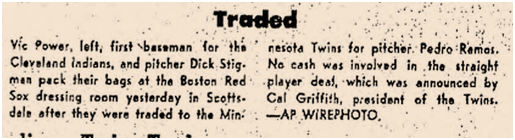
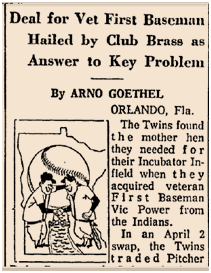
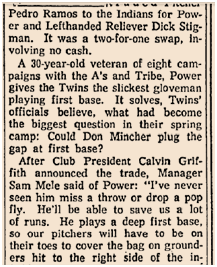
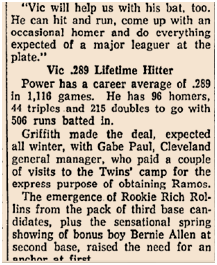
Vic Power was traded along with young reliever Dick Stigman to the Twins from the Cleveland Indians for right hander Pedro Ramos 53 years ago this week, on April 2, 1962. This happened as the team was winding down the '62 spring training schedule, and seemed to address the needs of both teams. At the time, parting with the talented Ramos, a fixture in the '61 starting rotation, was a significant event. He was their second starter, after staff ace Camilo Pascual, and is the trivia answer to "What Twins pitcher is credited with the first regular season win in team history?Jim Kaat was just coming into his own that season, and would win 18 games. They also had the enigmatic lefty Jack Kralick in house. In Stigman, the Twins were glad to get a promising, young arm. But the "sexy" part of this transaction was obvious...


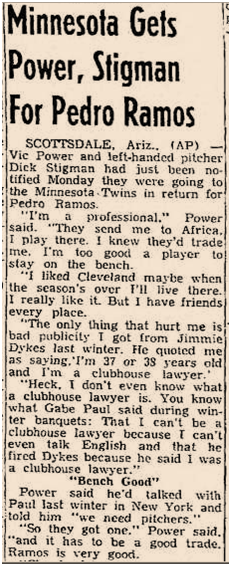
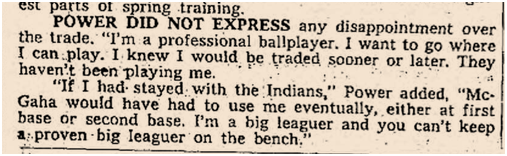
The news piece below from the 4/3/62 Jefferson City Daily summed up the trade, besides giving a very detailed, honest set of responses from Power himself (born Victor Power Pellot). Power was the key acquisition for the Twins , and at age 33, was joining his third organization. The Twins organization, going back TEN YEARS to their Washington Senator days (Google news item link) had coveted Power as a player. In another lifetime, as a Yankee in the early 1950s, he was in line to become the first black player for that organization. But the Bronx Bombers instead tapped Elston Howard for that role, for reasons that are now obvious. Some very transparent racism can be inferred from the Yankee brass responses, in The Sporting News piece linked here, from August 19, 1953


He had a reputation for marching to the beat of his own drummer, and was not necessarily the "company man" preferred by management. He was flashy in his dress, as well as the automobiles he drove. He was glib and candid, much to the consternation of his employees. He was conspicuous for enjoying the company of white women. And, maybe worst of all, he [GASP] made putouts at first with a sweeping, one-handed stab - unorthodoxy and panache frowned upon by the baseball lords of the day. 

Each of the above infractions were decided liabilities for dark-skinned players who desired stable employment before Civil Rights legislation came into effect.


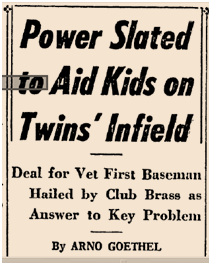
Twins Manager Sam Mele, on the other hand, stated the case for acquiring Power (to whom I devoted a "Remembering Vic Power" post some time back) in this piece:


There was a youth movement (Brainerd Daily Dispatch, 4/2/62) underway at The Met. Besides now having the green-as-a-pea kids third baseman Rich Rollins and second baseman Bernie Allen on the roster to start the season, Minnesota also had the mercurial Zoilo Versalles returning at short. Manager Sam Mele went on in the article to say "Power should be a steadying influence on the kids. They won't have to worry about making perfect throws. If it's within Power's reach, he'll come up with the ball." Griffith's concerns about his infield defense were legit, as the team ranked 8th (ten team AL) in defense in 1961; in Power, he now had his "Mother Hen" to corral those youthful slings to first. 

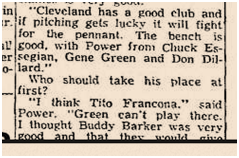
Power himself had a little extra to add in this account, which sums up the pride and inner confidence he held for his talents:


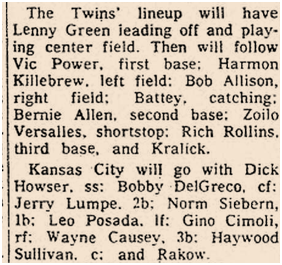
The Brainerd Daily Dispatch revealed the Twins new mindset for what would constitute their daily lineup to begin the 1962 season. Anybody surprised at who's slotted for left field, replacing Jim Lemon? Some big, ox-strong kid, name of Harmon Killebrew:


The trade would indeed benefit the Twins in their infield defense that year, besides elevating their place in the standings. They went on to post a 91-71 record, second in the league, moving them a step closer to respectability. Power would win his fifth Gold Glove Award, and rate 21st in the 1962 MVP voting. He would also play a pivotal role in the first Twins no-hitter by Jack Kralick (story at link) on August 26 that year. 

But that was just another day at the office for Victor Pellot Power. For his part, he seemed to enjoy his time in Minnesota, judging by his comments in a Baltimore Afro-American piece from March 31, 1964.

More insight about Power and his role as a MLB trailblazer can be gleaned at this very cool Baseball Hall Of Fame article.  
As the old professional at the mic, Herb Carneal, would end his broadcasts, I also say:
"So long, everybody!"


No, please don't go there....ohhhhhhh(!)....okay...
....what man wouldn't be proud of that assertion?


Monday, October 18, 2010

Snapshots From Twins Territory: Bernie Allen 1962

Everybody's All-American: Bernard Keith Allen, looking as 
if he was fresh out of Boy Scout Camp. Why his
mother let him out of the house, I'll never know.

 Use your imagination, and you can almost hear it...
Rookie Twins announcer Herb Carneal: "And Kaline grounds it to Rollins-he fields it, over to Allen, steps on second..on to Vic Power at first, and Kaline...he-eeesss's OUT, a double play..."
The Twins that summer, along with Bernie Allen,  were still fresh out of the box that summer of 1962. It was also the year of the Telstar Communications Satellite, The Cuban Missle Crisis, the release of the first Beach Boys single, "Surfin," the first African-American, James Meredith, to enroll and attend the University of Mississippi, and, by the way, the birth year of the blogger guy you know as The Twins Twinkler.

Second baseman Allen placed third in the American League Rookie of The Year Award voting in '62 (behind future Twin Buck Rodgers (2nd) and Tom Tresh (1st)). He was an All-American shortstop out of Purdue University, where he was also the Boilermakers starting QB.  He and his crew beat the Gopher football squad in 1960 at Memorial Stadium in Minneapolis by a score of 23-14. This game gave him an insight into Minnesota sports fans, with fair, good-natured treatement given him and his teammates as they left the field.  This factored into his thinking when he chose to sign with Calvin Griffith and the Twins.

He took Billy Martin's place at second, having a fine year , as the Baseball Reference site shows.  This was an accomplishment in that he merely avoided having the demure Martin bash his lights out.  But factored in too were his twelve homers and otherwise excellent offensive and defensive numbers, and you then had a candidate to fill the organization's ongoing second base vacuum. He was chosen for the 1962 Topps Rookie All Star Team. He appeared to have "the right stuff." Or, so it seemed...
Bernie Allen 1963 Volpe Portrait, Twins
Team Set. Disembodied heads frighten me.


Bernie Allen, 1963 Topps Card
 This May 21, 1962 article from Sports Illustrated, written by Walter Bingham, gives a fascinating insight into Allen, Rich Rollins, Sam Mele, and the early season Twins of that year.

 Unfortunately, the league pitchers adjusted to him, and his output dropped the next year, in '63.  Not surprising, as might be expected for a guy having only 327 plate appearances in 80 games.  It's a tough game! In 1964, he was injured while receiving a lousy throw* on a double play ball from the mercurial Zoilo Versalles, leaving him vulnerable to the hard slide from the baserunner, Don Zimmer.
*as described by Jim Thielman in "Cool Of The Evening"

His knee was shredded.  It eerily predated the injury Rod Carew would suffer six years later, ; on a similar play, the '69 Batting Champion was taken out by Brewers first baseman, Mike Hegan. Only after surgery and rigorous workouts did Sir Rodney resurrect his career!

Calvin Griffith's team doctor decreed that Allen didn't need surgery. As it turned out, quite the opposite was true.  Allen eventually was put under the care of orthopedic specialist Dr. Don O'Donoghue.  The same fellow eventually worked wonders with Gayle Sayers, Willis Reed and scores of other athletes. Looking back, it's tempting to slam the cork and yarn stuffing out of Griffith, but his inactivity was rather in line with the way club owners conducted in player affairs back in those days, going on the cheap. Months after the injury took place, Allen was finally put under the knife.


Fellow Purdue teammates and alumni
Joe McCabe and Bernie Allen,
Spring, 1964. PINSTRIPES!


 So out of sync with the current state of sports medicine, and giving the professional athletes every benefit of the doubt with each flinch and facial tic.  Sports teams today do everything possible to avoid risking permanent injury to one of their "investments." Now, it's not considered unusual for a current Twin like J.J. ("The Iron Horse") Hardy to start only 95 games out of 162 during the 2010 season, with his various ailments.


          A-Ha! Does my little eye spy Harmon Killebrew (3)
          and Vic Power (28)in the background?


  Ultimately, Allen's story is a one of a man who fought his way back. Only through intelligence, grit, and positive thinking did he return to baseball and the Twins. Pitching coach Johnny Sain bolstered his attitude with what we would today call "self-help books," a mode that had proven successful with Twin pitchers like Jim Kaat.  Sain was ahead of his time!

Allen's career never sulfilled the promise that it hinted in that summer of '62, but he did sustain a long career. He finished his career with the Yankees and then a few games with the Expos, in 1973 (see link above for stats). John Swol on his excellent Twins Trivia  site has posted an interview he conducted with Allen from a while back.  Not especially a man of many words at this time of his life!

May Your Taters Fly Far!
Twinkler Out


Friday, July 30, 2010

Remembering Rod Carew, The Magician With A Bat

Rod Carew's "Mod Squad" 1972 Topps baseball card, my favorite!

Rodney Cline Carew...

Three favorite adjectives for him? 
Perfection, effortless, unstoppable...he was the magician with the bat.  He played 12 seasons with the Twins, from 1967 to 1978.  This ended all too abruptly when he left the Twins after 1978 to join the California Angels.  A heartbreaking situation for Twins fans that was, especially considering the team had already lost both Larry Hisle and Lyman Bostock the previous year to free agency...

Rodney was a no-brainer all-time Twin and Hall of Fame player the day he left Minnesota.  He's now immortalized in the team's "sculpture garden" (in addition to Kirby Puckett and Harmon Killebrew) on the Plaza outside brand-new Target Field in Minneapolis. He gave fans like me a reason to tune in my radio in the 1970's for late night Twins games on the west coast, when they fielded some pretty mediocre clubs. I mean, the middle infield in the '74 opener was Rod at second, and the hot, new shortstop...Sergio Ferrar?  Exactly. 

Three main memories of him?
*The casual, three-quarters-underhand flip throw to Harmon for the out, second to first...
*The curious running style, his arms held curiously out to his side as if he were holding onto the rails of an escalator...
*The smooth warmup swings before the pitch, before he assumed a bent-over crouch with his bat held parallel to the ground...

Such an idiosyncratic guy.  It seemed as if there were two games going on - the one everyone else was playing, and then his elegant, "my-own-little-universe" version.  A man among boys. He was liable to hit the ball anywhere from the lefthanded batters box - a bleeding, lineshot to the gap in right, a little dinking bloop over the shortstop, or one of his famous bunts down the third baseline. 

No one ever seemed to be in the right spot for those bunts, even if they knew he might lay one down.  No question, he was the best bunter in the second half of the 20th Century. I remember hearing how he'd tap pitches in practice with disgusting regularity in ballbags placed around the grass in the vicinty of home plate
*********
He was born at 7 o' clock in the evening on a train traveling in the Panama Canal Zone on October 1, 1945. His mother, Olga Carew, wanted the birthing to take place at the largest hospital in Panama, Gorgas.  Her reason was practical: so many children were dying at the local facilities in Gatun. The train's bumping along exacerbated matters.  Luckily, a nurse on the train enlisted the aid of a physician, Dr. Rodney Cline, a man in the right place at the right time to have his name linked with baseball history.

The Back Story
Rod and his brother Dickie were verbally and physically abused by his father Eric Carew, a temperamental, drinking man. He would eventually abandon his family. Before that, Rod could tell a whuppin was coming just observing the way his father approached his home on the sidewalk. His Mother, Olga, would jump in front of his blows as he tried to wack away at their sons. Rod used the baseball diamond as a means of escape, as well as recreation; he was initiated into the game using broomsticks for bats and paper bags for gloves in Panama.  That was better than wandering off into the nearby jungle.  Indeed, kids who ventured carelessly could encounter poisonous snakes on the prowl...


And with that depressing genesis, quiet, private Rod Carew would find his identity in playing amateur baseball as a teenager in New York city.  He relocated there in 1961 with his brother, joining their mother. Much of his tutelage took place on fields just a short distance from Yankee Stadium, where the dynastic Yankees of the early '60's reigned. He could hear the roar of the crowd wafting through the air when Mickey Mantle or Roger Maris put a charge into one. 


Legend has it that the Twins were tipped off to his talent that early summer of 1964 by local scout Herb Stein, who saw the 6 foot, 150 pound Rod playing for the New York Cavaliers in the Bronx Federation League (a sandlot outfit).  He took batting practice in the fabled Yankee stadium. The ballpark at that time featured monuments honoring Babe Ruth and Lou Gehrig right out on the playing surface.  They were near the flagpole in centerfield.  And it didn't seem weird at all. 

Now, of course, we have padded fences, shin guards, elbow guards, et. al.  You'll have to go to another universe to find granite markers on a playing field.  But I digress... 

Even with his skinny frame, he began blasting balls out of the park to all fields while wearing one of Tony Oliva's #6 uniforms  It grew so conspicuous that then-Twins manager Sam Mele hustled him off the field - fearing the Yankees might beat the Twins to the punch and sign him to an amateur free agent contract. Carew remembers catcher Earl Battey coming up to him afterwards, remarking "Hey, how's it goin,' skinny kid?" He signed a free agent minor league contract with the Twins on June 24, 1964.


From Montana Standard (June 28, 1964)

Intriguing, How Things Might Have Been...
1967 Twins Issued Photo:
The Rookie, Rod Carew

Rod played in the Cocoa Rookie League (see minor league stats) that first summer, before moving up to "A" ball for the seasons of 1965 and '66.  It is not well known that the Twins, along with other teams during the Vietnam War era (see "Hardball Times article on major leaguers in 'Nam), had him designated for an early call up to the majors during the 1965 season.  The possiblity existed that players could be selected any time for active duty overseas.  Rookie catcher John Sevcik and second baseman Bernie Allen were both eligible for the draft, but the call never came. Intriguing, the thought of Rod Carew starting at second base against Sandy Koufax and the Dodgers in the 1965 World Series! Cool, actually!

Below: boxscore of first spring training game 
played by Rod Carew in Twins uniform
Sunday, March 14, 1965


[picture at left: the Twins middle infield, spring training, 1970]  As it was, he went right from A ball to the major leagues in 1967. But that was only because Twins team owner fought for him to be included onto the opening day roster, over Manager Sam Mele's objections. The skipper wanted to give Carew more seasoning, to develop his fielding prowess.  The curmudgeonly owner prevailed.

Griffith was vindicated as Carew was voted Rookie of The Year in 1967 (voting results).  That was the year the greatest pennant chase in baseball history took place, when 4 teams could have mathematically won the pennant on the last day of the season.  The Red Sox won out over the Twins, Tigers and White Sox for the chance to advance to the World Series against the St. Louis Cardinals. See my post on Rod's Major League Debut, "In The O's Nest."

The Stealer - 1969
Rod and the Twins both had what was considered a subpar year in 1968. Before the 1969 season, he and newly assigned manager Billy Martin retooled his running game and his fielding maneuvers; he also switched to a heavier bat, with a bigger barrel. It forced him to cut back his swing, discourage him from overswinging, and gain bat control.  The result was his first American League batting title, which he corralled by hitting .332.

Remember, this was against the backdrop of the Vietnam War, Woodstock, Led Zepplen, student protests, and civil unrest in many cities nationwide, Chuck Manson (ugh!). But all I remember from that season was a lovely summer, Fourth of July fireworks, my mom, dad and family, swimming outings to nearby lakes...and, of course, the inspired play of a surging baseball team with many, colorful stars - including Rod. He was also participating in National Guard drills during that season (a sure sign of the times!), which took him away from competition for many games at a time.

He also gained notoriety with his seven steals of home (one short of Ty Cobb's season record), a facet of his performance that year recalled wonderfully in the highlighted blog account.

Billy Martin suggested that Carew take a long, walking lead instead of coming to a stop. How long a lead Carew took depended on how close the third baseman was to the bag and whether the pitcher went into his windup or checked him from the stretch position.

Of his seven steals of home during the 1969 season under the approving eye of manager Martin, Rod Carew used the surprise factor five times in the first inning.

[Stealing against Angels, 1969]

''Pitchers,'' Carew has explained, ''don't expect you to take a risk so early and kill off a potential rally.'' Carew also ran in a crouch that, he believed, propelled him toward the plate faster. But he also knew when not to try to steal home. Never with two strikes or three balls on the batter. Never with none out. Even so Carew had six steals of home by June and in July he equaled Pete Reiser's 1941 record. He stole home nine more times in his career, but he was a marked man.