Check Out This Post!

Harmon Killebrew On David Letterman!?

With the appearance of Joe Mauer last week on Jimmy Fallon, I was reminded of another episode of a famous Twin who appeared on late ni...

Showing posts with label Earl Battey. Show all posts

Monday, September 17, 2018

Twins Walk Off Grand Slams!

"Mr. Becquer, meet Misters Allison, Green & Battey"


Yesterday, Francisco Mejia, Padres catcher, took Jeffrey Springs of the Rangers deep with 2 outs in the bottom of the ninth for a walk-off grand slam to defeat the Rangers 7-3. You might recall Mejia was the prized trade chip in the Pad's trade of Minnesota (Chaska) native Brad Hand to the Cleveland Indians on July 19 of this season. So sad Cleveland won't have the benefit of his services in the foreseeable future (Twins fans, insert chuckle here)..


It was MLB's seventh walk-off grand slam of the 2018 season. All of which made me wonder "how many game-winning, walk-off grand slams have been hit in Minnesota Twins history* I thought, there must have been about 5, 6, at least.

* Grand slams hit in the home half of the last half inning that put the home club in the lead, and  which automatically end the game

 I wasn't far off! Basically right on...of course! :D


The actual result of my search? A grand total of FIVE times in 59 seasons of Twins baseball.  Or one every 12 years or so.

By the way aLI (average pressure index) is a Baseball Reference creation alluding to the average pressure factors upon the batter in their individual at bats. Which would say Becquer was feeling a HEAP of stress, perhaps thinking his status with the club in that inaugural Twins season might hinge on that very at bat (see Reusse story below!) . It's also interesting to note the 40 year span from Hall's 1966 bomb until Jason Kubel got the Twins back on the map in the 2000's.

Twins All-Time Walk-off Grand Slams, 1961-2018

Rk Player Date
Opp Rslt HR RBI aLI Pitcher Batter
1Julio Becquer1961-07-04 (1)CHWW 6-4146.990Warren HackerJulio Becquer
2Jimmie Hall1966-08-02BOSW 7-3142.372Don McMahonJimmie Hall
3Jason Kubel2006-06-13BOSW 5-2142.962Julian TavarezJason Kubel
4Joe Crede2009-05-13DETW 14-10142.044Brandon LyonJoe Crede
5Brian Dozier2018-07-15TBRW 11-7145.570Matt AndriesseBrian Dozier
Provided by Baseball-Reference.com: View Play Index Tool Used
Generated 9/17/2018.


MLB'S 2018 Walk-off Grand Slams


Results
Rk Player Date Tm Opp Rslt Pitcher
1Francisco Mejia2018-09-16SDPTEXW 7-3Jeffrey Springs
2David Bote2018-08-12CHCWSNW 4-3Ryan Madson
3Daniel Robertson2018-07-22TBRMIAW 6-4Kyle Barraclough
4Xander Bogaerts2018-07-14BOSTORW 6-2Chris Rowley
5Jose Bautista2018-07-06NYMTBRW 5-1Chaz Roe
7Jason Heyward2018-06-06CHCPHIW 7-5Adam Morgan
Generated 9/17/2018.  - FOR SOME REASON, BBREF WILL NOT LIST DOZIER'S GS
ON JULY 15 IN THE GENERATED REPORT - I HAD TO DO IT MANUALLY
IN THE FIRST CHART.  #CONSPIRACY! #SAD

Yeah, those greedy Cubs have TWO already in 2018!!


See Patrick Reusse's July 3, 2010 Article about Becquer's Grand Slam via the Minneapolis Star Tribune. It is corkin' good!


"So long, everybody!" - Herb Carneal

Wednesday, February 4, 2015

1965 Twins Win 1st Pennant (Video) - 9th Inning


Our friends at the Pavek Museum of Broadcasting have done it again, posting this beautiful, crisp video from the pennant clinching game of September 26, 1965 (BBRef.) at Washington's old D.C. Stadium, later renamed R.F.K. Stadium, the first home of the new Washington Nationals


I personally find this a joy, which is a little like saying the fox enjoys the occasional foray into the hen house. Twins / Green Bay Packers announcing legend Ray Scott is at center stage here, along with announcer Frank Buetel (in booth to call the ninth inning)  and the many greats of the 1965 Twins: Harmon Killebrew, Tony Oliva, Jim Kaat, Bob Allison, Cesar Tovar, Camilo Pascual, Rich Rollins, Earl Battey, Mudcat Grant, Jim Perry etc*. Let yourself go, and see 'em as they were!
*Previous three create everlasting image with shaving cream and feather fedora after 35:30 mark 

"So long, everybody!" - Herb Carneal


Monday, June 9, 2014

Earl Battey 1961 Baseball Digest Feature


Do yourself a favor and check out this link to June 1961 Baseball Digest at my Google Docs with a superb Earl Battey article. Battey was the first Twins player ever to appear on the cover of that magazine, as the Twins first season had just begun in Minnesota just a few weeks earlier.A great piece on the first, great catcher of the Twins, who was named the top catcher on the Twins 40th Anniversary in 2000.

It's from a fantastic, mint edition which I just recently bought off Amazon. I rather fancy it as a historical document, partly because it was published just a month or so into the beginning of the first expansion era in baseball. Besides that, it really is telling as an illustration of sports journalism, circa 1961.

To wit: I truly doubt that any major sports publication today, or any magazine really, would give a damn what I thought about anything, much less pay me for ideas submitted:


[Blurb at left from "Greatest Catches" story - see table of contents in the Google scanned Table Of Contents - I wouldn't mind the money, if the offer from Baseball Digest is still valid..]

You'll notice the date stamp, "MAY 4 - 1961" on the back page, probably denoting when it was received by the store of sale. The story references the Twins first game on April 11, 1961 (BBRef box), which means the interview for the June issue was conducted very shortly after that game before it went to press.

Battey really shows himself to be an incredibly well-spoken young guy (he was 26 in 1961). I mean, this story is really chock full of intelligent, cogent, and insightful responses. The BD staff writer, Charles Dexter, included quite a few long, thoughtful quotes which made it seem at times as if Battey himself wrote the article in the first person.

My favorite sections were his insights into Twins pitchers like Camilo Pascual, Jack Kralick and Pedro Ramos, and how they comported themselves in the lockerroom. I'm only a little surprised not seeing any references to Jim Kaat. Probably indicates where the big lefty was in the staff's pecking order as the season was beginning.

An ironic section on page 15 mentions that Earl had John Roseboro as a neighbor in Compton, California at the time. Of course, all good Twins fans know that Roseboro eventually replaced Earl as the Twins everyday catcher, in 1968, after Earl and Ron Perranoski came in the Versalles/Grant trade. You can read about Earl's post-career at this SABR bio article from 2009.

I included the table of contents in the scan, plus the revised Twins and Yankees rosters as of '61 May, in addition to those for the first two expansion teams in MLB history, the California Angels and the new Washington Senators. I kid you not! If you see any articles you would like pdf scans to read, just let me know. I can try to email you a copy.

There are some nice pluses in the magazine.
See if you can recognize some of the names
of the Twins coaches (or others)
in the chart below! Yeah, just a tad jumbo, but it wasn't 
displaying well at large size!


NOTE: Check out the back side of the magazine at the end of the scan: a full-color advertisement. Rather cool!

You can get a short sample of the older Earl, at this
You Tube video from 1986 I posted a while ago. You get
some idea of the understated, but warm manner
of the man. Fairly engrossing, if I might say so.

I conclude in my best Herb Carneal-ese: "So long everybody!"

Friday, November 22, 2013

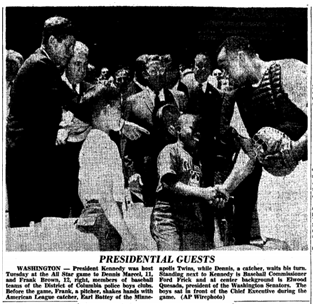
President Kennedy, Earl Battey, And The 1962 All Star Game


"World War II Aviation hero Quesada and a few other friends"
                                           Those little tykes (Dennis Marcel, Frank Brown, members of the Washington Boys Club)
                                                     certainly got a front row to history! PHOTO
Cecil (Cecil William) Stoughton 
The Twins would win their first pennant in this same ballpark three seasons later.

The above photo was posted by Minnesota Twins President Dave St. Peter on Twitter today, the 50th anniversary of November 22, 1963 assassination. Earl Battey shakes hands with President Kennedy at D.C. Stadium before the playing of the 1962 All Star Game. Between them stands then-MLB Commissioner Ford Frick, and Elwood R."Pete" Quesada  (glasses), the new Senators chief majority owner. Off to the side (left) stands Minnesota Senator Hubert Humphrey and an unidentified dignitary. Do examine this You Tube video of the game. You see superb footage of not just the ceremonial first pitch, but that of Pascual pitching in the the 6th inning during the NL rally, the Rollins blooper hit, run scored, and closeups of JFK sitting in the box seats.

In it's lightheartedness, the entire scenario that included two young boys as guests stands in stark contrast to the pivotal fall approaching, i.e., the Cuban Missile Crisis, and the year to follow in the Kennedy's lives.


Above Photo from Alton Evening Telegraph 7/11/62- "Minneapolis Twins" - LOL!! (see PDF)

Battey was the starting catcher for the AL that day, going 0 for 2 at the plate in the 3-1 loss to the NL. He still shined, however, using his howitzer of an arm to throw out Roberto Clemente on an attempted steal in the fourth inning. Twins third baseman Rich Rollins also started that day going 1 for 2, scored the only AL run, and was hit by a Don Drysdale pitch (yes, Dandy Don drilling someone, quite the shock!). 

Twins star righty Camilo Pascual was the losing pitcher, tossing 3 innings, and allowing 2 earned runs.   The Sporting News (page 1) of  July 21 included a great account of the game, with the circumstances surrounding their handshake in the photo, plus a black and white photo of Battey on page 2.


You can view a story with this Kennedy photo, game report included, at a newspaper PDF link to the Burlington Daily Times of July 11, 1962. One of my personal favorites, Stan Musial, was playing in his 22nd All Star Game that day, got a key hit off Camilo, and earlier had a personal audience with JFK (see Eau Claire news link PDF). Dodger shortstop Maury Wills also got a ton of press with his exploits, running wild and stealing bases.  The Lima News also had a nice account and photo of the game's stars the next day. 

It was the first All Star Game ever played at D.C. Stadium, the home of the new expansion Washington Senators. They had come into existence in 1961, when the original Senators franchise up and moved to Minneapolis-St. Paul to become the Minnesota Twins. D.C. Stadium would later host the 1969 All Star Game, renamed R.F.K. Memorial Stadium by then. Clem's Baseball retro stadium site is fantastic in its photographic and architectural schematics of the stadium and its history. The FIRST cookie-cutter style stadium, as the You Tube video makes plain.

Kennedy threw out the First Ball, with Lyndon Johnson standing by (left), hoping he'd be asked to throw one of his infamous curve balls in relief if needed - you'll read of the photographers caught napping at The Sporting News link above. That would include Presidential Photographer Stoughton.


Prior to handshake - President attends the 32nd All-Star Baseball Game, throws out first ball. Speaker of the House John W. McCormack, Dave Powers, Vice President Johnson, President Kennedy, Commisioner of Baseball Ford. C. Frick, Lawrence O'Brien, others . Washington, D.C., D.C. Stadium - PHOTOCecil (Cecil William) Stoughton


First pitch of the game below: note high pitch, where Battey sets up to receive - higher strike zones were more the norm, especially pre-1969...

Photo: Logansport (IN) Herald 7/11/62, see PDF)

More than likely, I'll be adding to this post later, the incessant tinkerer.


Ready to wing it towards Earl!

As Herb Carneal signed off after post game shows:
Wednesday, September 4, 2013

Jack Kralick & The First Twins No-Hitter, August 26, 1962

This post is the companion piece to "1962 Camera Day." It is one of my more enjoyable posts personally, and I hope you can take something away from it as well!
* * *

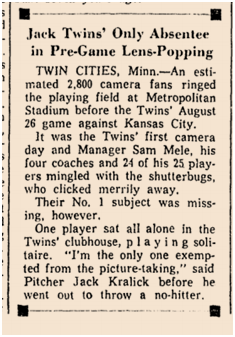
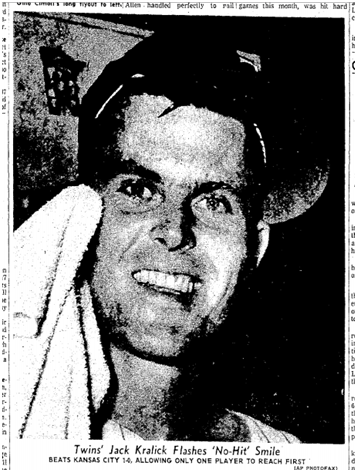
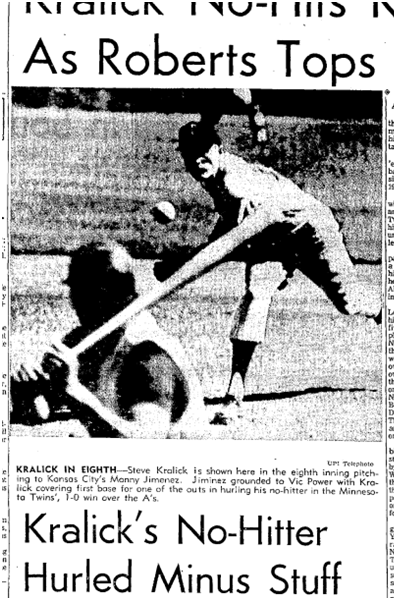
Here is my favorite photo from the whole endeavor: a picture and a piece from The Sporting News, detailing Jack Kralick's 1-0 no-hitter versus the Kansas City Athletics:


The entire Sporting News Story of "Jittery" Jack's gem can be found in PDF form here in page one and here in page 2. Make sure you read the bottom of page one, to view the description of the Allison catch to save the no-hitter. Below is his line as seen at BBReference:


Pitching IP H R ER BB SO HR ERA BF GSc IR IS WPA aLI RE24
Jack Kralick, W (10-8) 9 0 0 0 1 3 0 4.02 28 89 0.736 1.22 4.6
Team Totals 9 0 0 0 1 3 0 0.00 28 89 0.736 1.22 4.6
Provided by Baseball-Reference.com: View Original Table
Generated 9/4/2013.

Some box scores (see the August 26, 1962 near-perfect game link) flow so well that they give you a good sense of the game's rhythm. Dare I say it - this game is very eye-catching in print (or on the screen, as it were) - not as pretty as say, 1960's pin up favorites Mamie Van Doren or Brigitte Bardot, but still damn pretty in the numeric, aesthetic sense. You might not believe me, especially if you clinked on the last two links, but I'm thinking ground ball hound Tommy John when I view the innings that must have flown by frustratingly quick for the Athletics batters. We all get our kicks in different manners.

The economy and effectiveness of Jack Kralick's performance are apparent - a very worthy and signature performance for the Minnesota Twins first no-hitter in Minnesota. The time of game was a 1:57, and as Kralick and Kansas City starter Bill Fischer were tossing so many 1-2-3 innings, it had to be a challenge for the stations broadcasting the contest to fit in their ads and promos. Damn!! Not enough time to advert the Thunderbird Motel, right across the parking lot on Cedar Avenue!! 

Playing into the rapid pace of this game was the fact that the K.C. batters were actually swinging away, typical of 1960's hitters - this was over  thirty years before money ball, after all. In their average lineup in '62, only Norm Siebern demonstrated above-average plate discipline, earning 110 walks; the next-highest total, 54, belonged to Ed Charles (who would go on to achieve cult hero status with the Amazin' Mets in 1969.

It was Charles who nearly ended the no-hit bid in the fourth inning,with his opposite-field drive that forced Bob Allison to reach above the right field fence in front of the bullpen (description, PDF page one above). There went the one, serious threat.

Besides Allison, also important to Kralick's success was having, quite possibly, the best defensive first baseman in modern baseball history backing him, Vic Power. As opposed to shortstop Zoilo Versalles, who was credited with handling the baseball ONCE, on a fourth inning 6-3 groundout by Bobby Del Greco (just preceding Charles's threatening flyball), Power was involved in plays resulting in 17 of the 27 outs in the ballgame. This was spectacularly achieving the goal the Twins management had in mind to stabilize the Twins infield by trading for Power (discussed in the post "A Maestro At First: Trading For Vic Power, April 2, 1962"). See the chart below for the full rundown:

[BELOW] Plays involving Twins first baseman Power,
 inning play occurred, fielder designated on 
play (pitcher 1, catcher 2, etc.)

Groundout-unassistedthird out-1st inn
Groundout: 1-3second out-2nd inn
Groundout: 1-3third out-2nd inn
Groundout: 5-3first out-3rd inn
Groundout: 4-3third out-3rd inn
Groundout: 6-3first out-4th inn
Groundout:3-1third out-4th inn
Groundout: 4-3second out-5th inn
Groundout: 3-1third out-5th inn
Foul fly: unassistedsecond out-6th inn
Groundout: 5-3first out-7th inn
Groundout: 1-3third out-7th inn
Groundout: 4-3first out-8th inn
Groundout: 1-3third out-8th inn
Groundout: 4-3first out-9th inn
Foul fly: unassistedsecond out-9th inn
Foul fly: unassistedthird out-9th inn


It was obvious to both Battey and Kralick that he didn't have control of his curveball early in the contest, as seen in the Winona Daily News PDF. My pet theory is that Kralick focused much better, bereft of his "yellow hammer," so that he was even more on point spotting his sinking fastball and slider. Of course, none of this would have meant anything without Lenny Green's sacrifice fly, driving home Bernie Allen in the 7th inning.


As noted in the previous post "'62 Twins Camera Day," Kralick had been absent from the fan photo-taking activities, pregame. In keeping with his "lone wolf" persona...


This game somewhat parallels the Francisco Liriano no-hitter on May 3, 2011:  the same score, & each were thought to be either sub-par or VERY sub-par in their performance of late prior to their classics. 


Hope you enjoyed this look at the first great pitching performance in Minnesota Twins history!!

As the great broadcaster ended his post-game shows, I also say:

Tuesday, January 17, 2012

Kodak Snapshots - June '63 At The Met


                      Lenny Green takes his pregame cuts

It all looks so carefree and unburdened.  A sunny, 1960’s summer day at Metropolitan Stadium in Bloomington, Minnesota. From analyzing data from blurred scoreboard images, I’ve deduced this is the game the 1963 Twins played against Chicago White Sox on June 20, 1963, albeit without complete certainty. It was not uncommon to wait days for film developing, up to and beyond a week for rolls to arrive back from a photo lab in the Twin Cities back then; thus, pictures taken in late month may not have been developed until after the first of July, in this instance.

 
                                                                           Everybody was ready for a foul ball.

Usually, close up inspection of the board helps pinpoint the exact day, time of day, year, who was on the mound – but these images have the appearance of pregame warm-ups, what with the lack of game data on the board operated by Charlie Wilcox. The visiting team name is blurry at best, but the characters suggest “CHICAGO” to my eye. Have a go at it yourself, if you wish!


           Note the unpadded expanse of outfield fence!
              Plus, there was no shade -  the  second deck
              was finally constructed during the 1965 season.

 
I said it was “carefree.” As if they lived in a big, TV sitcom world of Deputy Fifes, Dick Van Dykes and Jethro Bodines. We know better. The day of this game was almost exactly 5 months before President Kennedy's assassination. Buddhist monks were immolating themselves that summer in the streets of Saigon to protest government raids on their pagodas, in the effort to crackdown on  communist infiltrators in unstable South Vietnam. Also bedeviling them was the constant threat of Chairman Khrushchev and the Russian Bear, and...the unsettling arrival of yet another cheesy Elvis movie in theatres that fall (Fun In Acapulco). The horror!

                                                                                                Crewcuts, curls  and Twins caps! 

I look at the people and wonder about their lives. So many families, and dad’s with their kids! They came, and plunked down their hard-earned cash – nobody used credit cards then - to purchase tickets the day of the game. They paid $1.50 for those outfield bleacher seats (rich guys $3 for those lower, main mezzanine seats), when the median household income per year was $5,807. They raptly watched even the warm-ups, with only the organ fills, Bob Casey’s announcements, and the impossible fielding antics of Vic Power around first base to occupy them. That they were enriched and enjoyed a day at the ballpark without the broadcasting of pop music over the PA is enviable to me. The between-inning announcements and video board hype (hysteria) in today's  ballparks severely distract from the game's simple essence, in my humble opinion.

       Dailey had that one magical year - '63

On this game day, the fans saw Harmon Killebrew and Earl Battey hit roundtrippers. Ace Twins closer Bill Dailey relieved Jim Kaat in the sixth after the latter couldn’t get past the first five batters in the frame . Yes, the guys in the 'pen certainly had to earn their money the hard way! Dailey shut down the Sox the rest of the way, giving up only 2 hits over the next four innings, along with four strikeouts. He would come into ballgames that year riding in a convertible, to the tune of “Won’t You Come Home Bill Bailey? (Louis Armstrong, You Tube video below).” That was considered a spectacle 49 years ago.


All things considered, I wouldn't mind time-traveling back to that day, to enjoy a Schweigert hot dog and a Schmidt tall one in the cheap seats!  

         1962 game program ad


As our broadcasting buddy Herb Carneal ended his broadcasts, I say "So long everybody!"

Metropolitan Stadium Photos courtesy of Radio Sputnik (Flickr photos)