"Lenny was a sweetheart and a super guy to have on the club."
- Tom Mee, Twins Public Relations Director
 |
Passion + Intensity = Lenny Green.
|
Kirby Puckett was just thirteen months old.
Torii Hunter's smiling face would not come along for another 14 years. A two-year old named
Jim Eisenreich was playing with blocks up in St. Cloud, Minnesota...

And
Lenny Green was in the starting lineup for the Twins in their inaugural game on April 11, 1961, versus the Yankees at the Stadium. He was the centerfielder in that game (
link to his game logs), as he was for the majority of the games for the Twins that season. He came to the Senators/Twins organization in 1959 in a trade from the Baltimore Orioles in exchange for the shrimpy-yet productive,
Albie Pearson, the 1958 American League Rookie Of The Year.
He was a guy you rooted for, a guy who played with passion and could relate to people. The
Minnesota Historical Society (great stories at link!) featured Twins memories a while back. One fan recollects an early summer game interrupted by fog; at one point during the delay, Lenny ran out to the outfield, with glove and wearing a miner's hat with a light, looking as he was ready to roam for flyballs. It elicited a roar from the spectators!
He had above average speed, was an excellent fielder with good range, a below-average arm. In
"Split Doubleheader," Morlock and Little had this quip regarding Lenny's arm, and the 1963 outfield combination of
Harmon and/or
Bob Allison in left, and
Jim Lemon in right:
"...Killebrew...would have had to chug heartily to beat Leadfoot Lemon (the '61 left fielder) in a footrace. Allison had average speed, and Green had above average speed, but was lucky if he could toss a routine fly back to the infield on the third bounce...The best possible combination that could be made on a ball hit between Green and Killebrew would be for Green to chase it down, flip to Killebrew, who would fire to third to try to catch the batter."
That said, Green's
range factor (ranked third twice among centerfielders, '60 & '65) and hustle had to have compensated some for his throwing deficiences. He placed in the top 5 in fielding percentage four times from 1960 through 1965; furthermore, he ranked in the top four centerfielders in putouts in '61 and '62. As a modern comparison for today's Twins fan, prospect
Ben Revere projects similarly in his skill set, as a speedy, slap-hitting, weak-armed outfielder (and that from
Paul Molitor who has worked with Revere on his fundamentals).
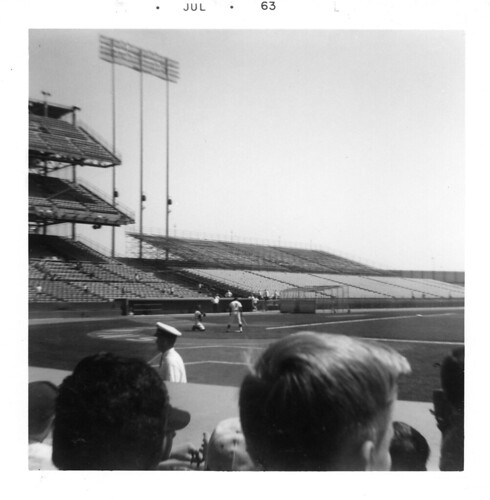 |
| Batting practice, 1963, at The Met |
Lenny held the Twins consecutive hitting streak of 24 games for 17 season before
Kenny Landreaux broke it with his 31 gamer in 1979.
In his streak, stretching from May 1 to May 28, he:

Born in Detroit at the height of the Depression in 1933, Green picked up his passion for baseball from his father; Gene Green was a Ford Motors employee, who played outfield for the plant team. Contemporary Jerry Griffin ( from
biography at SABR Project) remembers young Lenny as a "
graceful athlete, who could run like a deer, and was a strong line drive hitter...the ultimate team player who always had a big smile for everyone he met."
 |
| Team promotional picture |
The new team and its stars were an example of
cause celebre and general uproar in Minneapolis-St. Paul and its nether environs during the early '60s. Tom Mee recalls stopping in a little bar in Nimrod, Minnesota with Green,
Earl Battey and Doc Lentz on a preseason Winter Caravan tour.
Only the bartender was on hand. Mee said to him "We're with the Minnesota Twins. This is Lenny Green..." and before he could say anything else, the slack-jawed fan blurted '
Lenny Green! I'll be damned! Lenny Green! Lenny Green!'" ad infinitum. "Everybody loved Lenny. And he could play" (from
Showers, "Twins At The Met").
 |
| Spring training, Orlando, early 1960's |
Poor Len. He always seemed to miss the gravy train on its way out of the station. He, along with
Vic Power, was traded to the
California Angels in 1964, a year before the Twins went to the World Series. His old team before Minnesota, the Orioles, went to and swept the '66 Series. After the Angels, he put in a solid stint with the Red Sox - and again, was traded before
The Impossible Dream of 1967. He played with the Tigers into June of 1968...but then was released 3 months before that outfit played in the big dance of '68. He was voted a $200 winners share (others made over $10,000 for making it the full season). If you're scoring at home, thats four championship teams, four years running, of which he was a member. Just could never stick with any of them long enough to enjoy the thrill of victory. But he never lamented - he's quoted by Bill Nowlin in 2007 thusly:
"
No, no," he relied, when asked if he missed getting the money and notoriety, "I had a good career, and I enjoyed it. No, I don't ever feel left out. I feel blessed to ever have been able to play."
After baseball, Lenny got a job with Ford, like his Dad, as a security supervisor for 27 years before retiring in the late '90's. A bad back made surgery necessary in 2007, interrupting an otherwise enjoyable retirement.
 |
1963 Topps card
|
And with the Twins long history of top-shelf flycatchers, from
Jimmie Hall to
Lyman Bostock, from Eisenreich to Kirby, from Torri and now
Denard Span, he could always lay claim to being the
first centerfielder of the Minnesota Twins!
To Quote Herb Carneal:


