Check Out This Post!

Harmon Killebrew On David Letterman!?

With the appearance of Joe Mauer last week on Jimmy Fallon, I was reminded of another episode of a famous Twin who appeared on late ni...

Showing posts with label Don Mincher. Show all posts

Sunday, April 27, 2014

Game Of The Week: First Home Opener In Minnesota Twins History, April 21, 1961


Twins center fielder Lenny Green, up against chain link fence. Later, a concrete 
grandstand would replace cheap bleachers, and the makeshift planking for steps.


The Met parking lot - the former cornfield was only partially 
filled for that very first game in The Land of 10,000 Lakes.

The first Major League Baseball game in Minnesota history took place just four days after the U.S.-led Bay of Pigs invasion of Cuba. On the day of the game, President Kennedy was receiving communiques from Chairman Khrushchev, with ominous warnings against future interventions in Latin America. Also portentious that week was the Kennedy Administration's promise to the government of Laos to send about 300 U.S.military advisers into combat zones to help turn back communist insurgents in that country and others in the region; a ceasefire was in effect in Laos (Salt Lake Tribune) while the politicos assessed strategy. JFK this week also sent a private memorandum to Vice-President Johnson asking "Is there any space program that promises dramatic results that would represent a victory against the Soviets?" This would be the kick start for the greatest engineering, technical, and scientific undertaking in history - the Apollo program.

(Clover Leaf Twins card, 1961)

Don Mincher is the trivia answer to the
question "Who hit the first Twins regular-season 
home run at Metropolitan Stadium?" For the other 
Twins ballparks, Gary Gaetti (1982, the H.H.H. 
Metrodome) and Jason Kubel (2010, Target Field)  will do. 

Alas, the only sure win that week for Washington was secured by it's brand new American League entry. The Senators's invasion of Twins territory produced a 5-3 win that was decided in the ninth inning (BBRef). It was a sterling, close affair, with standout efforts by Minnesota's Lenny Green, Don Mincher, Camilo Pascual, Senators's slugger Dale Long, Washington starter Joe McClain, and reliever Dave Sisler. The latter escaped a bases-loaded, one out situation against Minnesota in the final frame. 

First, however, it was preceded by a gala welcome home for the Twins players and representatives:


Brainerd Daily Dispatch, April 19, 1961

The parade on Wednesday was joyful...


ABOVE: Don Mincher (left, crewcut) and Ron Henry, in Welcome Home Parade


The University Of Minnesota Marching Band arrives from center field for lineup
 introductions...and stayed lined up in the infield for the National Anthem. Note lack 
of seating in the foul territory behind first base. Construction of seating came to   
a halt when the game commenced, and would resume after the last out.


Note: signature walk-up path not yet constructed, from dugout to homeplate 

The Met as it looked on April 21, 1961 (BBRef), with Camilo Pascual on the mound; watching near the home team dugout were dignitaries such as  AL President Joe Cronin, MLB Commisioner Ford Frick, former NL President Will Harridge, Minnesota governor Elmer L. Andersen, and the mayors of Minneapolis of St. Paul (but not Bloomington Mayor Gordon Miklethun - the home ballpark in the city's limits apparently didn't confer upon him any special status!). Go to The Sporting News of May 3, 1961, and you'll read a rather pessimistic summary by George Moses of the Associated Press. You might think he took his lead from AL club owners still unhappy with Twins owner Calvin Griffith's push to move the franchise out of the nation's capitol. If Moses had taken the time to get the Minnesota fan's perspective (accessible in this account in the Winona (MN) Daily News of April 22, the tone would been much truer to the reality at the ballpark that day. Jim Wallace of the Brainerd Daily Dispatch ("It Wasn't That Bad") also had a nice rebuttal in his column the next day.


FIRST PITCH!
Winona (Minn.) Daily News 4/22/61


That the game only attracted 24,606 was a curious circumstance, however, given the lead-in hoopla. The forecast for that day was for temps in the 50s, with clear skies. It ended up an an overcast day, 63 D., but with no rain. So - what was up? A contributing factor may have been the absence from the starting lineup of Harmon Killebrew, who had pulled his left hamstring muscle running out a grounder in the Saturday, April 15 game at Baltimore (Twins game #4 in the '61 schedule). It was thought he would miss three weeks, but he rested for only two, reappearing in the April 29 game versus the Angels.


Minnesotan's may well have taken the attitude that without a big fly in the offing from Killebrew , the effort just wasn't worth it. Otherwise, I would posit that, despite the joy evident from acquiring a big-league team, rank and file Minnesotans just didn't have it in their mindset to take time off from work in that era, or to pull their kids out of school just to see what we now regard as history. Part of a region's character, you might say. Nevertheless, the opening ceremony was a fun spectacle, as this historic video makes clear. 


The Metropolitan Stadium scoreboard during Senator 
Willie Tasby's ninth inning at bat  on that April 21, 1961.


Enable audio - hover cursor near lower R-hand corner - click speaker icon

The Sporting News, May 3, 1961

Pascual pitched 8 innings that day, giving up three runs with 3 walks and 4 strikeouts (he would lead the league in that figure, 221). After giving up a long ball to first baseman Dale Long in the first, he appeared to right the ship. When Lenny Green homered to what would later become the right field bullpen to tie the game at 3, the Twins looked poised for a 9th inning rally. It wasn't to be. Washington pushed across 2 in their half of the ninth off trusty, "Old Blue" Ray Moore. Green was also the first Twins player to score in a home game, jogging home unfettered on Mincher's fourth inning bomb over the center field fence.


There are 8,000 things worth commenting upon in this short piece. But, the one I
most enjoyed was the narrator's pronunciation of "Minna-SO-tah" at the very end.
As if he was hip to the fact we have 10,000 Norwegians per acre in these parts.

Yes, a disappointing start, with nary a stampede through the turnstiles - but it wasn't a disaster. The Twins would win the next two games and the series that weekend, Sunday's game being a 1-0 shut out for Jack Kralick. Minnesota would eventually reach that coveted 30,000 attendance figure in game number 34 - a doubleheader on May 21 (BBRef, the 20th & 21 home games) versus Cleveland. Overall, they drew 1,256,723 for the 1961 season, third-most in the AL (of ten teams). Minnesota would go on to become a perennial home attendance leader in the American League, in fact, for the decade of the 1960's.

As Herb Carneal would phrase it: "So long, everybody!"

Monday, August 26, 2013

The 1st Camera Day, 1962: Day Of The Jack Kralick No-Hitter

By sheer coincidence, the Twins 1962 Camera Day landed on the very day (8/26/62, BBref Box) the franchise's first Minnesota no-hitter (post link!) was pitched, by Jack Kralick. Through the goodness of Twin Cities blogger Michael Haas (@digitalHaas, Alright Hamilton!), we have this beautiful set of photos from that historic day. They were shot by his grandfather, who attended the game that day along with Michael's mother and grandmother. We also get a sampling of Michael's thoughts at the end of this post, lending context to the photos. 1962 Twins team members Jim Kaat, Zoilo Versalles, Vic Power, Don Mincher, Dick Stigman, Ruben Gomez, Rich Rollins, Johnny Goryl, Hal Naragon, Marty Martinez, Coach Floyd Baker, and Manager Sam Mele are all present in this collection.

What is so great to me is how relatively shiny and new Metropolitan Stadium was - it was only in it's seventh season of existence, and its second as home to the Twins. The right field view is beautiful, encompassing the scoreboard, crowd, and bullpen areas. Especially nice is the Rollins / Valdivielso photo, with the first base foul territory and upper deck mezzanine in the background.

          [ NOTE: HELPS TO SINGLE CLICK PHOTO, ENLARGE FOR DETAIL! ]
My first inclination before posting these photos was to couple them with archival newspaper reports of the famous game by Kralick. After some thought, however, I felt they deserved a post of their own.  A separate blog entry will follow this week, concentrating on the original "Black Jack's" efforts.


[below: player with Rich Rollins (R) is Ruben Gomez, and not Jose Valdivielso as noted. To correct)


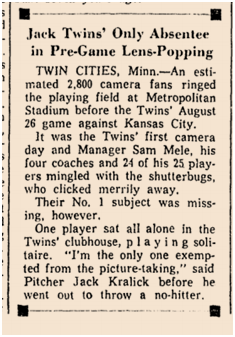
Ironically, Jack Kralick was nowhere to be found on the field for interested fans. The Sporting News Sept. 8, 1962 edition gave this explanation (see PDF of TSN page for extra context from that game) :


My Questions For Michael Haas: Behind The 1962 Camera Day Photos

ClassicTwins: I've always wanted to know about that blog title: "Alright Hamilton." How did that come about? How would you summarize the blog?

Michael: Oh, it's just a line from the movie "Fast Times At Ridgemont High," uttered by Sean Penn's character. I didn't put much thought into the title, obviously. Actually, we were a pretty legitimate blog in the pre-Twitter days. Myself and a few others tried to document the Twins fan experience and random off-topic things. You can see the archives at alright-hamilton.blogspot.com. The alright-Hamilton.tumbler.com is where I post random media very sporadically. I wish I could get back into the writing daily, but I just lost the momentum. Someday.

ClassicTwins: I get that "momentum" thing. Tell me about the photos, Michael. What’s the history behind them?


Michael: My Aunt digitized these old slides and gave some framed prints to my Mom for Christmas. My Grandpa was likely the photographer. My mom, 12 years old, is visible in the Athletics’ dugout on the left, and that’s my Grandma in the blue dress.


ClassicTwins: Very cool, a piece of family history with your grandparents and mom at the game, the photos literally a snap shot of a small part of their lives at the time. Could you give any information regarding the type of Twins or baseball fans they were – avid, casual, or otherwise? Did they make regular outings during the summers to Met Stadium to see the Twins? Do you know if they had any favorites among the players or coaching staff?


Michael: I would describe my grandparents as casual fans. I don’t remember them having much to say about the Twins while I was growing up in the 90’s. However, they must have been pretty close with the team because my Grandpa worked as an usher at Met Stadium. I’d guess my mom was the big fan of the family. I think she has a Bob Allison autographed picture around somewhere. And I know she still has her ticket stubs from games 1 and 2 of the 1965 World Series she saw as a 15 year old. I have no idea why she didn’t go to 6 and 7.

ClassicTwins: Bob Allison – perhaps the “Mr. Photogenic” of all the Twins ‘60’s guys. Does the photo set give you any particular feelings, i.e. “I wish I could have seen Earl Battey play in person,” or “Did the Twins REALLY have Harmon play left field a lot when they had Vic Power around to play first?” Or anything at all that you wonder about from that period in Twins history?


Michael: Well, the things that strike me most is the ballpark and the uniforms. I had no idea the Athletics had changed their primary colors to orange and black during their brief stay in Kansas City. It’s also interesting to see the way Metropolitan Stadium evolved over the years as they added seating. What’s most amazing to me is the fan access to the players and the field. Can you imagine what it would be like, as a 12-year-old, to stand on tobacco juice and sunflower seed shells in the dugout with the players? It would be fun to know what was going through their heads.


ClassicTwins: Great observation! I like word-pictures! So, how would you rate yourself as a fan? What was your favorite player growing up as a kid? Or now?


Michael: I’m a big Twins fan, but I’m a reasonable one. I don’t let their stinky performance affect my mental health, or anything like that. I grew up in the era of the ‘M’ hat and Kirby Puckett. I don’t actually remember either World Series title, but in every picture of me as a kid, I’m wearing a “World Series Champ” hat.


ClassicTwins Are there any particular games you’ve attended that stand out in memory?


Michael: The best two games in recent memory that I’ve attended were game 163 in 2009 and the Jim Thome walk-off bomb against Thornton and the White Sox in 2010. Every fan remembers those two games.


ClassicTwins: What do you think about Target Field (what a dump, right?)?


Michael: I like Target Field a lot. We’re four years in and it still feels brand new. In fact, I’m still learning about the best views, best seats for the money, and most excellent and secret parking spots. The only thing I dislike about modern stadiums is the separation between seating areas. They put a moat in Target Field to close off the padded seats from the regulars, and they place almost all the memorabilia in exclusive seating areas. But that’s the nature of the modern sports palace - - gotta make sure the corporations feel special.


ClassicTwins: I have no doubt many Twins fans share that idea! I loved my single visit to the Legends Club area, swanky, but I wish it would be easier to just glide through there, in particular, and see the fantastic museum-like exhibits. Great stuff, Michael! Anything else pertinent you’d like to add about “1962 Camera Day At The Met”?


Michael: That’s really all I got. But it sounds like you’ve done further research on the game and roster than I, so anything you want to add about that era would be really cool. You could just add my twitter handle I guess. Thanks a bunch. I really think the Twins have a cool circle of fans on the internet, and you’re one of them.


ClassicTwins: You show yourself a man of great judgment. 
10-4 on that handle: @digitalhaas.

Thanks again, Michael and Win! Twins! (okay, that IS how the song is properly titled!).


***

What a great thing it was, having our Mr. Haas's permission to go ahead with these gems!
As the great Twins announcer finished every broadcast, I also say:
"So long, everybody!" - Herb Carneal

Thursday, February 23, 2012

Game Of The Week: Second-Guessing Harmon Killebrew, Aug. 6,1961

This is the latest in a series honoring the late, great Harmon Killebrew, who died on May 17, 2011.

NOTE: eventually, all killers
end up with their mug shot
on the post office wall, or
in the newspaper sports section .
I recently came upon this 51 year-old clipping, found in the subterranean archives at Classic Twins. Though incomplete, it was found on the back of an AP photo and news story of Warren Spahn, celebrating his 300th win. Its central figure is the dominant icon in Minnesota Twins history, and it's scant detail allows a glimpse at one of the few instances in which he was the receiver of something besides glowing endorsement. That it occured as it did could be attributed to the fact that he had only two full seasons under his belt, and was earning his stripes as a 25 year-old star for the fledgling '61Twins. Of course, it's happening in the media capital of the world helped make it water cooler fodder around the country. That criticism alone made it absorbing for me - a lifelong citizen of Twins Territory.

It was the last time the Twins would play in New York during the 1961 season. In a deflating series, the Twins lost four games that weekend to the eventual World Champs; the last three were by one run. The game in focus was the first of a Sunday doubleheader, which the Twins lost in extra innings on a fielding decision by Harmon Killebrew.

The Game

The Aug. 6, 1961 box at BBRef is a fine stop to catch the sequence of events. In short: right hander Ray “Old Blue” Moore was pitching for the Twins in the bottom of the 15th inning, the game tied at 6 each. The Yankees had loaded the bases for Yogi Berra with one out, following a walk to Mickey Mantle. The eventual Hall of Fame catcher slapped a grounder at fellow future Hall inductee Killebrew at first. The conventional play would have had him throwing home to cut off the winning run (Bobby Richardson).


The game record at BBRef says Killebrew, instead, chose to go for the inning-ending double play. It is likely he factored the old-timer Berra into the split-second decision;  the left fielder that day was playing his 1,927th game since 1946, the majority of which he played as a catcher. But The Baseball Gods made Killebrew pay for that...his throw to shortstop Zoilo Versalles forced out Mickey Mantle, but the gamer Berra wrested every bit of energy he could from his 36 year-old legs to beat the return throw. Richardson scored the winning run. The Bombers basked in their accustomed glow while the upstarts from Minnesota limped down the coast to begin a weekday series in Boston.

Killebrew with The Mick, Jim Lemon and Roger Maris at Yankee Stadium,
in August of 1961. I'm getting a Mount Rushmore effect!
In the process, it unleashed the Monday morning quarterbacks of the press, questioning Killebrew’s “wrong play.” The game and series helped propel New York to its winningest month that season, and dropped Minnesota to 25 games back of the Evil Empire. It was the “TC” boys sixth straight loss. Yes, for Twins fans accustomed to the Yankees seemingly endless domination in the 2000s, nothing much has changed under the sun in 50 years (1987 and 1991 notwithstanding...). The discussion lasted into the next weekend, at least, when the Spahn photo was published in the Minneapolis Star.


In Case You Were Wondering...

Killebrew's 1961 Fielding / Lifetime Statistics As First Baseman

YearTmLgAgePosGGSCGInnChPOAEDPFld%RtotRtot/yrRF/9RF/GlgFld%lgRF9lgRFGAwards
1961MINAL251B119115102997.11053972671491.987119.388.73.9909.459.34AS,MVP-11
14 Seasons1B9699296267810.28145752155569678.992-6-19.318.33.9919.719.57
Generated 2/18/2012. Rtot: total zone fielding above average; RF/9: range factor per 9 innings RF/G: range factor per game. You are encouraged to match like-colored columns for comparison. Big chart! Try clicking on "original table" if partially obscured.

The "lg" prefixes  denote league averages for the same sets of criterion. These stats seem to suggest the idea that while Killebrew had average to poor range; on the other hand, he also made relatively few errors, was sure handed with the balls he could reach, and probably compensated for his deficits with good positioning the longer he was in the league.

The statistics show what we already knew by the eyeball test: Killebrew’s record as a fielder in 1961 and for his career confirms he was sub par in range (as compared to the league’s other first basemen) and foot speed. BBref and Fangraph's are in accord in assigning him a TZ (total zone) of 1 in 1961, which places him in the "extremely average/low average" in that oh-so-convoluted-yet-encompassing fielding construct. And I while I wasn’t around in ’61 (only being familiar with the Harmon of the late ‘60s and early ‘70s), it’s hard to imagine he’d been Juan Pierre-like in foot speed ten years earlier. Quite the opposite; think of a latter-day  Benjie Molina (whom, it has been said, runs “like he’s got a bear on his back”). I recall seeing Harmon with binoculars, during a game in the early '70s; the image of him sitting on the dugout steps, eating potato chips is etched upon my mind. That and that vicious swing of his.

Suffice it to say, while he was an exceptional athlete with superior throwing arm strength, he was sub par in those other, essential attributes.

Doing what comes naturally: Harmon being harmful on the Senators and catcher Gene Green, 1961 (Sports Illustrated Archive Photo). I can watch video of him regularly from the '60s and still feel awe at how hard he swung. Paul Bunyan indeed.
OK, I'm A Homer, But...

While there was no mistaking Harmon’s role as Minnesota's slugger extraordinaire, there is that other issue which has been part of the Killebrew story – his defensive position in the field. Killebrew played 119 games at first and 65 at third in 1961. Then, he was shuttled, more or less continuously during the 1960’s, between third, first, and left field. The only exception to this was 1967, when he played160 games at first.  After ’61, Harmon didn’t play first at all (save for 4 games in ’62) until 1965, when Manager Sam Mele penciled him in for 72 at first, and 44 at third. The presence of slick fielding Vic Power on those early Twins teams, Don Mincher in mid-decade, and Rich Reese at the end of the 1960’s made it incumbent on Killebrew to move over to help other teammates find a defensive position, a stronger glove, or to add another strong bat to the lineup. 

The point of this filibuster, you ask? The constant jockeying between positions had to affect his fielding instincts for the worse. Whether it’s licking envelopes, yelling at office subordinates, or driving a fork truck, it’s hard to gain the rhythm and instincts to be effective at what you do without the constant reps, the daily security of routine. Little things aren't so automatic, like positioning for certain game situations, or, say, choosing the best percentage play to get a putout.

Athletes are notorious creatures of habit. The Nick Puntos of the world, who can thrive defensively without positional security, are rare animals. Here was Harmon Killebrew, the dominant power hitter of his team and of the entire decade of the 1960’s moving around the diamond for the betterment of his team – It would be unthinkable to ask Albert Pujols to find another slot out of respect for Kendrys Morales and his glovework now in 2012. Not that Pujols has ever been compared to a Dick "Dr. Strangeglove" Stuart as a fielder.

No debate here. Harmon gets a posthumous pardon for his error in judgment.

If it was good enough for Herb Carneal, so it goes for me:
"So long, everybody." - TT