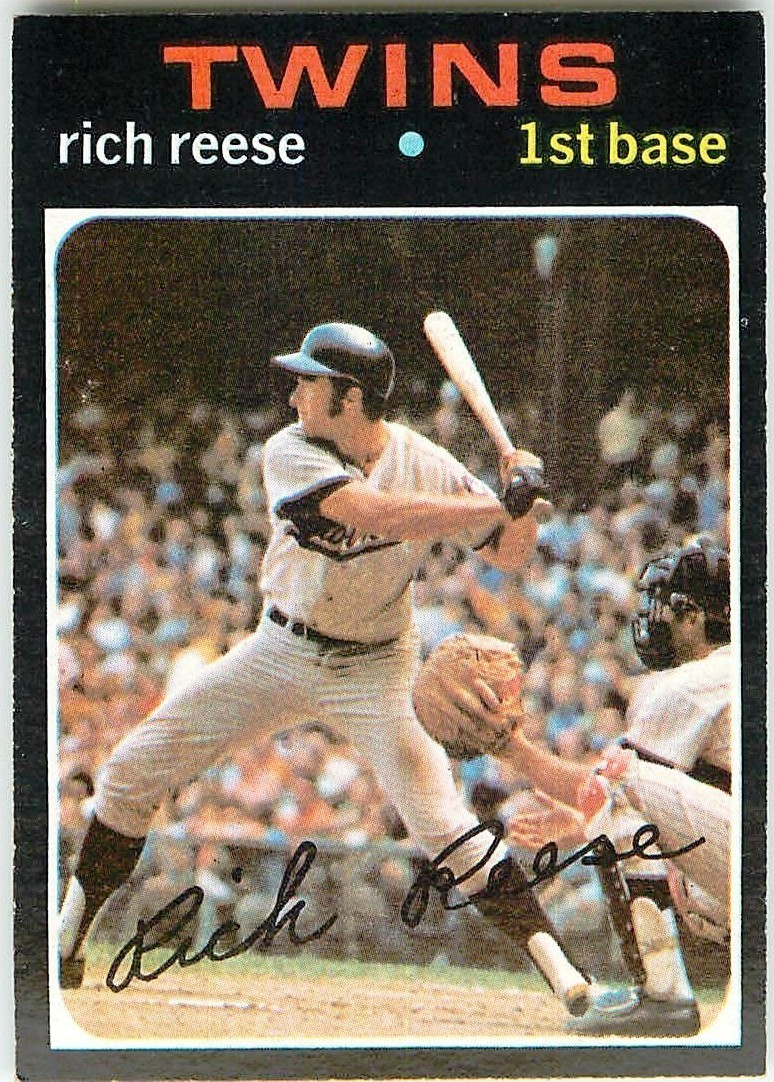
For us little baseball card fiends, acquiring the Rich Reese 1971 card in a pack that summer was a clear occasion for going orgasmic. Going that crazy over a guy who was a 1-2 season flash-in-the-pan* is a clear indication of the state of the baseball card industry in the early '70s. All I remember are the knock-down, drag-out trade negotiations for this Twins favorite between neighborhood boys, to wit: "You can have 2 of my Charlie Manuals and 1Leo Cardenas for your Reese...deal...??"
*Sorry for that last comment, old-timers...Rich, a heckuva man, but he never did fulfill the early promise that made future all-starCraig Nettlesexpendable as a Twins prospect.
Topps had finally been challenged as the industry leader in 1967 by Marvin Miller and the MLB Players Association for increased royalties (see Classic Twins post with legendary Oliva / Killebrew cards). Action shots - AND current stock photos - were finally being updated after the players' mass refusal to have their photographs taken anew. That, plus the black border format, made the '71 set such a hit with card collectors.
Otherwise, Reese had mass popularity with Twins fans, not in small part for ending Oriole pitcher Dave McNally's 1969 winning streak on Aug. 3, 1969 ("Baseball In Minnesota," story link; BBRef game box).
For all you cardboard stalkers who value such commodities, the entire '71 set is up for auction today on Ebay for a mere $2,000 starting bid. Walking around money for the wealthy gent!
As our Hall of Fame broadcaster Herb used to say it"
This is the latest in a series honoring the late, great Harmon Killebrew, who died on May 17, 2011.
NOTE: eventually, all killers end up with their mug shot on the post office wall, or in the newspaper sports section .
I recently came upon this 51 year-old clipping, found in the subterranean archives at Classic Twins. Though incomplete, it was found on the back of an AP photo and news story of Warren Spahn, celebrating his 300th win. Its central figure is the dominant icon in Minnesota Twins history, and it's scant detail allows a glimpse at one of the few instances in which he was the receiver of something besides glowing endorsement. That it occured as it did could be attributed to the fact that he had only two full seasons under his belt, and was earning his stripes as a 25 year-old star for the fledgling '61Twins. Of course, it's happening in the media capital of the world helped make it water cooler fodder around the country. That criticism alone made it absorbing for me - a lifelong citizen of Twins Territory.
It was the last time the Twins would play in New York during the 1961 season. In a deflating series, the Twins lost four games that weekend to the eventual World Champs; the last three were by one run. The game in focus was the first of a Sunday doubleheader, which the Twins lost in extra innings on a fielding decision by Harmon Killebrew.
The Game TheAug. 6, 1961 box at BBRef is a fine stop to catch the sequence of events. In short: right hander Ray “Old Blue” Moore was pitching for the Twins in the bottom of the 15th inning, the game tied at 6 each. The Yankees had loaded the bases for Yogi Berra with one out, following a walk to Mickey Mantle. The eventual Hall of Fame catcher slapped a grounder at fellow future Hall inductee Killebrew at first. The conventional play would have had him throwing home to cut off the winning run (Bobby Richardson).
The game record at BBRef says Killebrew, instead, chose to go for the inning-ending double play. It is likely he factored the old-timer Berra into the split-second decision; the left fielder that day was playing his 1,927th game since 1946, the majority of which he played as a catcher. But The Baseball Gods made Killebrew pay for that...his throw to shortstop Zoilo Versalles forced out Mickey Mantle, but the gamer Berra wrested every bit of energy he could from his 36 year-old legs to beat the return throw. Richardson scored the winning run. The Bombers basked in their accustomed glow while the upstarts from Minnesota limped down the coast to begin a weekday series in Boston.
Killebrew with The Mick, Jim Lemon and Roger Maris at Yankee Stadium,
in August of 1961. I'm getting a Mount Rushmore effect!
In the process, it unleashed the Monday morning quarterbacks of the press, questioning Killebrew’s “wrong play.” The game and series helped propel New York to its winningest month that season, and dropped Minnesota to 25 games back of the Evil Empire. It was the “TC” boys sixth straight loss. Yes, for Twins fans accustomed to the Yankees seemingly endless domination in the 2000s, nothing much has changed under the sun in 50 years (1987 and 1991 notwithstanding...). The discussion lasted into the next weekend, at least, when the Spahn photo was published in the Minneapolis Star.
In Case You Were Wondering...
Killebrew's 1961 Fielding / Lifetime Statistics As First Baseman
Generated 2/18/2012. Rtot: total zone fielding above average; RF/9: range factor per 9 innings RF/G: range factor per game. You are encouraged to match like-colored columns for comparison. Big chart! Try clicking on "original table" if partially obscured.
The "lg" prefixes denote league averages for the same sets of criterion. These stats seem to suggest the idea that while Killebrew had average to poor range; on the other hand, he also made relatively few errors, was sure handed with the balls he could reach, and probably compensated for his deficits with good positioning the longer he was in the league.
The statistics show what we already knew by the eyeball test: Killebrew’s record as a fielder in 1961 and for his career confirms he was sub par in range (as compared to the league’s other first basemen) and foot speed. BBref and Fangraph's are in accord in assigning him a TZ(total zone) of 1 in 1961, which places him in the "extremely average/low average" in that oh-so-convoluted-yet-encompassing fielding construct. And I while I wasn’t around in ’61 (only being familiar with the Harmon of the late ‘60s and early ‘70s), it’s hard to imagine he’d been Juan Pierre-like in foot speed ten years earlier. Quite the opposite; think of a latter-day Benjie Molina (whom, it has been said, runs “like he’s got a bear on his back”). I recall seeing Harmon with binoculars, during a game in the early '70s; the image of him sitting on the dugout steps, eating potato chips is etched upon my mind. That and that vicious swing of his.
Suffice it to say, while he was an exceptional athlete with superior throwing arm strength, he was sub par in those other, essential attributes.
Doing what comes naturally: Harmon being harmful on the Senators and catcher Gene Green, 1961 (Sports Illustrated Archive Photo). I can watch video of him regularly from the '60s and still feel awe at how hard he swung. Paul Bunyan indeed.
OK, I'm A Homer, But...
While there was no mistaking Harmon’s role as Minnesota's slugger extraordinaire, there is that other issue which has been part of the Killebrew story – his defensive position in the field. Killebrew played 119 games at first and 65 at third in 1961. Then, he was shuttled, more or less continuously during the 1960’s, between third, first, and left field. The only exception to this was 1967, when he played160 games at first. After ’61, Harmon didn’t play first at all (save for 4 games in ’62) until 1965, when Manager Sam Mele penciled him in for 72 at first, and 44 at third. The presence of slick fielding Vic Power on those early Twins teams, Don Mincher in mid-decade, and Rich Reese at the end of the 1960’s made it incumbent on Killebrew to move over to help other teammates find a defensive position, a stronger glove, or to add another strong bat to the lineup.
The point of this filibuster, you ask? The constant jockeying between positions had to affect his fielding instincts for the worse. Whether it’s licking envelopes, yelling at office subordinates, or driving a fork truck, it’s hard to gain the rhythm and instincts to be effective at what you do without the constant reps, the daily security of routine. Little things aren't so automatic, like positioning for certain game situations, or, say, choosing the best percentage play to get a putout.
Athletes are notorious creatures of habit. The Nick Puntos of the world, who can thrive defensively without positional security, are rare animals. Here was Harmon Killebrew, the dominant power hitter of his team and of the entire decade of the 1960’s moving around the diamond for the betterment of his team – It would be unthinkable to ask Albert Pujols to find another slot out of respect for Kendrys Morales and his glovework now in 2012. Not that Pujols has ever been compared to a Dick "Dr. Strangeglove" Stuart as a fielder.
No debate here. Harmon gets a posthumous pardon for his error in judgment.
If it was good enough for Herb Carneal, so it goes for me: "So long, everybody." - TT
"Oliva's got real quick hands, like Stan Musial, and he's got bat control like Willie Mays. Tony always gets a piece of the ball - like nobody I've ever seen."
The National Baseball Hall Of Fame announced on Monday the voting result of its Veteran's Committee, in honoring the "Golden Era" stars of the 1947-72 period. Long-overdue recognition finally awarded Ron Santo. The former Cubs third baseman was among the greatest players of the modern era, and his choice was entirely fitting. I join the chorus of others wishing he had been elected long before he passed away just over one year ago.
Q: Who was the best hitter you ever faced?
"Tony Oliva. Because, he could hit any pitch, anywhere. He did not have a weakness." - Hall of FamerJim "Catfish" Hunter, Baseball Digest, Aug., 1992
Pre-injury, Tony Oliva was a
multithreat, all-round player.
He was widely regarded as
a prodigy in his first, spectacular
seasons.
As I am a long-time, ardent fan of both Jim Kaat and Tony Oliva, I had already concluded that the result would not be to my liking well before the voting took place. Understand, my initial infatuation with baseball is due, in no small part, to the fabulous Twins teams of the late 1960's, when I was a tyke. These teams had rosters filled with lyrical, alliterative names like Rich Reese, "Pepe" Tovar, Leo Cardenas, Rod Carew, Jim Perry, and, of course, the late, great, Harmon Killebrew. These names, especially when rendered over the radio by announcing great Herb Carneal (1965 All Star Game audio link), were as much a part of my childhood summers as the buzzing cicadas, Dairy Queen shops and cornfields surrounding my small town in south-central Minnesota. The drive from my home to Met Stadium in suburban Bloomington, Minnesota was a short one, maybe 35, 40 minutes. I looked forward to pregame batting practice in that erector-set of a ballpark. It used to be farmland, cornfields too. Once inside the ballpark, you'd see the expanse of green, with those Twins players looking like giants, or mythical gods to my small eyes. I marveled at Oliva taking batting practice in his prime, before knee injuries and age took their toll. He could spray the ball anywhere. The first game I can recall attending was actually a Met Stadium doubleheader against the defending champion Detroit Tigers (July 29, 1969, BBRef Box) in which Tony, The Killer and Carew each hit homers. A nice way to start as a fan, I think you'd agree...
"He was as good as any hitter of his time...Better."
I knew that the Hall's voting board probably realized its oversight in not selecting Santo, or Gil Hodges long ago. The "Old Timers" Committee was revamped in 2001 to help correct situations such as this. I had already digested the opinions of Aaron Gleeman from a 2005 post, in which he basically dismantles the notion of Oliva as a viable candidate from purely a statistical standpoint. A truly admirable piece of writing, and analysis - there's a reason why Aaron's baseball opinions are so respected. His conclusion: many others with stats similar to Oliva's are NOT in the Hall, and others - in his view, Dick Allen - are more deserving. When you make adjustments to Allen's length of career to approximate Olivas (total at bats, games played), as Gleeman did, you definitely get the impression that Allen was the better, more valuable player.
Sept. 1, 1969 (BBRef box), : was there ever a more perfect image of extension & balance?
as being similar, complete hitters, and also because they hit left handed.
Ahem! While not trying to place myself in the position of arguing the candidacy of Oliva over Allen, I donot find it a stretch to say that Oliva was, indeed, the better player over their first 8 seasons (which ran concurrent, starting in 1964, when they each won the Rookie of The Year Awards in their respective leagues). Oliva, at the plate, running the bases, tracking flyballs, throwing out baserunners, being a buoyant presence in the clubhouse, made the Twins a better team than did the divisive Allen for his Phillies, Cardinals, Dodgers, White Sox, the Phillies again, Athletics...am I forgetting any there? In any event, you get the point. Dick "Don't Call Me Richie" Allen was a great, albeit flawed performer. Even though he was Elizabeth Taylor* in cleats, jumping from team to team...
*or Madonna, Christina Aguilera, Jennifer Anniston, for you younger kids, on the Nocturnal All-Star Team of Love
"...The guy I watched was Tony-O...When I got to the big leagues, people assumed that Harmon Killebrew must have been my favorite player as a kid. But I always focused on watching Tony swing the bat and hit the ball to all fields."
Bear in mind also that this was the period of great rightfielders like Henry Aaron, Roberto Clemente, Frank Robinson...pretty easy to get lost in the shuffle. Then add to this picture the fact that Oliva played in small market Minneapolis-St.Paul. Barry Larkin also has the same dilemma as a Hall of Fame candidate, playing his whole career in Cincinnati. Gleeman's picture is incomplete, as he apparently never sawOliva in his prime. You can make the numbers say what you want - they do matter. But you are remiss in not weighing the opinion of people who saw and played against him. His contemporaries. That should be factored for any other eligible candidate, for that matter. Their word has to count for something. For without the anecdotal, eyewitness comments of his peers, you only get a sterile, one-dimensional, statistical view of the player. I think their comments in boldtype speak volumes.
Minneapolis Star Tribune photo: Opening Night, Oakland vs Twins April 6, 1973
Put it this way: do you see similar comments in print about Ron Santo being "the best third baseman"? Or best hitter, baserunner, fielder, etc.? Not really. At least, not that I'm aware of...this isn't to say Santo wasn't a great player. You'll notice they were saying those things for and about Tony...and I'm merely stating that Oliva deserves a nod of respect, or consideration when people speak of the elite players of his time, though the excellence of his play is fading from the collective memory; the legion of sportswriters, scouts, and players who witnessed Oliva in his time are replaced by a new generation unfamiliar with him, and puzzled by the buzz over a fellow with "only" 220 homers and .304 lifetime average.
Check Tony's first, excellent years in the table. Pitchers in the 1960's were throwing downhill off a 15-inch high mound (10" today). That was just crazy! No wonder nobody was scoring or going yard very much! It was a notorious pitching-dominated era, as countless others have pointed out. He yet compiled a marvelous power/speed profile during a challenging period:
Ask yourself: had Tony's two second-place MVP finishes been firsts instead, what would that have done for his HOF chances? BOLDFACE numbers denote league-leading totals.
MinnPost'sSteve Aschburner's take on the "Cuban Cruncher," as Linkugel and Pappas refer to him below, makes an intriguing point. He correctly stated that Oliva bested Bill Mazeroski, Orlando Cepeda, Bruce Sutter and Jim Rice consistently (often decisively) in the voting by the Hall Of Fame committee during his initial candidacy years (1982-1996). Ironically, each has leapfrogged Tony, and have been inducted in the years since he went off the main ballot. His argument, if I may paraphrase it, appears to be "if them, why not Tony?"
Batting against the White Sox, 1971, Met Stadium
"Oliva, not [Jose] Canseco, is the greatest Cuban hitter who ever lived."
While interesting, I find problems with Aschburner's logic: it can be used to justify a lot of bador illogical choices. I think players like Tony, Roger Maris, Don Mattingly, and Garry Templetonwere Hall of Fame talents who've been given scrutiny by voters in recent years, and who lit up their leagues for an abbreviated time. And therein is the distinction I draw. At some point, we have to pay attention to the Hall's 10 year minimum standard of high calibre play. If we are to have this hallowed museum where we profess to honor only the greats, only the people that fit the criterion, then we have to follow through. Tony and these guys don't fit in.
No, it's not what people want to hear and read. Not me. Not Steve Aschburner. Certainly not Tony; while being at his core a high-spirited, kind man, he has also expressed frustration with the voting process. He wants acknowledgement as being one of the greatest players of all time, which is natural. Who can blame him? Players tend to be less inclined to use strict HOF guidelines to gauge their worth. Again, all the quotes I'm supplying attest to his talent. He brought the goods, the numbers, the greatness...but it was for onlyeight years, if we are being honest with ourselves. While we could quibble over including his 1973 season to tack on another year for consideration (when he came back after recuping for most of '72), even that year is nowhere near Tony's performance of his 1964-1971 period.
1970: with daughter Anita, Fathers - Kids game at Metropolitan Stadium. Minnie Mendoza (center) and Jim Kaat (left, head on hands) are visible.
"He was one of the best hitters I ever saw. And it was not only what he hit, but when. He always seemed to be getting big hits."
"You mean, Tony Oliva's not in the Hall of Fame yet?"
So, were left with this: Tony and Jim Kaat will have to wait another three years before they can come up again in rotation for the voters to consider. Perhaps Oliva will have to make peace, as will his fans, with the prospect that he will have even less backing the next time, in 2014, and will remain on the outside looking in. He'll be graceful, no doubt. And we'll do well to make do, remembering the excitement, joy, and memory of our very own, Tony-O.
As our Hall of Fame Broadcaster Herb Carneal ended his postgame, I say to you:
Further proof that the Met Stadium area dining experience was at once rural / bourgeois & cosmopolitan.
For you out-of-towner, city slickers this VERY regional set of ads adorning and augmenting Rich Reese must strike you as disconcerting, if not charming or quaint. And no, I do not recall seeingbovine herds strolling through the old Met during our sojourns there in the 1960's and '70s.
To Quote Hall Of Fame broadcaster Herb Carneal : "So long, everybody!" - TT
Yes, I know there's a rather big Vikings NFC Championship game today, but...here's my first Twins blog! All shiny and buffed for your enjoyment and dining pleasure!
The Twinkler has been wondering what to delve into with this new blog site "Classic Twins." Too many subjects and so little time! Hope you like this image: pinch-hitter extraordinaire Rich Reesefrozen in time, from the 1969 Twins Yearbook. "GOT MILK?"
I suppose the first things I'll want to touch on in this year of our Lord 2010 is the Twins new Target Ballpark. And then, perhaps Joe Mauer, his sideburns and monotone delivery during milk commercials. And so on...
Mostly, this blog will be a disgustingly nostalgic look at Minnesota Twins past. Be it the exotic, no-hands fielding style of Willie Norwood, to the eccentric, pagan-like bat sniffing rituals of Carlos Gomez, it'll be a lighthearted look at all things Twins. With an occasional rant sometimes!
I'd love it if you left comments, clean ones. But if swearing is part of your lifestyle, try to keep it limited to phrases such as "ah shoot," or "gold dang it anyhow," or perhaps "look at those knockers!," if you're really feeling nuts. I get to choose whatever comments go up on the blog, in any event.
Speaking of poor Rich Reese, having to milk all those cows from Sleepy Eye (Minn.)- you'd think they'd have already bottled all that milk for all the patrons at the old Met Stadium, the pressure on that man! Bad enough he was the last out in Catfish Hunter's perfect game in '68, and also the last batter faced by Nolan Ryan, becoming the record breaking 383rd strikeout in the latter's final game of the historic 1973 season.