Check Out This Post!

Harmon Killebrew On David Letterman!?

With the appearance of Joe Mauer last week on Jimmy Fallon, I was reminded of another episode of a famous Twin who appeared on late ni...

Showing posts with label Marvin Miller. Show all posts

Saturday, April 7, 2012

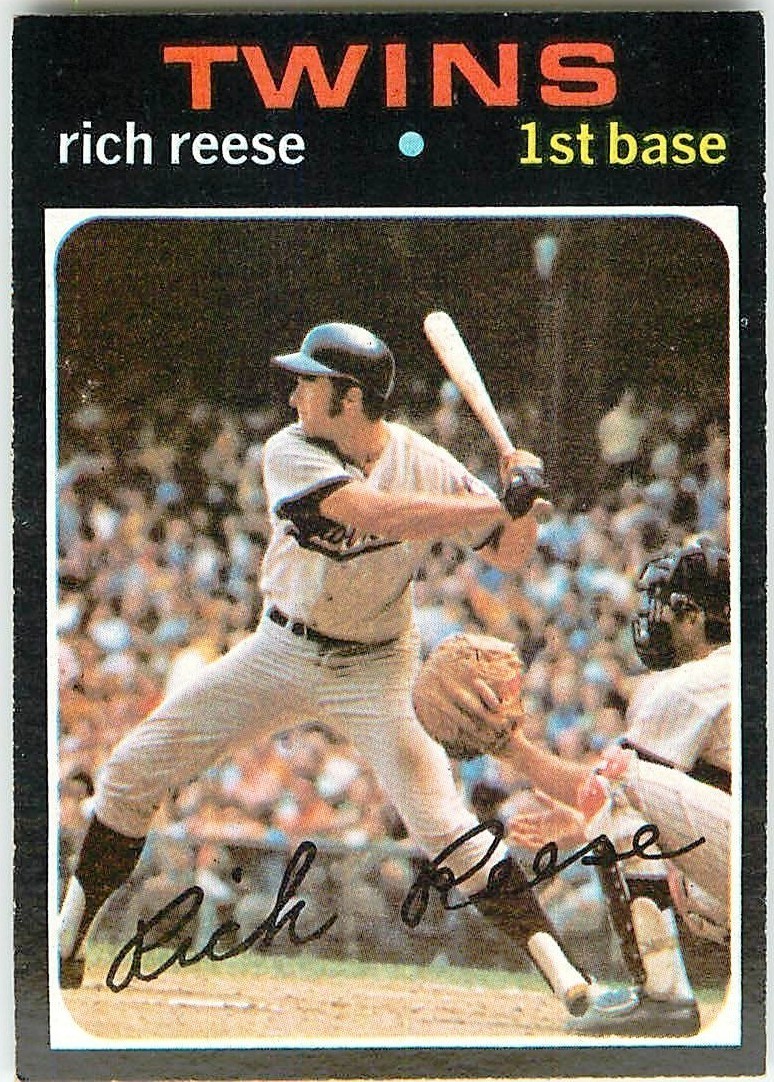
Twins Card Spotlight: Rich Reese's 1971 Topps #349


Rich:  A SIDE BURN SUPERSTAR


For us little baseball card fiends, acquiring the Rich Reese 1971 card in a pack that summer was a clear occasion for going orgasmic. Going that  crazy over a guy who was a 1-2 season flash-in-the-pan* is a clear indication of the state of the baseball card industry in the early '70s.  All I remember are the knock-down, drag-out trade negotiations for this Twins favorite between neighborhood boys, to wit: "You can have 2 of my Charlie Manuals and 1 Leo Cardenas  for your Reese...deal...??"

*Sorry for that last comment, old-timers...Rich, a heckuva man, but he never did fulfill the early promise that made future all-star Craig Nettles expendable as a Twins prospect. 
               
Topps had finally been challenged as the industry leader in 1967 by Marvin Miller and the MLB Players Association for increased royalties (see Classic Twins post with legendary Oliva / Killebrew cards). Action shots - AND current stock photos - were finally being updated after the players' mass refusal to have their photographs taken anew. That, plus the black border format, made the '71 set such a hit with card collectors.


Otherwise, Reese had mass popularity with Twins fans, not in small part for ending Oriole pitcher Dave McNally's 1969 winning streak on Aug. 3, 1969 ("Baseball In Minnesota," story link; BBRef game box).
Reese with kids, "The Big A" in Anaheim, CA
Circa 1969 Coutesy of Padre Steve
For all you cardboard stalkers who value such commodities, the entire '71 set is up for auction today on Ebay for a mere $2,000 starting bid. Walking around money for the wealthy gent!

As our Hall of Fame broadcaster Herb used to say it"

Friday, November 4, 2011

1976: The Twins Bill Campbell As Baseball's Original Free Agent Signee Part Two

[Updated, April 14, 2013 - updated with pdf doc, 12/2/13 - 
Part One of this Bill Campbell saga can be found at THIS LINK]

Thirty-five years ago today, November 4, 1976, was a momentous day in baseball history. It was the day that Major League team owners bid on the first group of free agents in the "Reentry Draft."This draft was distinguished from free agency statuses granted to Andy Messersmith and Dave McNally cases, as these players were stand-alone "test cases" used by MLBPA head Marvin Miller to create the environment that could be used to justify a structured draft that the Major League teams would have to abide.  I view the list (below), and have to marvel at the top flight pool of future Hall of Famers (Reggie Jackson, Rollie Fingers) and All-Stars (Bobby Grich, et. al.). Minnesota's Bill "Soupy" Campbell (Classic Twins post on Soupy) and Eric Soderholm* were in that group.

The Sporting News called it a "gold rush," but it was more a wild n' wooly cattle drive of the game's top stars to market, to continue the Wild West motif that was the 1970's. And our very own Bill was numero uno - the FIRST official signing under the new agreement between Marvin Miller, the Players Association, and Major League Baseball. It was a formal end to the system known as "The Reserve Clause." Campbell was the only Twin to have served actively in the Viet Nam war, as a radio operator.


*Great interview with Soderholm at Baseball Alamanac. Sheds light on difficulty of squaring off against Calvin Griffith in contract negotiations. Recalls comment Griffith made to Pedro Ramos during contract squabble: "If you don't like the offer, you can go back to Cuba and cut sugar cane" (Google Books link).


Calvin Griffith
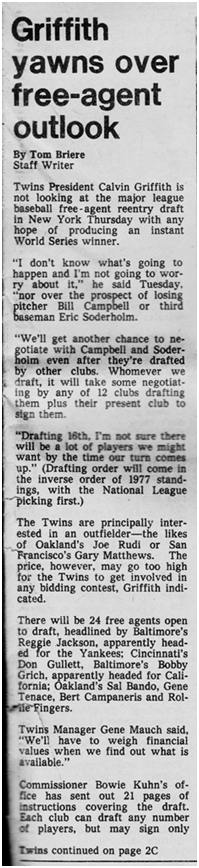
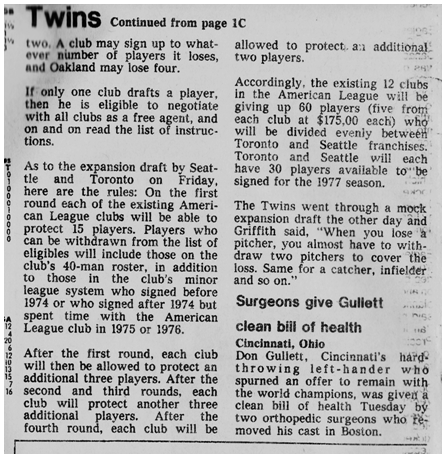
The next clip is  from the Minneapolis Tribune Sports section of the previous day (11/3/76) . Tom Briere's piece allows an insight into the mindset of then-Twins President Calvin Griffith* on the eve of that momentous draft. Cal comes across today as curiously detached, and stand-offish; you have to wonder if he truly understood the weakness of his bargaining power in this new format:

 
 *Link to my "Meeting Calvin" post. The modern psychology of players, media relations, economics...it was getting apparent to the Twins hierarchy that the game was passing Griffith by. They would appoint a 4-man management team that year, ease him out of the team presidency.


...And who would have guessed, with that laissez-faire attitude, this would result?


THE SPORTING NEWS, NOV. 20, 1976

Of course, the '76 draft proved to be highly damaging to the Twin's chances to seriously contend for the pennant in 1977, when the club fielded an offensive juggernaut (batting stats) that was bereft of quality starting pitching. The 1977 draft would deal another more serious blow to the team's depth of talent , with the defections of Lyman Bostock and Larry Hisle. Sans them, the Twins would not factor in a pennant race until another turnover of youth, the Puckett-Hrbek-Gaetti-Viola Twins of the 1980's, would surface and win it all ten years later.

For those of you interested, here are the results of that draft day as described in the Jan. 1, 1977 edition of The Sporting News (again,  Jack Lang's article):
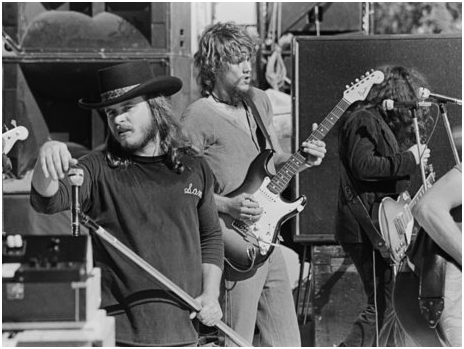

Only two day's earlier, Georgia Governor Jimmy Carter had defeated imcumbent President Gerald R. Ford in the general elections. The country was moving on after Watergate, Vietnam, the '60s, and the heartbreak that came with them. Undoubtedly, the old order of power was "gone with the wind," as Ronnie Van Zant* sang - and now, so too was The Reserve Clause in baseball that had bound players to their teams.  The freed bird flew, and the Twins had lost their uber-closer. He would go on to win the Rolaids Relief Pitcher of The Year (again) with Boston in /77, as well as the The Sporting News AL Fireman of The Year, and be selected to the AL All-Star Team.

*link: Van Zant was a big-time baseball fan, an 
enthusiastic ballplayer as a boy in Jacksonville, FLA.

Overall, this episode in team history set an organizational operating template that has lasted into the present day. More often than not, the Twins are still one of the clubs that draft, develop and then lose top-flight players long before their talents have regressed. Exits by Johan Santana, Torii Hunter, and now (possibly) Michael Cuddyer, Jason Kubel and Joe Nathan in 2011 are bitter reminders that teams in markets like Minneapolis-St. Paul have a fairly small window of time for contending. 

It's paradoxical that while baseball has changed so much in the last 35 years, one thing is still very much the same - the very democratic and rewarding institution of free agency has also made it very heartbreaking for loyal fans like ours in Minnesota to see the Twin's best and brightest move on to the Bostons and Californias of the world.

As our buddy at the mic, Herbie Carneal,
would say: "So long, everybody." - TT

P.S. - check out this newspaper pdf re: Campbell's 1977 pitching workload

1977 Topps Baseball Card.
Undoubtedly, the airbrushing
over the Twins logo was just
another way Twins fans had 
salt rubbed into their wounds..

Thursday, March 31, 2011

Bill Campbell -Funky Disco Era Reliever: Pre-free Agency Part One


[EDITED July 19, 2014 - the sister post to this piece is at this link, following Campbell's road to becoming the first-ever free agent under the new bargaining agreement in the post-Dave McNally / Andy Messersmith era]


So much of the spring training discussion of the 2011 Minnesota Twins has revolved around their bullpen, specifically the interesting closing tandem of Joe Nathan and Matt Capps.  The early blueprint has Capps shifting into the closer's role when Nathan has already pitched consecutive games.  This is a fortunate luxury that will hopefully pay dividends for Nathan's career as he seeks to regain his form as perhaps the greatest closer in Twins history. That's basically why they gave up top catching prospect, Wilson Ramos, to have somebody like Capps available to pitch that closer inning at the end of games while Nathan recovers. But there was a time in Twins history when their closers pitched far more innings at the end of games - and in fact, functioned essentially as starting pitchers on a smaller scale! Enter the Twin pitcher voted the Rolaids Relief Man of 1976 as Exhibit A John Swol had a fine summary of Bill and recorded an interview you can playback at his Twins Trivia site.

There weren't too many relief pitchers better than Bill "Soupy" Campbell in the mid-1970's. He became the Twins first free agent to leave Calvin Griffith's plantation, on November 6, 1976. Griffith was an owner from the old school, tightfisted, and he battled players down to the last nickel during contract negotiations. Campbell was definitely in that era's category of excellent relief pitchers, a list including Sparky Lyle, Goose Gossage, Bruce Sutter and Kent Tekulve. His 1976 season was astounding...and just look at his multi-inning appearances...it boggles the mind now!  However, you should first sing along to Dylan's 1976 "Maggie's Farm" Video beforehand, substituting "Calvin" for "Maggie" in the chorus!

In that Bicentennial summer, Bill Campbell could brag about his:
  • 17 wins in relief
  • 20 saves
  • 167 innings pitched
  • Of his 78 appearances, only 13 merely lasted 1 inning.
  • 56 appearances were multi-inning games
  • 23 of his appearances were 3 innings or more
  • 6 times he pitched 5 innings or more
  • Surprisingly, he only blew 7 saves all year, after pitching all those innings
  • Earned a 7th place finish in the Cy Young voting, 8th place in the MVP voting
  • Grew a fu that Charles "Old Hoss" Radbourne would have envied

This guy was money in the bank when he came into a game!  Funny, how you never really hear his name mentioned among the great Twins relievers much at all.  But I remember him quite well, those long arms whipping around from behind his body, making his ball hard to pick up for the batter.  He moved on to the Red Sox the next season, before the Players Union installed a controlled trickle
of free agents:
"The now-powerful players' union negotiated it [the reserve clause] out of existence in the 1970s, setting up the lucrative free agent era. Union head Marvin Miller, who knew that universal free agency would be just as bad as having no free agency, negotiated a system based on service time for potential free agents." - from Answers.Com
In short, instead of letting everybody into the pool at the end of their contract, Miller was wise to create a trickle flow of free agents.  The lower supply would serve to increase the individual take in player contracts.  Too many high level players would dilute the money pool, so the control was set up.  But before that, his agent, Larue Harcourt (see photo), negotiated Bill's big pot of gold - 5 years, $1M - with the BoSox (why, oh why, do people say these agent / lawyers have sleazy names?). In any event, his exodus from the Twins wasn't preordained, and hi staying in Minnesota received a lot of conjecture during and after the season (see page one of this feature from The Sporting News (Oct. 16, 1976) and also the conclusion to the piece on page two.
A face that would have served him well as a
      bit actor in a western barroom scene.
 Appropriate, as 1970's baseball was a lot like ...
                    well, the wild, wild west. 

By today's rules, a player only becomes eligible for free agency after 6 years of inclusion on the team's 40 man roster. Under that format, Campbell wouldn't have become eligible to bolt until after the 1978 season. As it was, within three years, the Twins lost Campbell, Bert Blyleven (his trade preempting his all-but-certain free agency), Larry Hisle (team's top slugger), Lyman Bostock (Twins best pure hitter after Carew), Eric Soderholm (starting third baseman), and Dave Goltz (staff ace after Blyleven).  It was all sickening stuff for Twins fans to stomach - the exodus from the shantytown and cotton field that our (now-lovely) Twins Territory was. It made it ever more difficult for the club to compete in the late 1970's...gone was their chance to win another pennant (or two) in those years.


        Soupy's career ended with
        the Montreal Expos in
       1987, after he pitched in 7
       games at age 38.

As Herb would say: "...and the count rides along..."
TT

Friday, December 31, 2010

Willie, Mickey, Harmon & "The Marv": How Marvin Miller Altered The 1968 Topps Set

Mays & Mantle were past their peak / ready to retire,
but Harmon's finest hours were yet to come, post '68.
Chico couldn't pinch himself hard enough: "How'd I get in a
picture with these guys?" Latin rhythms, indeed...

Ah, the serendipitous, weird and woolly circumstances of the origins of certain Topps baseball cards.  Cards #480 and #490 from that wild and historic summer could also be titled "Chico and The Men," or "Three Stars En Fuego," respectively (to mirror the incendiary, messy themes in matters political and cultural).

The latter, as any All-Star game buff should know, alludes to the near-Death Valley conditions at roasty, toasty Busch Stadium in St. Louis at the 1966 Game, where these two portraits originated.  In the tilt that saw the last AS Game appearance of Sandy Koufax, spectators were being transported out on stretchers owing to heat exhaustion. It may be apocryphal, but it's said that Joe Torre melted into the turf that day, not to be unearthed until 1969, during which time he had been traded to St. Louis from the Atlanta Braves.

Twin's catcher Earl Battey picks up gear, disconsolately
leaves field after Maury Wills' hit drives home 
Tim McCarver with the 1966 game winner.
Why the use of two-year old shots, like the above All-Star game shots of Harmon Killebrew and Tony Oliva with other stars of the game? Marvin Miller, the newly appointed head of the Major League Baseball Players Association, had urged the players to reject having their pictures taken anew in 1967, as a means of gaining leverage against the Topps company. That boycott is documented most excellently here at this SABR Cards post.  Topps had signed players as minor leaguers for the extravagant fee of $5, which locked them into binding contracts paying only $125 a year once they became major leaguers.

Those gravy-sucking pigs!

Marvin Miller: a cool cucumber - even while being told by
Joel Shorin what he could do with his proposal.

 But beyond that, Miller mostly wanted the union to get a lucrative slice of the profits from Topps, with an eye to increasing pensions, etc. Upon hearing Miller's pitch, Topps President Joel Shorin simply responded "I do not see the muscle in your position." How power and monopolies corrupt even the best of us! But after the players banded together, Miller's ploy worked. As described at Dean's Baseball Cards:

 "Shorin eventually caved to Miller’s demands.  The newly negotiated contract required Topps to pay each player $250 (double the previous $125) per year and, more importantly, Topps would pay the Players’ Association 8% of sales up to $4 million and another 10% after that.  The way that Topps compensated the players had changed forever..."


No, this wasn't an attempt to showcase
new Twin Ron Perranoski's 'do. Topps
just didn't have any thing else to offer,
following the relievers trade from the
Dodgers in exchange for Zoilo Versalles
and Mudcat Grant. At least it was better
than all those putrid black cap shots...

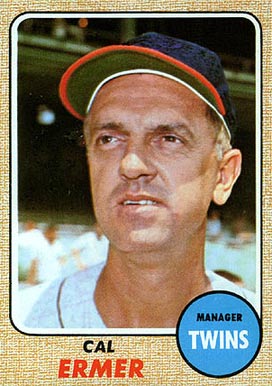
...such as that used for Manager
Cal Ermer and scores of players.
Topps had to scramble with this

one that seems to picture him in his
former employ (from the late '50's
no less) of the Detroit Tigers.


(Special thanks to Twinscards.com for letting me plunder and pillage their vintage Perranoski & Ermer stock. And to myself for taking the time and extraordinary human effort to scan and display featured cards #480 & #490 from my own arsenal)So, say what you want about Miller increasing greed, avarice, his later disruption of team rosters with the movement of free agents, causing the downfall of the Soviet Union, or creating mass halitosis through the availability of more Red Man Chewing tobacco in locker rooms - the 1968 Topps set owes him some credit for indirectly creating some monuments to a couple of classic Minnesota Twins players.

Happy New Years - May 2011 See Your Taters Fly Far! - TT