Check Out This Post!

Harmon Killebrew On David Letterman!?

With the appearance of Joe Mauer last week on Jimmy Fallon, I was reminded of another episode of a famous Twin who appeared on late ni...

Showing posts with label Johan Santana. Show all posts

Saturday, August 4, 2018

Rule 5s & Circle Changes: Johan Santana Joins Twins Hall


The well-ballanced, Tom Seaver-styled "drop and drive" delivery-
whom Santana should have tied for career Cy Young Awards
were if not for some ridiculous voter preferences for Bartolo 
Colon and Mariano Rivera in 2005 Santana was plainly superior (see link)
Photo Credit: Steve Ellis

Johan Santana joined the elite list of all-time Twins Hall of Famers tonight, earning the exclusive blazer and a free, all expenses paid discount for a Murray's Silver Butterknife steak meal. It was a great night of Twins luminaries coming back to mesmerize Target Field, and a great acceptance speech by Santana. I completely remember my one and only Twins spring training visit in his 2000 rookie season. There wasn't much else to grab you with that team. The only other really notable development with the Twins roster heading into that year was the acquisition of Butch Huskey. Moving on...

We had gathered to watch him with the other spring squad members file into the main, Hammond complex on a sidewalk (located behind his catcher in the above frame) leading in from a side workout field. I remember turning to my brother-in-law, Mark, and gushing "There's the new rule five guy!," mindful of the mushrooming hype about him in the local, Minneapolis press dating back to the previous winter.

Baby Johan dispatches Jose Canseco, 


It would have been cool had he spent his entire career with the Twins. I was actually kind of done with him when he pushed for a trade to one of the New York clubs in late 2007. But, now in hindsight, New York...I get it. I'm only sorry they rode him into the ground with all the extra innings, higher pitch counts. 

As it was, he was a brilliant meteor, with his career years and Cy Young Awards bunched together, like the Ks on the scoreboard displays around the American League. He was the best for about four, five years running. Like Koufax. Or, Koufax-lite, at a minimum.


Comparisons aside, he'll likely never make the Hall Of Fame, but in his era, he certainly was in the discussion when the best pitchers in baseball were debated. A factoid: his career didn't take off until minor league pitching coach Bobby Cuellar taught him the circle change - echoing an earlier  circumstance in Twins history. 

In the 1983 season, then-Twins pitching coach Johnny Podres taught a struggling Frank Viola the same pitch to complement his arsenal. The result? Two Twins Cy Young Award winners, and two with the same back story. The difference being that while Viola had been a second round Twins draft pick, Santana had been acquired by the Marlins on Dec. 13, 1999 as a Rule Five pick from the Astros, and then sending him packing the same day in a trade with the Twins for Jared Camp. Camp, of course, never pitched in the Majors.

Here is some backup for me regarding Santana being robbed in 2005 Cy Young Award voting:

Stark: Picking Santana

Nov 8, 2005 Jayson StarkESPN Senior Writer Close Senior writer for ESPN.com 21 years at the Philadelphia Inquirer Author of three baseball books One of these millennia, the Los Angeles-Anaheim-California Angels were bound to have somebody win a Cy Young Award. Wouldn't you think?

"So Long, Everybody!" - Herb Carneal

Monday, March 19, 2012

The Phenoms of Minnesota Twins Past: Part IV-Carlos Gomez


HE hope I dreamed of was a dream,   Was but a dream; 
and now I wake
Exceeding comfortless, and worn, and old,
For a dream's sake.
- Christina Rossetti, "Mirage," 1879

This past Friday night, Minnesota Twins centerfielder Joe Benson made a miraculous catch off the bat of David Ortiz at the Red Sox new spring training home, Jet Blue Park in Ft. Meyers, FL. The sprinting, over-the-shoulder grab was mindful of the famous play Willie Mays made in the 1954 World series. 

For this fan, it was notable in two other ways:
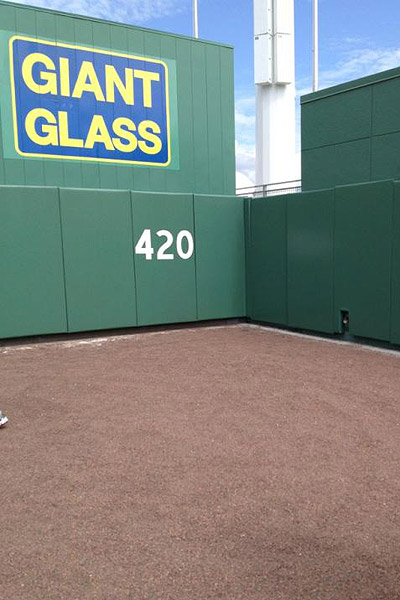
it was made in the deep, centerfield "triangle" area (see photo), which is a near duplicate of Boston's Fenway Park-famous for Twins fans as it was there that Torii Hunter broke his ankle in the same region (A. Gleeman photo) in a regular season game in 2005, thus ending the Twins post-season hopes.

Also, Benson's grab is similar to those made by another Twin player of recent vintage, possessing a comparable skillset: Carlos Gomez. Benson at times makes you believe he could cover the entire outfield by himself with his speed and arm strength. Like Gomez. The flip side: Benson is magnetically drawn to striking out like the murderous Jason was to girls in college sorority houses. Over his minor league career to date, he's whiffed an average of once every four trips to the plate (565 k's in 2,373 plate appearances (24%). Again, very like Gomez....and we hope against hope that his fate, at age 24, doesn't become another mirage, a la Mr. Carlos "Go-Go" Gomez.

2008 Upper Deck card: behold,
bunting technique perfection


The Twins famous trade of Johan Santana on Feb. 2, 2008 netted them Gomez, Kevin Mulvey, Deolis Guerra, and Phillip Humber. The Twins had been put in the unenviable position of paying a huge hunk of their payroll to Santana, who was destined for free agency after 2008-unless Minnesota unloaded him for the best possible offer. After multiple rumors of trade packages, smokescreens and bald-faced lies (probably) involving the Red Sox and Yankees, the only team left standing was the Mets. Brand, spankin' new Twins GM Billy Smith lost the staring match with the Mets. Now, five years on, it seems fair to judge that trade objectively.

Blogger Parker Hageman put it well recently when he compared it to Jack trading the cash cow for the proverbial handful of beans. Put another way, the Twins traded their precious ace without getting the best prospect in the Mets system (at that time, OF Fernando Martinez) or a player from their 40-man roster (Carlos Beltran, Jose Reyes or David Wright, though none from that group were included in the public discussion). The best that could be said of this collection of sprouts was that "they had potential," But in March of 2008, it appeared the Twins had acquired a budding stud in center fielder Gomez. His arrival in Minnesota couldn't have been more opportune, as he was viewed as an obvious replacement for the popular Hunter*, who had departed for Anaheim. His spring training that year showed flashes of brilliance, along with eccentric inconsistency.

*Along with Denard Span, who lost the centerfield battle in spring training...
Everything's relative. Since Leo Cardenas 

was known to lock his bats in a closet 

for not performing well, this isn't all
that odd to me... 

Spring Training-2008
Jim Souhan  (Minneapolis Star-Trib.) recorded this take on Carlos in a March 30, 2008 column.
"Ask a Twin about Gomez this spring, and the response would be a head shake and a giggle. When Justin Morneau stopped laughing, he said: "He is one of a kind. In so many ways. He can absolutely fly. He's the kind of athlete who comes along very rarely, with that speed and also having power.
"I don't think he quite knows how to use his power yet. He thinks he has to swing harder to hit it farther. Hopefully, he'll figure it out. His arm from the outfield is as good as I've ever seen, although he needs to be more accurate.
"He's a little out of control. He's 1,000 miles an hour. But when he comes to the plate, or gets on base, everybody watches."
Perhaps this passage from that same Souhan piece tells you everything you need to know about Carlos, both then and now:
"The other day in spring camp, Gomez was standing by the batting cage, waiting to hit, when someone lined a shot off the pitching screen. The ball shot back over the cage toward the backstop. Gomez took off on a dead sprint, executed a Willie Mays basket catch and held up the ball like a trophy. It was stunning and rather silly. No other player would think of doing that, and few could pull it off."
In 2008, at age 22, this is what the St. Bernard-like Gomez did in center field for the Twins:


YearGInnChPOAEDPFld%RtotRdrsRF/9RF/GlgFld%lgRF9lgRFG
20081511271.2453436984.9828173.152.95.9892.712.69
Provided by Baseball-Reference.comView Original TableGenerated 3/18/2012.

In summary, here's how he stacked up to the other CF's in the American League:
  • First in putouts  (54 more than Grady Sizemore, in same number of games)
  • First in range factor (RF/9) 3.15, with next closest: Rajai Davis, 2.92 
  • First in games played as a center fielder, 151 (tied with Sizemore) 
  • AND...first in errors as a center fielder, 8, tying with Delmon Young among outfielders
We're it not for his strong, yet inaccurate arm, Gomez could have been a hands-down Gold Glove winner, an obvious star-in-the-making. He certainly didn't lack charm for the role:


A fine, 4 for 5 night at the plate made this a memorable evening during the 2008 season. So, you see, it wasn't just his eccentricities, and fear of ghosts (see June, '08 Patrick Reusse column) that drew people to him. In small doses, he made you believe. Sorry to dredge up Telly Hughes, the King of the Cliches, for you Twins fans! 

July 26, 2009: just another day at the office for Carlos!

WARNING: for some reason, MLB videos seem to run in a loop - will need to pause the two here!

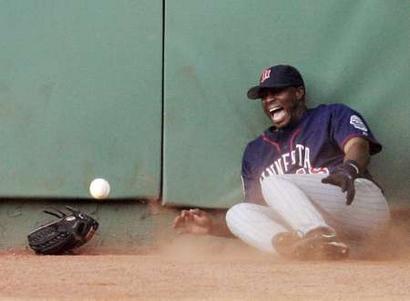
July 27, 2009 outfield injury - watch Gomez' pinwheeling, dazed, fall at the :57 mark. Carlos had mishaps, i.e, running into the centerfield wall, which gave the impression he'd been shot by a sniper. To wit: there's a vaguely Michael Richards "Kramer" aspect about this...


It has long been expressed that Gomez, if he were to concentrate on better plate coverage, he could emerge as a middle of the order hitter ("Lay off those outside pitches, ya big dummy!"). Again, it has never been a question of physical talent with him, blessed by The Baseball Gods with insane gobs of natural ability. The tantalizing thought of what he could be if he were to reign in his undisciplined nature, and make the necessary physical adjustments has vexed 3 organizations by now. Like the aforementioned Mr. Benson, he's a wind turbine, striking out 377 times in 1,678 lifetime Major League PA's - or, 22% of the time. The Twins, exasperated by Gomez' flailing, traded him to Milwaukee on Nov. 6, 2009 for shortstop J.J. Hardy (a subject I will tackle once I can gain the courage to do so).

Carlos Gomez scores winning run, Game 163, Oct. 6, 2009.
The win propelled the Twins to the ALDS against New York.
(AP Photo)
Jack Moore in his article "Should Carlos Gomez Stand Closer To The Plate?" at the Disciples of Uecker" blog addresses a fine tuning for 2012 that could be of help. Jack's opinion as a Brewers fan and baseball mind should be given credence.  At this point in his career, however, I would be hard pressed to see Carlos changing his approach with any kind of diligence.

He has the same problem Bobby Bonds (Sr.) had, and far worse: loads of offensive potential that is offset by poor pitch selection, and striking out way too much - thus negating his otherwise stellar contributions. He is a liability, therefore, to his team. Jonathan Ede piece in Media Milwaukee on March 18, 2012, concludes it is time for the Brewers to cut the cord with Carlos. I must say, he's persuasive, especially in light of the fact his comments mirror precisely the things said about the same player four springs ago. Like a lot of fans, I was a fan of his then, and I still am, with my ardent wish being he will one day turn the corner. How could you not root for a guy who left winter ball to be at the bedside of his son, afflicted with meningitis?

But then, most of us know what Burgess Meredith had to say about wishing...but I can still dream.

As our old broadcasting friend Herb Carneal closed his postgame shows:
"So long, everybody!" - TT

Friday, November 4, 2011

1976: The Twins Bill Campbell As Baseball's Original Free Agent Signee Part Two

[Updated, April 14, 2013 - updated with pdf doc, 12/2/13 - 
Part One of this Bill Campbell saga can be found at THIS LINK]

Thirty-five years ago today, November 4, 1976, was a momentous day in baseball history. It was the day that Major League team owners bid on the first group of free agents in the "Reentry Draft."This draft was distinguished from free agency statuses granted to Andy Messersmith and Dave McNally cases, as these players were stand-alone "test cases" used by MLBPA head Marvin Miller to create the environment that could be used to justify a structured draft that the Major League teams would have to abide.  I view the list (below), and have to marvel at the top flight pool of future Hall of Famers (Reggie Jackson, Rollie Fingers) and All-Stars (Bobby Grich, et. al.). Minnesota's Bill "Soupy" Campbell (Classic Twins post on Soupy) and Eric Soderholm* were in that group.

The Sporting News called it a "gold rush," but it was more a wild n' wooly cattle drive of the game's top stars to market, to continue the Wild West motif that was the 1970's. And our very own Bill was numero uno - the FIRST official signing under the new agreement between Marvin Miller, the Players Association, and Major League Baseball. It was a formal end to the system known as "The Reserve Clause." Campbell was the only Twin to have served actively in the Viet Nam war, as a radio operator.


*Great interview with Soderholm at Baseball Alamanac. Sheds light on difficulty of squaring off against Calvin Griffith in contract negotiations. Recalls comment Griffith made to Pedro Ramos during contract squabble: "If you don't like the offer, you can go back to Cuba and cut sugar cane" (Google Books link).


Calvin Griffith
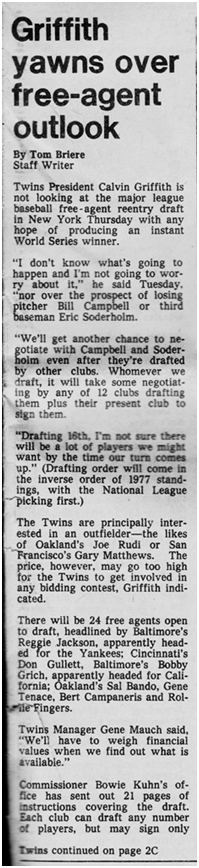
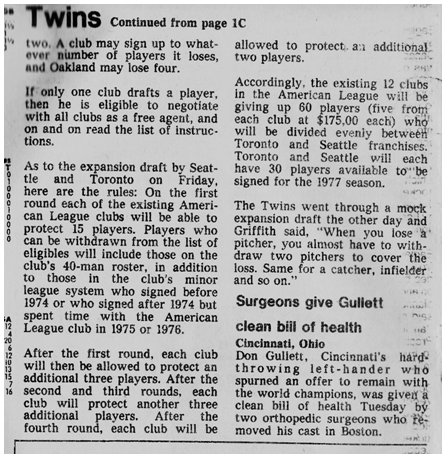
The next clip is  from the Minneapolis Tribune Sports section of the previous day (11/3/76) . Tom Briere's piece allows an insight into the mindset of then-Twins President Calvin Griffith* on the eve of that momentous draft. Cal comes across today as curiously detached, and stand-offish; you have to wonder if he truly understood the weakness of his bargaining power in this new format:

 
 *Link to my "Meeting Calvin" post. The modern psychology of players, media relations, economics...it was getting apparent to the Twins hierarchy that the game was passing Griffith by. They would appoint a 4-man management team that year, ease him out of the team presidency.


...And who would have guessed, with that laissez-faire attitude, this would result?


THE SPORTING NEWS, NOV. 20, 1976

Of course, the '76 draft proved to be highly damaging to the Twin's chances to seriously contend for the pennant in 1977, when the club fielded an offensive juggernaut (batting stats) that was bereft of quality starting pitching. The 1977 draft would deal another more serious blow to the team's depth of talent , with the defections of Lyman Bostock and Larry Hisle. Sans them, the Twins would not factor in a pennant race until another turnover of youth, the Puckett-Hrbek-Gaetti-Viola Twins of the 1980's, would surface and win it all ten years later.

For those of you interested, here are the results of that draft day as described in the Jan. 1, 1977 edition of The Sporting News (again,  Jack Lang's article):


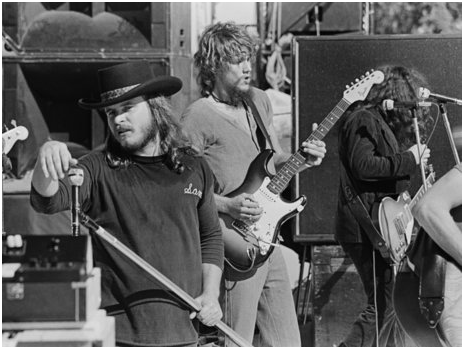
Only two day's earlier, Georgia Governor Jimmy Carter had defeated imcumbent President Gerald R. Ford in the general elections. The country was moving on after Watergate, Vietnam, the '60s, and the heartbreak that came with them. Undoubtedly, the old order of power was "gone with the wind," as Ronnie Van Zant* sang - and now, so too was The Reserve Clause in baseball that had bound players to their teams.  The freed bird flew, and the Twins had lost their uber-closer. He would go on to win the Rolaids Relief Pitcher of The Year (again) with Boston in /77, as well as the The Sporting News AL Fireman of The Year, and be selected to the AL All-Star Team.

*link: Van Zant was a big-time baseball fan, an 
enthusiastic ballplayer as a boy in Jacksonville, FLA.

Overall, this episode in team history set an organizational operating template that has lasted into the present day. More often than not, the Twins are still one of the clubs that draft, develop and then lose top-flight players long before their talents have regressed. Exits by Johan Santana, Torii Hunter, and now (possibly) Michael Cuddyer, Jason Kubel and Joe Nathan in 2011 are bitter reminders that teams in markets like Minneapolis-St. Paul have a fairly small window of time for contending. 

It's paradoxical that while baseball has changed so much in the last 35 years, one thing is still very much the same - the very democratic and rewarding institution of free agency has also made it very heartbreaking for loyal fans like ours in Minnesota to see the Twin's best and brightest move on to the Bostons and Californias of the world.

As our buddy at the mic, Herbie Carneal,
would say: "So long, everybody." - TT

P.S. - check out this newspaper pdf re: Campbell's 1977 pitching workload

1977 Topps Baseball Card.
Undoubtedly, the airbrushing
over the Twins logo was just
another way Twins fans had 
salt rubbed into their wounds..

Wednesday, May 4, 2011

25 Best Pitched Twins Games Ever: Francisco Liriano's No Hit Gem Joins The List

Heimlich Manuever applied
to Liriano, who's just 
swallowed his disbelief.

On Tuesday night, May 3, 2011, Francisco Liriano did not allow any hits to the Chicago White Sox at U.S. Cellular Field, in his 1-0 victory.  That makes it just the fifth no-hitter (Baseball Ref. game stats ) for the Minnesota Twins in their fifty-plus years of existence (see others in chart below).  It made me curious to see where it rated in terms of the best pitching starts in Minnesota Twins history. My search for answers began with finding the finest statistical seasons of the best Twins to ever toe the rubber, i.e, "Camilo Pascual's career year of 1963." From there, it was narrowed to "Which games from the Curveballer's big year stood out?"  That led to choosing a measurement to rank the best starts: Game Scores.

I hope the following has some interest for you. I personally like the historical aspect.
Feel free to add your comments!

This Wikipedia link contains a really nice capsule summary of every Minnesota Twin & Washington Senator no-hitter, including the very first spun by Walter Johnson


Game Scores

For objectively ranking the efficiency and effectiveness of a pitcher's starting performance, baseball's venerable statistics poindexter Bill James created the "game score" point method.  I like it a lot for its objectivity.  The playing of the game may be tweaked over time ( see "steroid use, impact upon offensive output," "evolution of taller pitchers," favorable ballpark factors," etc.), but it uniformly rates the performances with the same statistical info for Twins pitchers across six decades. It takes into account game data such as strikeouts, runs, innings pitched, hits allowed, runs allowed, etc. (see "Sabermetrics" link in sidebar for greater detail of method). The method gives us an idea where Francisco Liriano's start ranks in comparison to some of the all-time greatest pitching performances in Twins history.
The Top 25 (Links after date brings you to Baseball Reference description of game)
I'll go ahead and state the obvious.  Francisco's game was nowhere near the best start in Twins history.  It's not even the best overall game in his career - - you have to go back to his July 2, 2006 win over the Milwaukee Brewers for that.  But he definitely put himself in select company. One has to hope he jumped a hurdle in his pothole-laden road of 2011.

Honorable mention:
I remember listening to Luebber's game. Mesmerizing, it was. But, I decided not to list it among the top 25, with reservations.  Though it was very notable for the reason that Luebber carried a no-hitter through 8-2/3 innings, two consecutive hits, plus an error (see play by play account) convinced Twins Manager Gene Mauch that Luebber was gassed.  And with uber fine closer Bill Campbell in the 'pen, who could fault the move? Additionally, Luebber ( like Francisco Liriano's no-hitter) had a lousy strikeout/walk ratio of 2/2. His removal from the best game of his career, plus his sub-80 game score, eliminates him from The List. Luebber's love of the baseball lifestyle, as opposed to the actual craft of of pitching, held no sway with me in the decision to not include him.

Koosman's omission is harder yet for me to justify. The List, after all, can only have 25 picks ( a number written in blood by the Baseball Gods ). I may yet waffle and insert him in place of one of the other choices in the list.  His "aLI," or average leverage index (amount of pressure he faced, owing to the strength of the Yankee batting order and game situation) approaches that faced by Jack Morris in Game 7 of the 1991 World Series. In the end, quibbling over details like this was like shaving layers off an onion.  

We can't get bogged down in statistical ennui and nebulousness.  So, I went instead with the other Koosman game listed. Had to...Jerry's one of our own, don't ya know.


Jerry has always been very proud

that fans  fall all over themselves
to buy his rookie card.  Nobody has the
heart to tell him...
Additional Thoughts


There are several reasons why this event can be rated the most bizarre reversal of fortune in history for a Minnesota Twins pitcher. Here's a couple:
  • Liriano's sublimely awful performance in 2011 to date: his ERA went down to 6.61, from 9.13 after his previous start against the Tampa Bay Rays. I had attended that game (see post on that game experience). The Rays had a near cycle in the first inning, less a homerun; he game up two doubles, two singles, a triple, and a walk - 4 runs out of the chute. Granted, Frankie was pitching under some very cool, even snowy conditions. But Tampa's starter and winner, Wade Davis, faced the same adversities, allowing only two hits in 6+ innings.  As an eyewitness, I had the impression the 27-year old wanted out of the game from the start. Liriano's game line: 3 IP, 83 Pitches, 7 ER, 4 BB. 4 K Game Score: 19
  • Twins team performance in April. 2011: in the first, putrid month of play, the Twins as a team were 9 W - 17 L. They scored 82 runs, and gave up 139 (differential of 57 runs, an MLB worst). Throw in too that they were the last team this year to score 5 or more runs in a game, and reach double figures in wins. Worse then the Padres? Oh yes. Worse than the most impotent, offensive team of 2010. The pitching staff (see stats link) had a 5.06 ERA, gave up 31 HR, averaged 3.5 BB/Game...these are just the low lights, without mentioning fielding errors, baserunning follies, missed or poorly relayed signs.
The maxim "Win as a team, lose as a team" proves disgustingly true here.  But the Baseball Gods can evidently be kind to such a sad-ass collection, and suddenly bestow the golden touch as is their wont.


Part of the national discussion of the game, I noticed, placed the focus on a disputed play in the bottom of the 8th inning, at first base. Camera shots revealed that first base ump Paul Emmel missed the out call at first on the 5-4-3 double play attempt at first. The runner, Gordon Beckham should have been awarded first, as 1st baseman Justin Morneau missed the tag. Commentaries seemed to chime: "Liriano got a gift," or "It was pretty cheap," as if the game and no-hitter hinged on this single play.
Enough space to drive a
truck through, no.  But enough 
to fit a breadbox in the gap, si.
However, this play turns out to be an irrelevancy: Beckham would not have been given a base hit anyway, as his reaching base would have been ruled a 5-4 fielder's choice, with the hitless streak still intact. Again, I repeat: it was NOT a hit. A no-hitter is a no-hitter. Kudos to you, Mr. Francisco Liriano!!!


So, quit your whining, Twins naysayers. We part company now by saying"...And the count rides along" - TT
</div> </div> </div>

Saturday, January 29, 2011

My Dinner With Johan: Visiting Spring Training At Fort Meyers In 2000


It was the Spring of 2000 when I first saw
Johan Santana, that kid with the wide back
and big legs.  It wasn't even 3 months after
the Y2K scare, and 8 months before the
contentious Bush-Gore Presidential election.
 OK.  There was no dinner.  Or a cup of coffee. Or even much eye contact.  That would have seemed a bit weird, for him and me. But I did score 21-year old Johan Santana's autograph ten years ago, (thanks to Mark, my brother-in-law doing the hard work with the program below) in what was the lefty's first spring training with the Twins. He had been a rule 5 pickup by the Astros from Florida before being traded for Jared Camp the previous December.


Yes. He has a lovely Palmer script. Large portion at end of post.
I was content just scouting the "new guy" from a set of bleachers with a bag of peanuts while young Santana traveled with the other new recruits on the 2000 Twins roster from one workout field to another at the Hammond Stadium field. His first big league manager, Tom Kelly, kept his charges pretty busy, with various drills, batting, and fielding practices going on simultaneously at several fields in that morning's workout.


Memory serving me correctly, I saw Johan and
some other rookies enter the field near Section 115
(past third base)at Hammond Stadium on that March day in 2000.
Click on image for larger view.

What, exactly, is a rule 5 draftee? For a summary of it's whys and whereofs, I'll let this excerpt (from Fanhouse site, Dec. 8, 2010) link tell the story, if you're so inclined.

On a lark, we (Mark, my sister-in-law Nancy and I) had taken a 4-day jaunt down to Fort Meyers for a few days of warmth and baseball in March, 2000.  That's a golden memory of details worth repeating for print another time...

In any event, it's fun to think I was a witness to the beginning of the career of one of the greatest Twins pitchers to date. Johan went on to have three years of up-and-down  success (with an11-9 won-loss record) before becoming a sensation as a starter in mid-2003.  Credit pitching coach Bobby Cuellar for some minor league refining on that cool, circle change in 2002 at Edmonton AAA before sending Santana back as a polished lefty! 

The skinny on the "new kid."
I attended his first major league game on April 3rd, of 2000, in which Brad Radke gave up a homerun on the first pitch of the game and of the season to Gerald Williams of Tampa; yet, I don't remember seeing him pitch that day.
No, this Johan didn't invent a printing press.  But he could pretty
much print his own money after signing a 6-year contract in Feb., 2008
with those city slickers from the Big Apple. [sigh].
#36 Butch Huskey (right half) was the "big" off-season signing for the Twins.  Ay caramba!
May Your Taters Fly Far!
TT