Check Out This Post!

Harmon Killebrew On David Letterman!?

With the appearance of Joe Mauer last week on Jimmy Fallon, I was reminded of another episode of a famous Twin who appeared on late ni...

Showing posts with label Calvin Griffith. Show all posts

Sunday, December 30, 2018

When Harmon Killebrew's Career Almost Ended:The 1968 All Star Game


ALL STAR HONORS, BUT...
It was 50 years ago that Harmon Killebrew was elected to his tenth All Star Game, in 1968. That, despite having a very uncharacteristic down season to that point, having hit only 13 homers, with 34 RBIs in his team's first 81 games, and a .204 ba / .347 obp / .392 slg / .739 ops.

It mirrored the Twins season to that point, as Minnesota was in fifth place (ten team American League), 15 games behind first place Detroit. But his street cred as a one of the leading sluggers of the 1960s played to his advantage.

However, the outcome would prove one of considerable peril for him and his livelihood, and also for his burgeoning status as an all-time Twins icon.


via Gfycat


Season over, for all practical purposes. Off to the locker room to be met by crestfallen Twins
team owner Calvin Griffith.


Killebrew had held onto the ball for the putout, but in reaching for the throw, his lead,
left foot slipped in the soil around first base, causing him to overextend - such that
his hamstring took the brunt of the slip ("I heard it split like a rubber band" he said in a later
interview), and a small piece of bone pulled away from his pelvis.

FIELDTECH
The soil around first fine, was hardly optimal for a professional ball field. The science of groundskeeping in indoor ballparks was at a primitive stage in 1968, what with the Astrodome being the first indoor stadium in North America. The dirt was not hard-packed, but was more fine, granular, and lacking natural elements like wind, rain and sunshine to bake it firm. Hardly a good base of trust for a professional athlete ⍆


Hear Harmon's 2002 take on that play, and the aftermath, in which former MLB Commisioner Fay Vincent interviews him for this occurrence, and other facets of his career:


THE NBC BROADCAST
The video below offers an extended view of the 3rd inning, beginning as John Odom replaces
Luis Tiant on the mound for the American League. Again, you see:

* Curt Flood bust ass out of the box on the sharp grounder in the hole
* Hear the non-sensical comment by color analyst Pee Wee Reese after the incident
about  Killebrew not being "a gazelle," (as if that has any bearing on a hamstring injury)
* See Rod Carew, Jim Fregosi, and National League coaches Herman Franks (no. 23)
and Dave Bristol gather around Killebrew
* The very kind heckler in the crowd ("Get him off the field or get him a transplant!" -at the
4:31 mark) after Harmon is on the ground for an extended time
* The reference by Curt Gowdy about defensive replacement "John" Powell (not yet universally
known as "Boog" yet).


It just looks so benign when Harmon goes down, as if in slow motion. It totally belied
the seriousness of the injury, since a torn hamstring muscle of this severity is not
guaranteed to fuse back to normal position to ensure the performance and flexibility
needed by an athlete in any major sport. As Harmon states in the above audio, there were
many who believed he would never come back to form.

Down the corridor from the dugout to the
Astrodome clubhouse
AFTERMATH
The next four seasons would further cement Killebrew's Hall of Fame credentials:

Standard Batting
Year Age HR RBI BB BA OBP SLG OPS OPS+
19693349140145.276.427.5841.011177
19703441113128.271.411.546.957159
19713528119114.254.386.464.850138
197236267494.231.367.450.817138
22 Y22 Y57315841559.256.376.509.884143
162 162 38105104.256.376.509.884143
144466481.258.398.511.911153
Generated 12/25/2018.

Rehabbing begins, July 11, 1968

Killebrew likely suffered a grade 2  hamstring tear, exactly in line with what Dr. O’Phelan below (right) described as a “relatively severe” injury, couching things in doctor-speak. Harmon hit exactly 25% of his career home run total of 573 over the next four seasons after the injury. Without his diligent workouts in the winter after the 1968 season, the 1969 MVP year, and the following, successful campaigns and $15K pay raises* after the next two years never would have happened. Nor, I would add, his eventual 1984 election to the Baseball Hall of Fame.

* Killebrew became the first Twins player to earn over $100K for a season in 1970

(Below: "Killer Out 6 Weeks..." from The Michigan Daily, July 11, 1968 - use controls to increase size, grab and pull to view).


So long, everybody!” - Herb Carneal

Saturday, May 6, 2017

Farewell, Sam Mele

From 1966 Minnesota Twins Yearbook

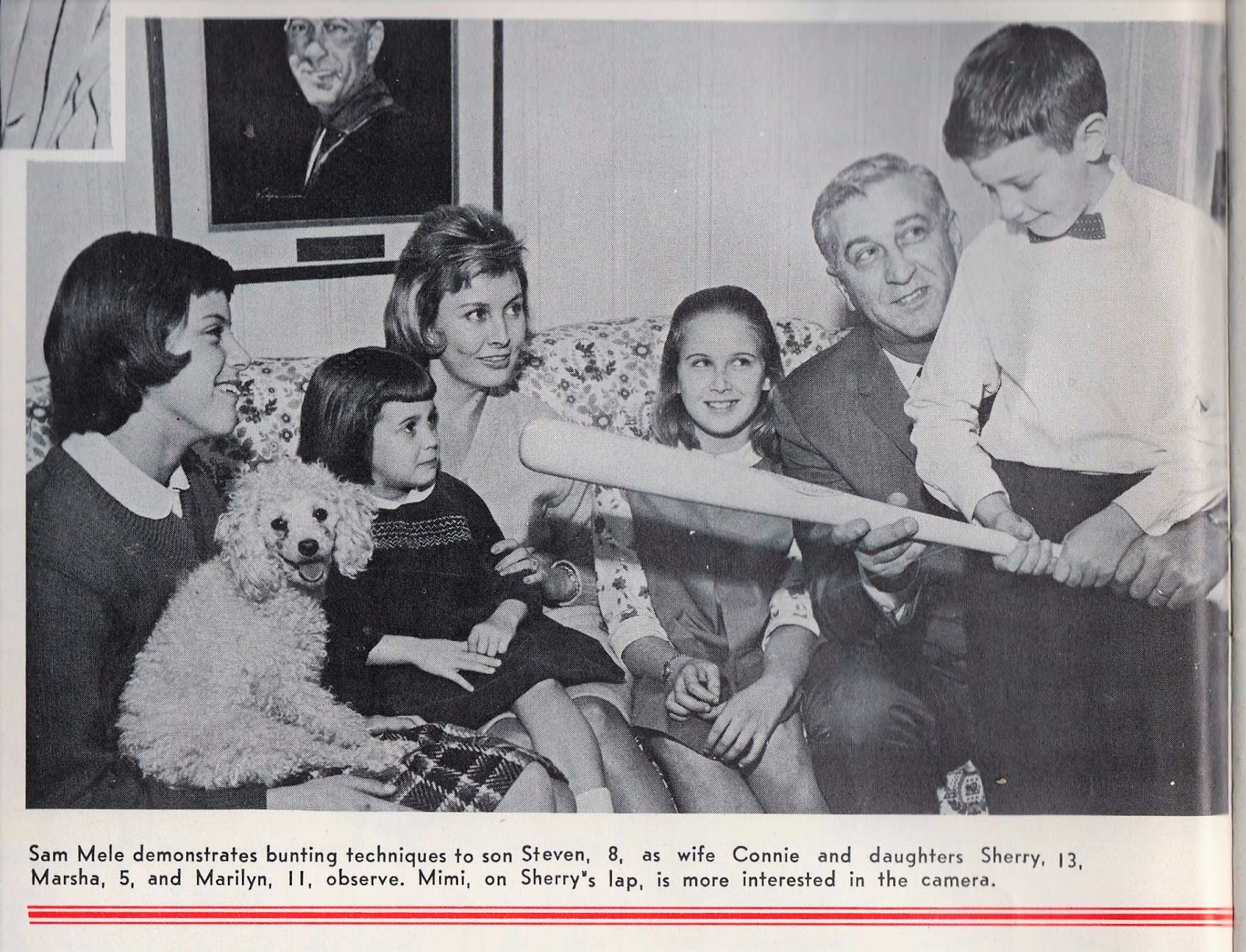
Sam Mele, the second man to ever manage the Twins, died this week. He passed away at his home on Monday, May 1, in Quincy, MA., at the age of 95. He was a solid hitter and outfielder as a player, before coaching stints with the Senators and Twins previous to his becoming their manager.

He was there to lead the very first era of team glory, and was the first Minnesota Twins manager to guide his team to the post-season. The Twins were the first to break the Yankee chain of domination, euphorically winning the 1965 American League Championship, before losing to the Los Angeles Dodgers in the seventh game of the World Series.


Managerial Stats Table
RkYearAgeTmLgWLW-L%TiesGFinishW-L%post
1196139Minnesota TwinsAL2nd of 425.286077
2196139Minnesota TwinsAL4th of 44549.4791957
3196240Minnesota TwinsAL9171.56211632
4196341Minnesota TwinsAL9170.56501613
5196442Minnesota TwinsAL7983.48811636
6196543Minnesota TwinsAL10260.63001621.429AL Pennant
7196644Minnesota TwinsAL8973.54901622
8196745Minnesota TwinsAL1st of 22525.5000502
7 years524436.54639633.8.4291 Pennant

Provided by Baseball-Reference.comView Original Table
Generated 5/6/2017.

He would seem to have been the ideal man to guide a young team, not only because he was relatively young (39) when he took over the managerial reins from Cookie Lavegetto in June, 1961, but also because he was patient and yet authoritative - a man who would stand by young players like Zoilo Versalles and still not put up with distractions.  No example better illustrates this than his handling of "Zee," who was far from a finished product when Mele took over in '61. Zoilo had a tendency towards inconsistency and volatility in his emotions. At one point, he and the manager had a tense confrontation in the dugout before a game, which escalated to the point that Mele him fined several hundred dollars (read up on that at the newspaper clip link following this paragraph). But once the air cleared, Mele put the outburst behind, and reinstated Versalles as the starting shortstop. Zoilo went on to become the American League MVP in 1965. It follows that Mele would deserve some credit for that success.

He is also known for a passionate, fiery, on-field demeanor, and goes down in Twins lore for an incident on July 18,1965 (Box), when he charged umpire Bill Valentine at Metropolitan Stadium, during a game versus the California Angels. You can view details of this at the Austin (MN) Daily Herald, July 19, 1965, and here at The Lake Charles (LA) American, July 19, 1965.


1966 Minnesota Twins Yearbook - click for larger view

"Let me help you adjust your tie"
More to his basic nature, however, he was apparently a strong, loyal family man, devoted to his wife and children, and well regarded in baseball circles. I find it significant that his first team, the Boston Red Sox, brought him back as a scout almost immediately in 1967 after Twins Owner Calvin Griffith fired him (see Monroe (LA) Morning News of June 10, 1967). He spent the next 25 years with Boston as a scout, before retiring in 1992.

1964 Minnesota Twins Yearbook - Click on photo for larger view

The Twins sent out a press release on Monday, stating:

“The Minnesota Twins are deeply saddened by the loss of Sam Mele,” the team said in a statement. “The former skipper was an important figure in Twins baseball history. The beloved Mele, not only led the 1965 Twins to the American League pennant, but also helped establish the importance of Major League Baseball across the Upper Midwest.”

So long, everybody!” -  Herb Carneal
Sam Mele

Sam Mele managed the Minnesota Twins to the American League pennant in 1965, but just a year and a half later was fired by the team. Subsequently, his former team rallied to finish the 1967 season tied with the Tigers, just one game out of first place in the American League.

Wednesday, October 26, 2016

It's Official: Senators Announce Move To Minnesota, Oct. 26, 1960

NOTE: this post is a part of my ongoing "Twins Genesis" series, with "The Naming Of The Twins" being the other published back on November 26, 2011.

In the October 26, 1960 edition of The Sporting News, Washington Senators President Calvin Griffith emphatically denied that a move of his team to Minnesota was in the works:
"Read my (semi-obscured)
lips - there will be no
move to Minneapolis...
today."
"That's a lot of baloney, and sounds like somebody's pipedream. It is news to me that the American League will discuss transferring the Washington club elsewhere."
But on that very same day, as we well know, Griffith and the rest of the AL bigwig suits came out of a smoke-filled backroom during the Fall MLB Owner's meetings to announce the info about the Senators move, besides the blockbuster new expansion teams being created in Washington (the "new" Senators) and Los Angeles (the Angels) to begin play in April, 1961.

Below embed - From the October 26 and November 2, 1960 issues of  "The Sporting News"


The Fall Owners meeting in '60 was preceeded two days earler by a fateful visit to Griffith's New York hotel suite by young Minneapolis businessman Wheelock Witney and Gerald Moore, Executive Director of the Minneapolis Chamber of Commerce, In their last-ditch, final pitch to convince him to commit to a move, they upped the ante by guaranteeing him 1 million in attendance for each of the first three years in Minnesota, plus full concession proceeds and $500,000 in local television and radio rights – almost three times more in broadcast revenue than he was earning in Washington. Now There was no way Griffith would delay. The deal was done - to The Northstar State was he headed. The owners stood by Calvin with a 6-2 vote.


It was the culmination of several years of rumored moves, thinly-veiled threats by Griffith to find greener pastures, and legal action to block said movement. Not that one could blame Calvin for wanting out of perpetual, last place penury, especially in the 1950s, Yankees-dominated era which he had inherited from his Hall of Fame Uncle, Clark Griffith.

 Now, to put a final nail in the upstart Continental League, and to get the jump on the National League, Griffith and his American League backers were moving boldly (if not with great foresight). It was not just a wonderful bonanza in Minnesota, and for its fans to have a professional sports franchise - expansion and relocation signaled the beginning of a new era in American professional sports, happening as it did at the start of the 1960s, with all the innovation and turbulence that change can bring. The NFL, NBA, and the NHL would take their cues, and follow suit in the years to follow.

"So long, everybody!" - Herb Carneal

Sunday, July 3, 2016

Game Of The Week: #1 Pick Eddie Bane Debuts For The Twins-July 4, 1973

It was 43 years ago this week, Wednesday, July 4, 1973  that Eddie Bane, the Twins sparkly and sizzling draft pick in Round One of the 1973 MLB Amateur Draft, made his debut less than one month after he was drafted (June 7, 1973). The Sporting News chose him as that spring's College Player Of The Year  (see link!) over players that would eventually be enshrined in the National Baseball Hall Of Fame. But he is an example of an individual whose talent could not live up to the hype, as a junkballing, Luis Tiant clone.


A PHOTO FROM MY CHILDHOOD BASEBALL SCRAPBOOK! 

[above] Interesting, odd juxtaposition "photoshopping" Bane into crowd: was the Star Trib implying Bane imbibed before his debut? Or that he'd gone into the stands drunkenly believing he could pitch just fine, thank you, from that spot to the KC lineup? (Steve Schluter photo: Minneapolis Star, Thursday, July 5, 1973)
By the time the ’73 season rolled around, it had already seemed a lifetime since the Twins had last been to the postseason. Following their loss to Baltimore in the 1970 ALCS, the Twins had finished in 5th place (1971), and 3rd (1972) in the six team American League West.
Yes, it was only $55,000 in 1973 money. But Bane sure had the satisfied look of a man who’d just gotten away with a bank robbery. And, in a way, he had…[photo VIA Minnesota Twins, from "The Twins At The Met," Bob Showers, 2009).
The Hype

The talent pool in the Minors had become shallow, with Steve Braun, Jim Holt, Steve Brye and Dave Goltz showing only mixed promise in their brief stints in the Majors.  Attendance at The Met was slacking off, alarmingly. Those mustachioed sluggers from Oakland had won the ’72 World Series, and the Royals were steadily stockpiling talent down in K.C.
Something had to give. And in a move that was never contemplated in the modern cases of Bryce Harper, Stephen Strasburg, and Mike Trout (whom Eddie scouted and recommended signing when he was with the Angels), Gerritt Cole, David Price, et. al, the Twins went against common practice – long, steady seasoning through years in the minors – and decided to plug him into the starting rotation while the publicity iron was hot. It wasn’t without precedent, however.

My friend John Swol at the superb Twins Trivia site (THANK YOU, JOHN!!) contributes this entertaining excerpt of a conversation he had with Eddie a couple years ago. As it sometimes happens, the recorded phone interview suffers from a less-than-perfect feed, a bit of tinny, trebly reception. But once you get past that, it is a wonderful first-person account of his debut by the man himself, who shows himself to be a humble, nice guy. He compares himself most deprecatingly to fellow rookie David Clyde as saying "the Twins didn't hamper my development at all by starting me immediately, I was as good as I was going to be anyhow..." to paraphrase his words. He explains the reason for his relative success in college versus the Majors, with reference to his curveball deserting him after he got to the show. I think you'll enjoy this bit! If I'm you, I'd head to his site, and go to his "Interview Archives" to hear the whole interview!

The Twins went all-out, handed out
this promotional photo card on debut night


The Twins were following the lead of the Texas Rangers, who just 8 days previously sent their top pick, the aforementioned 18-year old Texas high school phenom David Clyde (no. 1 overall) to the mound against the Twins in Arlington (see draft chart below). Bane was the eleventh overall pick in the nation out of Arizona State.  New Padres pick Dave Winfield (no. 4 overall) had played his first game nearly three weeks earlier, going 1 for 4 against the Astros Jerry Reuss in a 7-3 loss. I guess in the meantime, then, Bane had slow, steady seasoning in the bullpen workouts in front of coaches Vern Morgan and Al Worthington, by comparison...

He came to Minnesota with alluring numbers: 15-1 as a senior, 192 strikeouts in 140 innings pitched, and a 1.93 ERA.  Overall, he'd compiled a 41-4 record in three seasons against college hitters.  He was selected as The Sporting News Player of The Year, and became the Twins pick, right after Pat Rockett was chosen at no. 10 by the Braves. He thus came to Minnesota with a hunka hunka huge hype and with all the expectations that come with it. 
After that, The Twins must have felt a measure of justification when Bane shut out the Minnesota Golden Gophers and fellow draftee Dave Winfield 3-0, in the College World Series


B
The Game

I will merely give some basics, with the Winona Daily News of July 5, 1973  as well as the Jefferson City Post Tribune linked to supply extra detail. The start of the game was delayed, as Owner Cal Griffith ordered the field staff and umpires to wait until the turnstiles finally saw an ebb in the walkup rate. Then, Bane went out that and threw seven good innings, gave up only three hits, three walks, one run, and one run earned. But, laughingly, my mentality as a young fan was such that I was disappointed he didn't A. get the win, and B. that he didn't toss a complete game shutout - - so, I was definitely a sucker for the hype. But Bane's performance was actually all the more impressive for the fact he had not pitched in a actual game in weeks other than the bullpen sessions with the Twins. In facing 26 Royals batters, 13 of his outs came via the groundball (including one double play), and only three outfield chances (one flyout to left field, two to center), one lineout that Bane caught, and one runner caught stealing. The rest were strikeouts, three. The only trouble he encountered was Fran Healy's one out RBI double to right, scoring Hal McRae in the third, who had reached on a single. And that was about it for K.C. fireworks that evening.

My only other memory of that game was when Bane struck out Lou Piniellahis first, in the top of the second; I also took it as a point of pride that it took until the third for Hal MaCrae to record Kansas City's first hit, that single to left. He had a STELLAR first outing against the nucleaus of what would become the Royal's first championship team (in 1976). He was replaced by Ray Corbin in the start of the 8th inning. He pitched a scoreless 8th, but then allowed Kansas City to storm ahead with four runs in the 9th, to give them a 5-4 win.

For the remainder of that year, Twins management couldn't have been at all encouraged by Eddie's output. Of his 23 games in 1973, he only started 5, ending up with an 0-5 record, an ERA of 4.92 (although his fielding independent pitching (FIP) was 3.84, suggesting he wasn't ably supported by his teammates in the field in the games he pitched). He pitched into 1976, compiling an underwhelming 7-13 lifetime record, with a 4.66 ERA in what was basically a pitching-dominated era. The American League collective ERA in 1976 was 3.52, so Bane lifetime was an entire run + above that. His time with Minnesota ended in November, 1977, when he was granted his free agency status, and signed with the White Sox. He never appeared in a ML game with them, however, and he would later be traded to the Royals, ironically, in 1980 - and again, never surfaced in the Majors. 


Baseball Reference listed  Bane at 5'9", 160 lb - it was as if I were on the mound. Same size, same unimposing presence.
          Note: at second base in that first game (frame 2) is Hall Of Famer Twin Rod Carew. Nice support..
The Twins did have other choices in later rounds: Fred Lynn, Len Barker, Ruppert Jones, Eddie Murray, Floyd Bannister, LaMarr Hoyt, Mike Flanigan, Matt Keough, etc., all players that became all-star caliber guys - but the Twins tabbed Bane. Well, okay then...this was a case of the Twins not having enough diverse talent evaluation. Griffith and company were obviously seduced by the above college numbers, and without a Sherry Robertson, the former farm director around to trade notes, Calvin Griffith took the bait.

OvPckTmPosSean Smith of BaseballProjection.com">WARGDrafted Out of
1RangersDavid Clyde (minors)LHP0.285Westchester HS (Houston, TX)
2PhilliesJohn Stearns (minors)C18.5810University of Colorado (Boulder, CO)
3BrewersRobin Yount (minors)SS72.42856Taft HS (Woodland Hills, CA)
4PadresDave Winfield (minors)RHP59.42973University of Minnesota (Minneapolis, MN)
5IndiansGlenn Tufts (minors)INFRaynham HS (Bridgewater, MA)
6GiantsJohnnie LeMaster (minors)SS-6.81039Paintsville HS (Paintsville, KY)
7AngelsBilly Taylor (minors)OFWindsor Forest HS (Savannah, GA)
8ExposGary Roenicke (minors)SS14.41064Edgewood HS (West Covina, CA)
9RoyalsLew Olsen (minors)RHPSan Ramon Valley HS (Danville, CA)
10BravesPat Rockett (minors)2B-5.7152Robert E. Lee HS (San Antonio, TX)
11TwinsEddie Bane (minors)LHP-1.245Arizona State University (Tempe, AZ)
12CardinalsJoe Edelen (minors)3B-0.927Gracemont HS (Gracemont, OK)
13YankeesDoug Heinhold (minors)RHPStroman HS (Victoria, TX)
14MetsLee Mazzilli (minors)OF13.91475Abraham Lincoln HS (Brooklyn, NY)
15OriolesMike Parrott (minors)RHP1.4119Adolfo Camarillo HS (Camarillo, CA)
16CubsJerry Tabb (minors)1B-0.874University of Tulsa (Tulsa, OK)
17Red SoxTed Cox (minors)SS-1.9272Midwest City HS (Midwest City, OK)
18DodgersTed Farr (minors)CShadle Park HS (Spokane, WA)
19TigersCharles Bates (minors)3BCalifornia State University Los Angeles (Los Angeles, CA)
20AstrosCalvin Portley (minors)SSLongview HS (Longview, TX)
21White SoxSteve Swisher (minors)C-2.5509Ohio University (Athens, OH)
22RedsBradford Kessler (minors)OFClaremont HS (Claremont, CA)
23AthleticsRandy Scarbery (minors)RHP0.560University of Southern California (Los Angeles, CA)
24PiratesSteve Nicosia (minors)C0.8358North Miami Beach HS (Opalocka, FL)
Generated 7/4/2012.


"So Long Everybody"- Herb Carneal