Check Out This Post!

Harmon Killebrew On David Letterman!?

With the appearance of Joe Mauer last week on Jimmy Fallon, I was reminded of another episode of a famous Twin who appeared on late ni...

Showing posts with label Lyman Bostock. Show all posts

Saturday, July 12, 2014

Twins Brawls (Video): Roger Erickson Vs Bobby Grich April 22, 1978

Of note: this post was largely composed live, during a sunami-like migraine before the All-Star Game in Minneapolis in 2014- with little or no editing taking place. If that doesn't qualify me as a throwback gamer, I don't know what will. I had the feeling as if the video's principal actors were putting the hurt on ME, instead of one another at old Metropolitan Stadium. Just a small diversion for me from the hullabaloo and hype engulfing the Minneapolis area.

Left to right: (jackets) Twins Jose Morales, Geoff Zahn, (hatless) Angels starter Frank Tanana; Ron Jackson holds Twins pitching coach and legend Camilo Pascual, while Glenn Borgmann runs interference from the side.


I'd completely forgotten about this crazy melee on Saturday, April 22, 1978 (box) and was it ever. One minute rookie Roger Erickson is tossing an errant one inside, and the next thing you know, the 1968 Chicago Democratic Convention is breaking out! Bobby Grich was among the most intense, and valuable second basemen of the 1970's and 80's. He had an excellent OBP, power numbers, besides having one of the nicest, shortest swings (1972 All-Star Game video) you'll ever see. I'd choose him in a minute if compiling a fantasy all-time legends team. His SABR bio packs a pretty good punch *ahem* of info about him.


Yep - I can totally believe Rod took Dave LaRoche into storage closet
and beat the crap out of him for lipping off in a team meeting in '72

The California announcers (Don Drysdale and Al Wisk? Angel fans in the house, a little help?) were correct - Grich looked ready to punch anybody - beer sellers, ticket takers, Calvin Griffith, his own teammates, besides any of the patrons sitting near the Angel dugout throwing beverages and paraphernalia at him that day. That last was my favorite part of the video.

As it was, Twin Rich Chiles came out of nowhere to put a truly huge blind side hit on Grich, while future-Twins Ken Landreaux and Ron "Papa Jack" Jackson was seemingly everywhere . Also easily seen at the fisticuff fiesta is former Twin Lyman Bostock (#10 of Angels), and Twins Tony Oliva (coach, #6), Rod Carew (#29) and shortstop Roy Smalley (#5). The Sporting News (see mischievous Mauch grin in pdf) of May 13, 1978 asserts that is was indeed Carew that got in the quick head jabs on Grich's angry skull as he lay on the ground-some deft, stop-action views confirm that claim. The Grich quotes are doubly interesting as he implicates Twins Manager Gene Mauch as the instigator of the brushback.


And you thought charging the mound was a new thing?

Amazingly, only Grich was tossed out, the game resumed, with '65 Stars Oliva and Pascual being the only people on the premises who may have required any antibiotics or band aids. Welcome to 1970s baseball everyone, where Wild West lawlessness often prevailed (see link, "Disco Demolition"). Lost in the shuffle is this: the-then 21 year old Erickson righted himself to last 8 innings, though losing to the top lefty Tanana. It was his fourth major league start ( see popup stats), and his second against the Angels.

Look at this, and tell me Grich wasn't a bit wired as a habit...
(hover cursor on the screen to reveal audio button)


As Herb Carneal so eloquently put it: "So long, everybody!"


Sunday, November 24, 2013

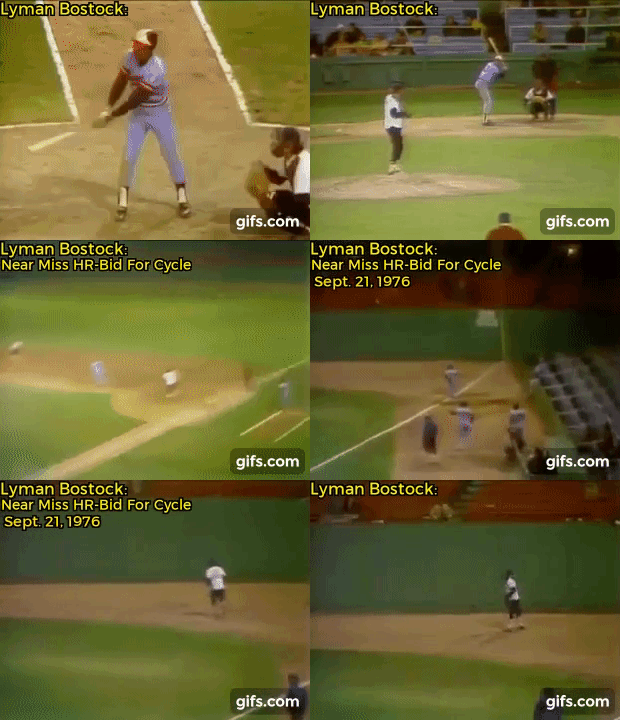
Game Of The Week (Video): Lyman Bostock's 4-4 Night Sept. 21, 1976

A video I discovered the other night, with the help of my Twitter friend Lord Of The Fries. It is the last 20 minutes of the 13-6 win against the White Sox on September 21, 1976.
Bostock, during his final at-bat
Beautiful beyond words. From seeing that uncomplicated, whippy swing of Lyman Bostock, Larry Hisle settling in under a can of corn in left field, Mike Cubbage (think John Denver in baseball hosiery), and that crazy pitching delivery of Tom Burgmeier from the first base side, to how impossibly unathletic Glenn Borgmann REALLY appeared - all on top of seeing hitless wonder Bob Randall (4 hits that night), Roy Smalley (in his first go-around with the Twins)  AND hitting wonder Rod Carew bat (hitless that night) - is too much for words. It was when my fandom was in its most innocent stage.
 "My last time up, I was definitely trying to hit a home run [for the cycle] and I almost got it." - Lyman Bostock, Winona Daily News, September 22, 1976 (VIDEO LINK: STARTING WITH BOSTOCK AT BAT)


BONUS: besides getting to see the faux, 1893-era Sox uniforms, you get to hear Harry Caray go completely incoherent at about the 5:30 minute mark, remarks about "Minnesota's proximity to Oakland versus Oakland's to Kansas City." Or some such gibberish. Oh yes - -I will be adding additions to this post on the original Minnesota Lumber Company faster than a psychotic carpenter, rest assured.

I couldn't watch this segment, and Caray's references to the leaders in the batting title race, without thinking about the controversial finish to come days later in the season finale (Oct. 3, 1976)  for Carew and Bostock against Kansas City's George Brett and Hal McRae. Brett won the title (news story pdf) by .001 of a point with a ninth inning inside-the-park home run, which McRae claimed Twins left fielder Steve Brye let drop purposely because of racial bias on the part of Twins Manager Gene Mauch. A story for another time..

Harry Caray, wiseguy: 
"Minnesota has a great shot at finishing second!" LOL! (5:00 mark)


Signing off, in the style of our old broadcasting buddy, Herb Carneal:

Saturday, April 13, 2013

1975 Minnesota Twins Camera Day

Today we call attention to one of the early, annual promotions staged by the Minnesota Twins. Camera Day has been chronicled slightly here at Classic Twins in a previous, early post, and here we get the full-color treatment. Among the finer nuggets of Twins and baseball treasures found on ye olde public internet is this collection of Twins players from Camera Day at the Met, before the Sunday, Sept. 14, 1975 game. 

I think it's cool for the glimpse of civilian clothing styles in vogue, the team's uniform of the mid-70's, and the simple beauty of a sunny day at Metropolitan Stadium. Plus, none of the players are unbelievably ripped and "top heavy" (see "Jose Canseco"), as would become common 20 years later. Normal, is the word I'm searching for.


 Rod CarewBert BlylevenLyman BostockLarry HisleTony Oliva Phil RoofGlenn BorgmannBill CampbellBill Butler, Porkchoppin' John Briggs,* Dave GoltzFrank QuiliciJoe Decker, and Danny Thompson are all here for perusal - at least, they're the ones I can ID. It's one of the excellent, vintage collections at snaebyllej2's Flickr photo share site - worth a look, take my word on that. It's one of the few examples of close proximity fans could hope to have with players back then, when Twitter and the internet, card shows, fan fests, and 24-hour cable sports were miles away on the horizon.

*All-time Twins leader, sideburn/facial hair category

As the great broadcasting professional Herb Carneal signed off, I say:
"So long, everybody.!" - TT

Friday, November 4, 2011

1976: The Twins Bill Campbell As Baseball's Original Free Agent Signee Part Two

[Updated, April 14, 2013 - updated with pdf doc, 12/2/13 - 
Part One of this Bill Campbell saga can be found at THIS LINK]

Thirty-five years ago today, November 4, 1976, was a momentous day in baseball history. It was the day that Major League team owners bid on the first group of free agents in the "Reentry Draft."This draft was distinguished from free agency statuses granted to Andy Messersmith and Dave McNally cases, as these players were stand-alone "test cases" used by MLBPA head Marvin Miller to create the environment that could be used to justify a structured draft that the Major League teams would have to abide.  I view the list (below), and have to marvel at the top flight pool of future Hall of Famers (Reggie Jackson, Rollie Fingers) and All-Stars (Bobby Grich, et. al.). Minnesota's Bill "Soupy" Campbell (Classic Twins post on Soupy) and Eric Soderholm* were in that group.

The Sporting News called it a "gold rush," but it was more a wild n' wooly cattle drive of the game's top stars to market, to continue the Wild West motif that was the 1970's. And our very own Bill was numero uno - the FIRST official signing under the new agreement between Marvin Miller, the Players Association, and Major League Baseball. It was a formal end to the system known as "The Reserve Clause." Campbell was the only Twin to have served actively in the Viet Nam war, as a radio operator.


*Great interview with Soderholm at Baseball Alamanac. Sheds light on difficulty of squaring off against Calvin Griffith in contract negotiations. Recalls comment Griffith made to Pedro Ramos during contract squabble: "If you don't like the offer, you can go back to Cuba and cut sugar cane" (Google Books link).


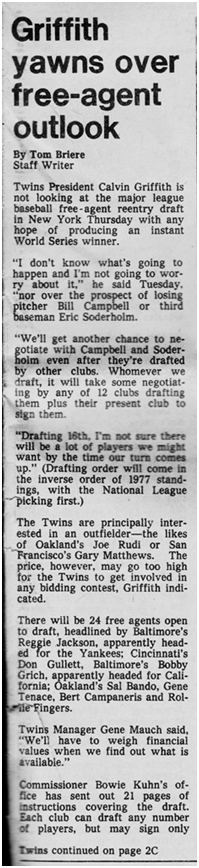
Calvin Griffith
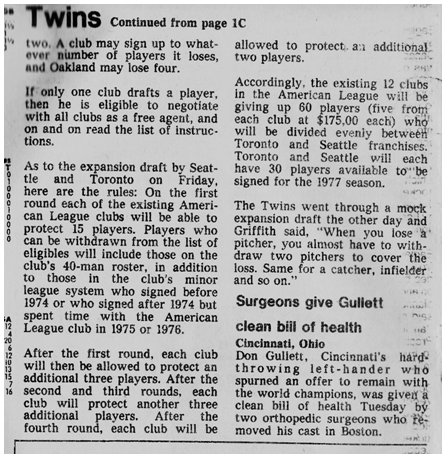
The next clip is  from the Minneapolis Tribune Sports section of the previous day (11/3/76) . Tom Briere's piece allows an insight into the mindset of then-Twins President Calvin Griffith* on the eve of that momentous draft. Cal comes across today as curiously detached, and stand-offish; you have to wonder if he truly understood the weakness of his bargaining power in this new format:

 
 *Link to my "Meeting Calvin" post. The modern psychology of players, media relations, economics...it was getting apparent to the Twins hierarchy that the game was passing Griffith by. They would appoint a 4-man management team that year, ease him out of the team presidency.


...And who would have guessed, with that laissez-faire attitude, this would result?


THE SPORTING NEWS, NOV. 20, 1976

Of course, the '76 draft proved to be highly damaging to the Twin's chances to seriously contend for the pennant in 1977, when the club fielded an offensive juggernaut (batting stats) that was bereft of quality starting pitching. The 1977 draft would deal another more serious blow to the team's depth of talent , with the defections of Lyman Bostock and Larry Hisle. Sans them, the Twins would not factor in a pennant race until another turnover of youth, the Puckett-Hrbek-Gaetti-Viola Twins of the 1980's, would surface and win it all ten years later.

For those of you interested, here are the results of that draft day as described in the Jan. 1, 1977 edition of The Sporting News (again,  Jack Lang's article):


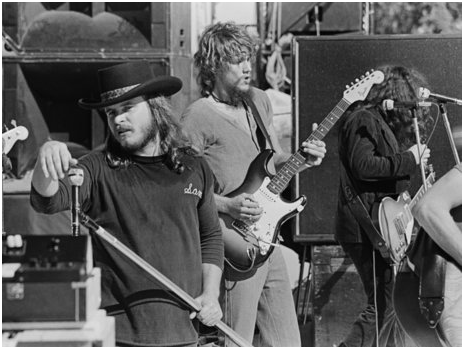
Only two day's earlier, Georgia Governor Jimmy Carter had defeated imcumbent President Gerald R. Ford in the general elections. The country was moving on after Watergate, Vietnam, the '60s, and the heartbreak that came with them. Undoubtedly, the old order of power was "gone with the wind," as Ronnie Van Zant* sang - and now, so too was The Reserve Clause in baseball that had bound players to their teams.  The freed bird flew, and the Twins had lost their uber-closer. He would go on to win the Rolaids Relief Pitcher of The Year (again) with Boston in /77, as well as the The Sporting News AL Fireman of The Year, and be selected to the AL All-Star Team.

*link: Van Zant was a big-time baseball fan, an 
enthusiastic ballplayer as a boy in Jacksonville, FLA.

Overall, this episode in team history set an organizational operating template that has lasted into the present day. More often than not, the Twins are still one of the clubs that draft, develop and then lose top-flight players long before their talents have regressed. Exits by Johan Santana, Torii Hunter, and now (possibly) Michael Cuddyer, Jason Kubel and Joe Nathan in 2011 are bitter reminders that teams in markets like Minneapolis-St. Paul have a fairly small window of time for contending. 

It's paradoxical that while baseball has changed so much in the last 35 years, one thing is still very much the same - the very democratic and rewarding institution of free agency has also made it very heartbreaking for loyal fans like ours in Minnesota to see the Twin's best and brightest move on to the Bostons and Californias of the world.

As our buddy at the mic, Herbie Carneal,
would say: "So long, everybody." - TT

P.S. - check out this newspaper pdf re: Campbell's 1977 pitching workload

1977 Topps Baseball Card.
Undoubtedly, the airbrushing
over the Twins logo was just
another way Twins fans had 
salt rubbed into their wounds..

Thursday, March 31, 2011

Bill Campbell -Funky Disco Era Reliever: Pre-free Agency Part One


[EDITED July 19, 2014 - the sister post to this piece is at this link, following Campbell's road to becoming the first-ever free agent under the new bargaining agreement in the post-Dave McNally / Andy Messersmith era]


So much of the spring training discussion of the 2011 Minnesota Twins has revolved around their bullpen, specifically the interesting closing tandem of Joe Nathan and Matt Capps.  The early blueprint has Capps shifting into the closer's role when Nathan has already pitched consecutive games.  This is a fortunate luxury that will hopefully pay dividends for Nathan's career as he seeks to regain his form as perhaps the greatest closer in Twins history. That's basically why they gave up top catching prospect, Wilson Ramos, to have somebody like Capps available to pitch that closer inning at the end of games while Nathan recovers. But there was a time in Twins history when their closers pitched far more innings at the end of games - and in fact, functioned essentially as starting pitchers on a smaller scale! Enter the Twin pitcher voted the Rolaids Relief Man of 1976 as Exhibit A John Swol had a fine summary of Bill and recorded an interview you can playback at his Twins Trivia site.

There weren't too many relief pitchers better than Bill "Soupy" Campbell in the mid-1970's. He became the Twins first free agent to leave Calvin Griffith's plantation, on November 6, 1976. Griffith was an owner from the old school, tightfisted, and he battled players down to the last nickel during contract negotiations. Campbell was definitely in that era's category of excellent relief pitchers, a list including Sparky Lyle, Goose Gossage, Bruce Sutter and Kent Tekulve. His 1976 season was astounding...and just look at his multi-inning appearances...it boggles the mind now!  However, you should first sing along to Dylan's 1976 "Maggie's Farm" Video beforehand, substituting "Calvin" for "Maggie" in the chorus!

In that Bicentennial summer, Bill Campbell could brag about his:
  • 17 wins in relief
  • 20 saves
  • 167 innings pitched
  • Of his 78 appearances, only 13 merely lasted 1 inning.
  • 56 appearances were multi-inning games
  • 23 of his appearances were 3 innings or more
  • 6 times he pitched 5 innings or more
  • Surprisingly, he only blew 7 saves all year, after pitching all those innings
  • Earned a 7th place finish in the Cy Young voting, 8th place in the MVP voting
  • Grew a fu that Charles "Old Hoss" Radbourne would have envied

This guy was money in the bank when he came into a game!  Funny, how you never really hear his name mentioned among the great Twins relievers much at all.  But I remember him quite well, those long arms whipping around from behind his body, making his ball hard to pick up for the batter.  He moved on to the Red Sox the next season, before the Players Union installed a controlled trickle
of free agents:
"The now-powerful players' union negotiated it [the reserve clause] out of existence in the 1970s, setting up the lucrative free agent era. Union head Marvin Miller, who knew that universal free agency would be just as bad as having no free agency, negotiated a system based on service time for potential free agents." - from Answers.Com
In short, instead of letting everybody into the pool at the end of their contract, Miller was wise to create a trickle flow of free agents.  The lower supply would serve to increase the individual take in player contracts.  Too many high level players would dilute the money pool, so the control was set up.  But before that, his agent, Larue Harcourt (see photo), negotiated Bill's big pot of gold - 5 years, $1M - with the BoSox (why, oh why, do people say these agent / lawyers have sleazy names?). In any event, his exodus from the Twins wasn't preordained, and hi staying in Minnesota received a lot of conjecture during and after the season (see page one of this feature from The Sporting News (Oct. 16, 1976) and also the conclusion to the piece on page two.
A face that would have served him well as a
      bit actor in a western barroom scene.
 Appropriate, as 1970's baseball was a lot like ...
                    well, the wild, wild west. 

By today's rules, a player only becomes eligible for free agency after 6 years of inclusion on the team's 40 man roster. Under that format, Campbell wouldn't have become eligible to bolt until after the 1978 season. As it was, within three years, the Twins lost Campbell, Bert Blyleven (his trade preempting his all-but-certain free agency), Larry Hisle (team's top slugger), Lyman Bostock (Twins best pure hitter after Carew), Eric Soderholm (starting third baseman), and Dave Goltz (staff ace after Blyleven).  It was all sickening stuff for Twins fans to stomach - the exodus from the shantytown and cotton field that our (now-lovely) Twins Territory was. It made it ever more difficult for the club to compete in the late 1970's...gone was their chance to win another pennant (or two) in those years.


        Soupy's career ended with
        the Montreal Expos in
       1987, after he pitched in 7
       games at age 38.

As Herb would say: "...and the count rides along..."
TT

Friday, July 30, 2010

Remembering Rod Carew, The Magician With A Bat

Rod Carew's "Mod Squad" 1972 Topps baseball card, my favorite!

Rodney Cline Carew...

Three favorite adjectives for him? 
Perfection, effortless, unstoppable...he was the magician with the bat.  He played 12 seasons with the Twins, from 1967 to 1978.  This ended all too abruptly when he left the Twins after 1978 to join the California Angels.  A heartbreaking situation for Twins fans that was, especially considering the team had already lost both Larry Hisle and Lyman Bostock the previous year to free agency...

Rodney was a no-brainer all-time Twin and Hall of Fame player the day he left Minnesota.  He's now immortalized in the team's "sculpture garden" (in addition to Kirby Puckett and Harmon Killebrew) on the Plaza outside brand-new Target Field in Minneapolis. He gave fans like me a reason to tune in my radio in the 1970's for late night Twins games on the west coast, when they fielded some pretty mediocre clubs. I mean, the middle infield in the '74 opener was Rod at second, and the hot, new shortstop...Sergio Ferrar?  Exactly. 

Three main memories of him?
*The casual, three-quarters-underhand flip throw to Harmon for the out, second to first...
*The curious running style, his arms held curiously out to his side as if he were holding onto the rails of an escalator...
*The smooth warmup swings before the pitch, before he assumed a bent-over crouch with his bat held parallel to the ground...

Such an idiosyncratic guy.  It seemed as if there were two games going on - the one everyone else was playing, and then his elegant, "my-own-little-universe" version.  A man among boys. He was liable to hit the ball anywhere from the lefthanded batters box - a bleeding, lineshot to the gap in right, a little dinking bloop over the shortstop, or one of his famous bunts down the third baseline. 

No one ever seemed to be in the right spot for those bunts, even if they knew he might lay one down.  No question, he was the best bunter in the second half of the 20th Century. I remember hearing how he'd tap pitches in practice with disgusting regularity in ballbags placed around the grass in the vicinty of home plate
*********
He was born at 7 o' clock in the evening on a train traveling in the Panama Canal Zone on October 1, 1945. His mother, Olga Carew, wanted the birthing to take place at the largest hospital in Panama, Gorgas.  Her reason was practical: so many children were dying at the local facilities in Gatun. The train's bumping along exacerbated matters.  Luckily, a nurse on the train enlisted the aid of a physician, Dr. Rodney Cline, a man in the right place at the right time to have his name linked with baseball history.

The Back Story
Rod and his brother Dickie were verbally and physically abused by his father Eric Carew, a temperamental, drinking man. He would eventually abandon his family. Before that, Rod could tell a whuppin was coming just observing the way his father approached his home on the sidewalk. His Mother, Olga, would jump in front of his blows as he tried to wack away at their sons. Rod used the baseball diamond as a means of escape, as well as recreation; he was initiated into the game using broomsticks for bats and paper bags for gloves in Panama.  That was better than wandering off into the nearby jungle.  Indeed, kids who ventured carelessly could encounter poisonous snakes on the prowl...


And with that depressing genesis, quiet, private Rod Carew would find his identity in playing amateur baseball as a teenager in New York city.  He relocated there in 1961 with his brother, joining their mother. Much of his tutelage took place on fields just a short distance from Yankee Stadium, where the dynastic Yankees of the early '60's reigned. He could hear the roar of the crowd wafting through the air when Mickey Mantle or Roger Maris put a charge into one. 


Legend has it that the Twins were tipped off to his talent that early summer of 1964 by local scout Herb Stein, who saw the 6 foot, 150 pound Rod playing for the New York Cavaliers in the Bronx Federation League (a sandlot outfit).  He took batting practice in the fabled Yankee stadium. The ballpark at that time featured monuments honoring Babe Ruth and Lou Gehrig right out on the playing surface.  They were near the flagpole in centerfield.  And it didn't seem weird at all. 

Now, of course, we have padded fences, shin guards, elbow guards, et. al.  You'll have to go to another universe to find granite markers on a playing field.  But I digress... 

Even with his skinny frame, he began blasting balls out of the park to all fields while wearing one of Tony Oliva's #6 uniforms  It grew so conspicuous that then-Twins manager Sam Mele hustled him off the field - fearing the Yankees might beat the Twins to the punch and sign him to an amateur free agent contract. Carew remembers catcher Earl Battey coming up to him afterwards, remarking "Hey, how's it goin,' skinny kid?" He signed a free agent minor league contract with the Twins on June 24, 1964.


From Montana Standard (June 28, 1964)

Intriguing, How Things Might Have Been...
1967 Twins Issued Photo:
The Rookie, Rod Carew

Rod played in the Cocoa Rookie League (see minor league stats) that first summer, before moving up to "A" ball for the seasons of 1965 and '66.  It is not well known that the Twins, along with other teams during the Vietnam War era (see "Hardball Times article on major leaguers in 'Nam), had him designated for an early call up to the majors during the 1965 season.  The possiblity existed that players could be selected any time for active duty overseas.  Rookie catcher John Sevcik and second baseman Bernie Allen were both eligible for the draft, but the call never came. Intriguing, the thought of Rod Carew starting at second base against Sandy Koufax and the Dodgers in the 1965 World Series! Cool, actually!

Below: boxscore of first spring training game 
played by Rod Carew in Twins uniform
Sunday, March 14, 1965


[picture at left: the Twins middle infield, spring training, 1970]  As it was, he went right from A ball to the major leagues in 1967. But that was only because Twins team owner fought for him to be included onto the opening day roster, over Manager Sam Mele's objections. The skipper wanted to give Carew more seasoning, to develop his fielding prowess.  The curmudgeonly owner prevailed.

Griffith was vindicated as Carew was voted Rookie of The Year in 1967 (voting results).  That was the year the greatest pennant chase in baseball history took place, when 4 teams could have mathematically won the pennant on the last day of the season.  The Red Sox won out over the Twins, Tigers and White Sox for the chance to advance to the World Series against the St. Louis Cardinals. See my post on Rod's Major League Debut, "In The O's Nest."

The Stealer - 1969
Rod and the Twins both had what was considered a subpar year in 1968. Before the 1969 season, he and newly assigned manager Billy Martin retooled his running game and his fielding maneuvers; he also switched to a heavier bat, with a bigger barrel. It forced him to cut back his swing, discourage him from overswinging, and gain bat control.  The result was his first American League batting title, which he corralled by hitting .332.

Remember, this was against the backdrop of the Vietnam War, Woodstock, Led Zepplen, student protests, and civil unrest in many cities nationwide, Chuck Manson (ugh!). But all I remember from that season was a lovely summer, Fourth of July fireworks, my mom, dad and family, swimming outings to nearby lakes...and, of course, the inspired play of a surging baseball team with many, colorful stars - including Rod. He was also participating in National Guard drills during that season (a sure sign of the times!), which took him away from competition for many games at a time.

He also gained notoriety with his seven steals of home (one short of Ty Cobb's season record), a facet of his performance that year recalled wonderfully in the highlighted blog account.

Billy Martin suggested that Carew take a long, walking lead instead of coming to a stop. How long a lead Carew took depended on how close the third baseman was to the bag and whether the pitcher went into his windup or checked him from the stretch position.

Of his seven steals of home during the 1969 season under the approving eye of manager Martin, Rod Carew used the surprise factor five times in the first inning.

[Stealing against Angels, 1969]

''Pitchers,'' Carew has explained, ''don't expect you to take a risk so early and kill off a potential rally.'' Carew also ran in a crouch that, he believed, propelled him toward the plate faster. But he also knew when not to try to steal home. Never with two strikes or three balls on the batter. Never with none out. Even so Carew had six steals of home by June and in July he equaled Pete Reiser's 1941 record. He stole home nine more times in his career, but he was a marked man.

Sunday, January 31, 2010

Lyman Bostock Story Part 1

Lyman Part 1 You Tube Video

You might decide to read the Lyman post that follows this video before watching it to fill in the cracks I left.

There are some wonderful game shots of him here that really bring his playing ability and character back for me!

Twinkler Out!

Remembering Lyman Bostock

[Notes: make sure you check out the Lyman video posted at the end of this post!] LAST REVISION, TUES., SEPT. 23, 2014

Before anyone ever heard of Kirby Puckett and Torii Hunter, a fellow named Lyman Bostock patrolled centerfield for the Minnesota Twins. He had hitting skills that were compared to Hall Of Famer Stan Musial, and was an excellent defensive player.

He was born in Birmingham, Alabama in 1950, eventually relocating to California with his mother a short time later. He never got to know his dad, Lyman Sr., who basically abandoned his family a short time after Lyman was born.

I just loved watching this guy play; to me, he played with a playground passion and abandon. It all looked so easy! Check the videos I linked, and you'll see! His swing was highlighted by his balance, and an ability to wait until the last moment on a breaking ball, and bring his bat around to hit a rope. Amazingly fast hands helped him to get quite a number of hits after he'd made his weight transfer, while hitting off his front foot. Today, only Ichiro Suzuki reminds me of Lyman, in the way he keeps his hands back, adjusting in mid-stride as the pitch is arriving, and hitting the ball where it's pitched.

To this day, I enjoy watching guys who seem to embody the classic spirit of the game: playing it with great skill, but yet with a joy and warmth that only a few people have, just like Kirby and Torii. Lyman's teammates loved him, nicknaming him "Jibberjabber" (see animated b & w photo below) as he was always engaging someone in the clubhouse and on the field.

I still remember watching his first major league game, and at bat, on local Minneapolis station WCCO. Legendary broadcaster Ray Scott was calling the play-by-play. He walked against future Hall of Famer Fergie Jenkins. He would come around to score on a groundout by Tony Oliva, and made his first hit in the next inning against Jenkins. The Twins won 11-4, with Bostock scoring three of those runs.
***
In January, 1977, my Minnesota Vikings lost the Super Bowl XI to the Oakland Raiders, 32-14. The bad boy Raiders pushed the aging Vikes defensive line all over the field, all day it seemed!

It was Bowl defeat number four for the Purple. Not only was there a gaping hole left in my sports calendar, but there was that humiliating defeat left to deal with! But, I wouldn't have to wait long for Redemption. My Twins were just around the corner!

I was just into my heyday of being interested in girls, and/or trying to get them interested in me. I remember hanging out with buddies after school at a place called "The Toy Pony," a forerunner to the modern video arcade. It was located next to Gehlen's Jewelry store.We pumped our quarters away into oblivion, waiting for girls to come in, a vain hope. That probably just gave us more time to brag about our skills with the fairer gender - deviant, misguided, horny little creeps that we were - and insult one another. Eventually, my parents forbade my going in there, worried about my turning into a bum.

It was also the last year in my boyhood that I actually would go into stores to purchase baseball cards. The 25-cent, 10 card packs represented a sort of Mason-Dixon line, marking the dividing line in my childhood to adolescence.

****

The spring of 1977 was signaled by the arrival of Twins pitchers and catchers to Tinker Field in Orlando, Florida. It had been that way for the Twins and their forerunners from Washington, D.C. since the second Roosevelt Administration. It would be cool to see if Rod Carew would regain the batting title, and if the Twins could beat out the Royals for the West Division title. I had a hard time keeping my mind on my studies and practicing piano. I think I secretly hoped I'd be a great player, and none of that other stuff would matter in the future. I was a skinny kid, but wiry, and fast and with a decent right handed swing. I loved playing so much, fire came out of my ass. I had even copied Rod Carew's left-handed stance, hitting well that way in Little League. I thought then: "It's a sign!"

The Twins were then an interesting mix of veterans like Carew and Larry Hisle, and young guys like Lyman, Roy Smalley, and Mike Cubbage. That year, they became one of the greatest offensive teams in Twins history. Lyman became an even better player, and was 2nd in the league to Rod Carew in batting, at .336. The famous June 26th game at the Met (which I attended with my cousins Bill, Bob and Uncle Jake) when Rod went over .400 in average while the Twins won 19-12 over Chicago, is one I'll never forget! Glenn Adams had 8 RBI's!

I was crushed when he elected to leave the Twins that fall, and sign with the California Angels (see Jacksonville Courier "Bostock No. 1" and The Sporting News "Bostock Values Angel's Halo Over Big Bucks"). That was compounded when Larry Hisle also left via free agency, to the Milwaukee Brewers. My guys! The batting order was gutted! It would take into the next decade, when the Hrbek, Gaetti & Puckett Twins came along, for the Twins to again rise to prominence.

But that became a small matter a year later, when Lyman Bostock was fatally shot while riding with childhood friends in the streets of Gary, Indiana. It was the first time I felt truly touched by death, even more so than when my only remaining grandparent died a few years previous. Incredible, poignant quotes can be read in this Sept. 26, 1978 edition the European Stars And Stripes. When I read these things, now consigned to the back pages of history, it makes me sad. Knowing no Twins fans born in the 80's and later would ever know how good this man was, personally and professionally. I know for me, the Twins, and baseball in general died that day. I would never be as serious a fan again until well into my adulthood.

The photo Topps was set to use
for Lyman's 1979 card

 The Vikings lost horribly again last week. But I guess that episode with Lyman really taught me at a young age that there's a lot worse things than failing at sports. Like subsequently losing my great friend Scott to suicide. And again when my wonderful niece Emily died in a car accident at age 19.
Life snuffed out in the flower of youth...good people aren't replaced. There's only the effort of getting along, remembering them fondly, and trying to do your best when your heart is broken.

Lyman Bostock Part 2  video recounts the eulogy and aftermath of Lyman and his legacy. I think ESPN did a fantastic job recalling his life and who he was as a human being!

As the sublime broadcaster would sign off:
"So long, everybody!" - Herb Carneal


[Note: I used details from the incredible on-line Lyman story from which the You Tube video orignated at ESPN eticket feature by Jeff Pearlman]