Check Out This Post!

Harmon Killebrew On David Letterman!?

With the appearance of Joe Mauer last week on Jimmy Fallon, I was reminded of another episode of a famous Twin who appeared on late ni...

Showing posts with label Michael Cuddyer. Show all posts

Monday, December 7, 2015

A Brush With Twins Fame - Rod Carew


The piece below, contributed by my long-time friend and Twins fanatic Greg Aase, is useful in answering a number of questions, especially "What was it like as a young fan to experience a Rod Carew autograph signing while he was in his prime?" Was he more like a Michael Cuddyer or Pat Neshek (very personable) or a Danny Valencia (actually cussed-out a youth in spring training after multiple autograph requests)? Or was he something in-between those extremes? 
It also offers interesting insights into player access in the late 1970s, and how making a very simple request could place even a young kid in the presence of a Twins legend. Very fitting, coming from a fellow born on the eve of the very first Twins World Series game, on Oct. 5, 1965!

Late afternoon, July 19thJuly 19, 1976.  A warm summer evening.  I am ten years old and on a school bus with my father.  Along with 40 other fathers and sons, we are traveling north on the various state highways and county roads between the small farm town of New Prague and our destination - Metropolitan Stadium in Bloomington, MN, aka the Met, home of the Minnesota Twins.  The local Rotary club held an annual father/son trip to The Met for its members, and this year we were going to watch our boys take on the Tigers.
To this 10 year old, a trip to the Met, or any other trip to the “Cities” (as most out state Minnesotans call Minneapolis/St. Paul), was a big deal.  Although New Prague was 39 miles from the stadium, there weren’t too many reasons for my family to leave our small town.  The general train of thought was that if you couldn’t find what you were looking for at Don’s Red Owl (the local grocery store), Rynda’s Hardware Hank (the really old time hardware store, complete with massive wooden cabinets of screws and toggles), Anthony’s (the god-awful clothing store, which offered the complete line of stiff, scratchy Dickies jeans), McMahon’s Snyder Drug (with their modest selection of DC Comics), or the local Ben Franklin (which was my main supplier of Topps Baseball Cards) you probably didn’t need it. So to head north, to the big city, was a big deal.
This 10 ten year old also loved the Met.  Having seen no other major league baseball stadium in person, I had no idea that the Met was, essentially, a minor league ballpark on steroids (see post "Met Stadium Pictorial, 1955-1961," Aug., 2011).  I didn’t know the history behind the place.  Officially built by the Minneapolis power brokers for the two minor league ball parks in the late 1950’s, it was really bait to attract major league teams to what the powers that be thought was now a major league town.  It was quickly, and haphazardly, expanded multiple times when the Twins and the Vikings came to town in the early 1960’s.  By the time I made my first trip to the Met in 1975, I had no idea the general consensus was it was a poorly maintained stadium with a whole bunch of lousy seats in the upper deck in left field, no upper deck in right, and a bunch of high school style bleacher seats everywhere else.   I also didn’t know that the Vikings, and to a much lesser degree, the Twins, were seeking a newer, shinier home (photo: 10 year-old Greg Aase, resplendent in brown corduroy).
I didn’t care about any of that. I loved the different brightly colored tiled panels on the outside walls. The parking lot seemed endless.  I loved the huge scoreboard with the Longines’ “Official Watch” at the top. I loved how you could sit almost anywhere, and in 1976, there were plenty of open seats, and watch the Northwest and North Central jets seemingly fly right next to the stadium as they came in to land at the “international” airport.  I enjoyed looking out past the outfield and the scoreboard and see the still open fields of south Bloomington and the Minnesota River valley.  It was a like a whole different world to me, a long ways away from New Prague, and that was fine with me.


Even though I didn’t know it then, the trip had some personal meaning.  My father and I were not particularly close in 1976.  He was a math and science teacher at New Prague High School and a very smart man.  Growing up, he was an Eagle Scout and a lifeguard. Although he taught math, his true calling was auto mechanics.  Taught by his father to wrench, he could diagnose and fix any car placed in front of him.  His nights and weekends were spent out in his garage, either fixing other cars to make extra cash, or tinkering on one of his own cars  (above photo: Ron Aase).
His only son couldn’t be less in his father’s image.  I bombed out of Cub Scouts, much to the disappointment of Scoutmaster Aase, thanks to my incompetence with knots and my disinterest in camping. I greatly preferred reading over math.  Multiple attempts by him to teach me to swim were unsuccessful and usually ended in shouting and tears.  I had no clue how an internal combustion engine worked and generally didn’t care. I loved the Beatles.  Dad’s taste in music was whatever WCCO-AM played, because that was the only station he ever listened to.  
One of our only common points was baseball.  The soundtrack to our summer hours in the car, or my fruitless time helping him fix cars in his garage, was to the smooth tones of Herb Carneal.  When things between us grew silent, we could talk about the sad decline of Tony Oliva, the Twins’ acute lack of pitching, or how cheap Calvin Griffith was getting.   A game of catch in the backyard, or attempts at the school ballfield down the street to fix my batting stance, were times that Dad and I had together that seem to bring some degree of peace to both of us.  So I looked forward to this father/son trip.
Not surprisingly, Dad and I had different plans for this particular trip.  After arriving at the Met, I purchased a 1976 yearbook and obtained a pen from my father. I had determined that this year was the year I was getting Rod Carew’s autograph (photo below: Rod Carew, via Sports Illustrated - August 19, 1976).


There was only one guy I cared about in 1976, and that was Rodney Cline Carew.  Four time batting champ, nine time All Star, the purest hitter in baseball at that time, and, best of all, a lefty like me.  He was the only superstar the Twins had.  One of my prized possessions was his 1975 Topps card, and when I attempted to play baseball at the afternoon Recreation games at Memorial Park I tried, to the mock and ridicule of my peers, to copy his stance. Just how I was going to get is autograph, I had no clue.  But I wanted it.
After we passed the ticket gate, I told Dad I was going to wander the stadium and see if I could get Carew’s autograph.  He told me not to leave.  I didn’t understand why.  Unbeknownst to me, one of Dad’s fellow math teachers, Don Dvorak, grew up in Waseca and went to Mankato State University with Jerry Terrell. Terrell was, at that time, a utility infielder for the Twins.  Dvorak was still
friendly with Jerry and had contacted him to see if he could visit with him before the game. At some point, my father had gotten me attached to this visit.   So, instead of wandering off on my own, my father told me to go with Mr. Dvorak.  From the bowels of the lower deck of the Met, we walked straight to the end of the aisle next to the Twins dugout.
Professional baseball in 1976 was a different world than the corporate, limited controlled access, state that we live in today.  In 1976, it wasn’t a big deal to walk down to the dugout, tell the bored security guard that you are here to see Jerry Terrell, give the guard your name, wait for the guard to yell at Jerry in the dugout to say that somebody was there to see him, and have Jerry yell back to “let them in”.  And that was pretty much how it happened.    One minute I’m standing at end of the aisle next the dugout, and the next minute I’m in the Twins dugout, shaking Jerry Terrell’s hand (above photo: Carew makes bubblegum cast of Terrell for posterity).
Jerry introduced us to a few other players sitting around the dugout.  The first was Craig Kusick
(“Mongo”), a kid from Wisconsin who should have been the power hitting first baseman the Twins desperately needed and got a few years later when they found a Bloomington kid named Hrbek, and Vic Albury, a journeyman pitcher. Vic looked like an extra from the Godfather via the sales department of Wally McCarthy’s Lindahl Olds – a thin mustache, short dark hair parted on one side and slicked down, a jaunty look on his face and a heater in his hand.  When Jerry called him over, Vic got up from the bench, walked over to where Terrell, Kusick, Mr. Dvorak and I were standing, gave me a skeptical, bored look, shook my hand, asked me how I was doing, and waited for me to stammer back “fine”.  He must have then determined that he had fulfilled his obligation, because he then nodded, turned, went back to his spot on the bench, took a long drag on his cigarette and pretended like all of us, including Terrell and Kusick, didn’t exist (photo above: Craig Kusick card via "When Topps Had Balls" Blogspot / below: Vic Albury, in a mellow, reflective mood)

Albury: "So...who let the snot kids in?"

Even though all this was great I wanted something more.  Vic and Craig and Jerry were all nice, but they were the B team.   I wanted Carew.  Unfortunately, Rod was nowhere to be found.  After a few minutes of chit chat, I couldn’t stand it anymore - I finally had to ask Jerry were Rod was.
His response - “He’s down in the clubhouse - he took his swings early.”
That was terrible.  Jerry was, in my mind, the step to get to Carew.  I mean, it was awesome to be in the Twins dugout, hanging with the players, but Carew was The Man.  And my quest to get his autograph was going to end in failure.
Then Jerry gave me hope.
“If he comes out at all before the game, he usually signs over there”, pointing to the end of the aisle just down from the dugout.  
After thanking Jerry and Craig, we were escorted out and up into the stands.  Mr. Dvorak headed back to where the rest of the group was sitting. I walked over to the next aisle and waited, with  5 other kids, for Carew.
Although access to players was much better in 1976 than it is now, Carew was the exception.  Rodney back in those days was considered “difficult”.  There is a former Minneapolis Tribune sportswriter that hates Carew to this day. Some of the grizzled sportswriter veterans that are still around will occasionally pass along a story on how prickly Carew could be.  He also never, ever signed autographs.
I stood at the end of the aisle for 15 minutes, and game time was approaching.  I can’t guarantee what the other 5 boys were thinking, but I suspect it was the same thing that was passing through my mind - we were going to strike out.  But then, running out of the dugout, and running over to the end of the aisle, was #29.  


He didn’t make eye contact with any of us, he just took whatever we put in front of him - a baseball, a piece of paper, a 1976 yearbook with his face on the cover, and he signed.  A big flourish of a signature, actually legible.  He signed everything put in front of him, and then he was gone without a word.  The whole thing might have taken 2 minutes.  But on his page in my yearbook - his autograph.


Thanks to the Internet, I now know the Twins won that night, 6 to 5.  Reliever Bill Campbell got the win.  Carew got a hit.  Jerry Terrell even got in the game.  It was a meaningless game to a 1976 season where the Twins were out of it by the All-Star break.  To be truthful, I don’t remember any of that. What does matter are the things I carry today - the great time that an awkward 10 year old kid spent with his father, the kindness  that a then-complete stranger showed me, a perfect summer evening at a long gone outdoor stadium, and two minutes with one of my boyhood heroes.  

So long everybody! - Herb Carneal

Saturday, February 11, 2012

Twins History In Motion: The Famous '65 Bob Allison World Series Catch

 [POST EDITED, WITH EXTRA CONTENT, 2/21/12]

The gif below is my latest entry in  the photo series, honoring the great Bob Allison. The Sporting News excerpts to follow capture the quotes of that day, from principals such as Jim Kaat, Sam Mele, Billy Martin, and, of course, Allison himself. The full game box of Oct. 7, 1965 can be found here at BBRef. 


Max Nichols was an excellent baseball writer for the Minneapolis Star. He achieved notoriety for casting the lone vote that prevented Carl Yastrzemski from winning the MVP Award unanimously in 1967. His vote went to Twin Cesar Tovar (see Joe Posnanski's story at "Nichols" link).


Please be patient! It can be a slow download, depending on your system!


I've always loved the emphatic out call given by umpire Ed Vargo on 
Allison's catch! That, and the clapping spectators.  For the life of me, it 
gives me a kind of JFK Zapruder film vibe.Go to MLB.COM for the 
black and white NBC video version.


Twins manager Sam Mele called it probably...


(excerpt just above, and following: by eventual 
Baseball Hall of Fame inductee (Writers Wing)
 Milt Richmon (UPI) for TSN)


These three things, besides his attempted peace-making role in the 1969 Dave Boswell - Billy Martin fight, should be remembered about Bob Allison by all Twins fans :


  • He was the ultimate, humble team player, so it would follow that... 
  • He was a much loved, respected teammate - Michael Cuddyer is a modern clone 
  • He played with an all-out football player's mentality, laying himself out on the basepaths as well as in the outfield - in fact, he may have been the most feared baserunner in MLB


All three of the above are obvious in the photos and newspaper accounts above.

Allison's catch was selected by Twins
fans as the "Favorite Moment" in team 
history.( Source: Aug./Sept., 2000 Twins Magazine)
 
As our own Hall of Fame Twins Announcer Herb Carneal ended his broadcasts:
Monday, January 30, 2012

Chuck Knoblauch & The Dollar Dog Rebellion: May 2, 2001

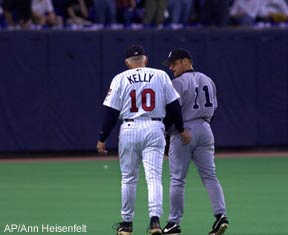
The Odd Couple: Kelly and Knoblauch  face down rowdies


[UPDATED, August 31, 2013]


I was there at the H.H.H. Metrodome to see the whole, mustard-slathered spectacle. 


Wednesday night, May 2, 2001, was the defining evening for prodigal son Chuck Knoblauch, when he found out he was no longer the fair-haired boy of Twins glories past. In contrast, the original Biblical son received nothing like the rude, verbal ass-kicking and shennanigans that Knobby received  in that series-ending game at the Metrodome. It was the venue's most surreal, darkest ballgame ever. It's the only time my team won when I wanted to wear a bag over my head in embarassment.
Above, right: behold the culprit of the evening!
It had all started so wonderfully for Chuck in Minnesota.
Bowman 1991 Rookie

After he was drafted #25 in the first round of the 1989 draft, he apprenticed for just parts of two years (A: 139 games, AA ball: 118 games) in the minors. Then there was the 1991 Twins World Championship and Rookie Of The Year award; there were the four All-Star selections, three top-20 MVP finishes, two Silver Slugger and Gold Glove awards. He did all this with a single-minded pursuit that bordered on mania. I remember a televised, steamy game from Cleveland in '95 or so - he did everything, hitting for extra bases, stealing, fielding - he was a rocket-propelled runt. Sadly, when you coupled the off-season workouts with the mail order food supplements (some apparently of the legal variety) that transformed him from a slightly pudgy little fellow into an intense greyhound, you had a guy that became viewed as a diva. His relations with Twins Manager Tom Kelly became strained. 

 
All the Twins could get
for Scott Erickson was...
Scott Klingenbeck.
 The lean years for the Twins extended from 1993 through the end of the Millennium. Knoblauch learned, as current Twins catcher Joe Mauer discovered in the summer of 2011, that (A) the fruits of losing made for an unpleasant aftertaste and (B) stars get the lion's share of criticism for the losing. The Twins traded away the Greg Gagnes, the Kevin Tapanis, the Scott Ericksons in a series of money-saving maneuvers until all at once, it seemed as if Knobby, Kirby and (later) Paul Molitor were the only sure things for the Twins. 


Once Puckett irretrievably lost his eyesight, Kelly was left with mediocrities like Rich Becker, Scott Stahoviak, Pat Meares, and Frankie Rodriguez to pencil into the lineup after Knoblauch at leadoff. His wife at the time found him uncommunicative after frustrating ballgames, despite his personal successes. He signed a contract in late-season 1996, but the losses still mounted - and by the end ‘97, he’d had enough, and made known he wanted out. He got his wish, forcing the Twins hand.  Enter Cristian Guzman, Eric Milton, Brian Buchanan, and Danny Mota in February, whom the Twins wrangled away from the Yankees for his services.


Commence the white-hot hatred of Twins fans spurned. As history would demonstrate later, vengeful Minnesota fans make Glenn Close (“Fatal Instinct”) look like the school librarian by comparison.


Fan to Knoblauch:
"You will NOT ignore me !"
When A.J. Pierzynski returned to the American League in 2005, he elicited similar antipathy. Like Knobby, he brought a bundle in trade booty: Joe Nathan, Francisco Liriano and Boof Bonser. What is it about the state's sporting public that they can't look good fortune in the face and see it for what it is? It's a paradox that's hard to fathom...


The Game - Wednesday, May 2, 2001
Ordinarily, a game that’s scoreless into the middle innings would be noteworthy on its own merit, with stellar pitching by starters Joe Mays and Orlando Hernandez. That helped create a taught, tense affair. It should have been a fascinating game. But there was something else at hand. As I watched that game in left field, I felt an increasing discomfort with what was going on around me; a crazed anarchy was in the air, very unsettling. Boorish kids of college age were giving it to the Yankees and Knoblauch; it wasn't just the loudness - it was the meanness, bitterness, bile, and beach balls pinging back and forth that made this freak show. One frustrated gentleman, obviously a middle-aged, Twins fanatic, was seen catching one of those bouncers, puncturing it, and telling the miscreants to "WATCH THE GAME;" his reward was debris and bear bottles thrown his way as well (oh, did that HURT my feelings!). This took place while the Twins were mounting a rally in the 6th inning. 


A number of factors contributed to this evening's weirdness:

No, drunk guys. It does NOT say
"start the throwin'"
  • It was dollar dog night with little to no limit on how many hot dogs you could buy (or throw as handy projectiles on this night)

  • The Twins were just returning to respectability in ‘01, and thus general admission left field seats went for a paltry $10. That screamed one thing: “Come one, come all ye drunken frat boys!”
     (It’s a fact: cheap prices appeal to the rude, boorish set, as well as thrifty families)
  • Knoblauch’s 2nd base days were over. He’d been replaced there by  a young Alphonso Soriano. That meant he had the privilege of playing with his back to those same lower left field seats. Bullseye! 
  • A popular FM morning radio station show in the Twin Cities was stirring the pot against Knoblauch constantly, especially fixating on the incident when he pushed a kid in Seattle


    At 9:11 p.m., Doug Mientkiewicz singled in Matt Lawton and David Ortiz to put the Twins up by 3 runs off Mike Stanton and the Yanks in that 6th. This created an excuse for an erruption of bottles and dogs and objects to be tossed to the turf, at Knoblauch - and it became so intense that 3B Umpire Angel Hernandez felt he had no other choice except to signal Manager Joe Torre to order his Yankees from the field. Tom Kelly, in an ironic twist, emerged from the Twins dugout to be Knoblauch's savior, in an attempt to calm the knuckleheads.

The letters on the backs of the imbeciles' shirts spell out
"Watch Your Back Chuck" when properly arranged. Nice!

At the same time, PA announcer Bob Casey was intoning with a perturbed urgency:

 "Ladies and gentlemen, this is an important, championship ballgame. If the trouble in leftfield does not end, the game will be forfeited and the Yankees will win. NOW QUIT THIS!"

Everybody's welcome..unless your name is "Chuck"

After 12 minutes, following the ejection of a posse of unrulies from General Admission, play finally resumed.  The Twins A.J. Pierzynski took a strike three called, and the Twins bullpen came on to stuff New York the rest of the way. That would have been the end of it, except that yet another flurry of Chuck-shucking happened in the 8th inning...resulting in another 5 minute delay. That stoppage promoted the umpiring crew to more seriously consider a forfeit ruling. But the threat passed when fans witnessed more ejections, and they yielded to sanity, finally. Shockingly, the game took only 3:01 to play. As a footnote, the Twins won, 4-2.

For his part Kelly was livid not only with the fans, but he also felt the stadium's sound system was playing so loudly that he couldn't convey his message to the offending patrons. ''It was a terrific game, and in my mind it was ruined,'' Kelly said. ''Hopefully, they can clean it up around here.''
"What in the name of the Wide
World of Sports is going on here?"

 
To his credit, Knoblauch understood that just a small minority was responsible, and resisted downgrading Minnesota fans and Minneapolis: ''They need to turn the page. It's been four years. I don't know what's going on here... Even after all this, I won't say anything bad about the city,'' Knoblauch said. ''It's probably a bunch of 16-year-olds who don't have a clue who Chuck Knoblauch is."

Chuck would later confide to the Star Tribune's Amelia Rayno in 2013 how the episode affected him: "It hurt...I mean, I'm human. I can't even give you any details. It was like an out-of-body experience ... that's the part of my life that's like, 'Really?' It really meant that much? You're trying to hurt me, knowingly throwing a quarter or a marble or something at me? It's twisted. It made me bitter about Minnesota, definitely."

As a longtime Twins fan, it should be obvious to the reader that I'm embarrased this ever happened. Yet, I think it fair to add this bit of clarification: had Chuck had a sense of humor about himself during his career, and not taken himself so seriously, he might have endeared himself as one of the more beloved Twins before he left. It may have mitigated the ugliness of May 2, 2001. So, in that sense he had it wrong: Twins fans felt they DID know him, and some felt he deserved this treatment. If you can imagine.

I don't foresee similar flareups with the returns of Joe Nathan, or Michael Cuddyer or Jason Kubel in the future. 


Chuck in The Big Apple: A classic case of
"Be careful what you wish for."

In the final analysis, there should be some credit given to Twins management; they had doubled the security contingent in left after situations on a relatively minor scale disrupted the Monday game. But with the opportunity for the Twins to win the 3-game series at hand, a 16,000 fan walkup besieged the Ticket offices Wednesday.  It caught the Twins off guard with their surprising success of that early 2001 season, according to Dave St. Peter. It was their biggest, mid-week attendance in 13 years in April or May.


 In retrospect, I don't think it can be disputed that Chuck Knoblauch was by far the best second baseman in MLB over 1995-1996. Furthermore, if you focus on peak performance, he had the best all-round years for any Twins second baseman in their history. That would include Rod Carew (with the exception of his ridiculous 1977 MVP season - but of course, he was a first baseman by then!). 

High Heats Stats also takes this to a greater, detailed level in it's analysis of Knoblauch's superior seasons, "Five Fascinating Facts About Chuck Knoblauch." Truly illuminating, that he was besting a Hall of Famer in Roberto Alomar.


It can be stated that trading Chuck for players like Guzman and Eric Milton undoubtedly bettered the product on the field, helped keep the Twins in Minnesota, and staved off contraction in 2001. Just another reason that residual bitterness towards Chuck Knoblauch is misguided and stupid.

 
As our announcing friend Herb Carneal put it:
So long, everybody!" - TT

Information from a May 4, 2001 Online Athens article was also extremely helpful in this recap.

Here's a You Tube video from '97 that foreshadows Knoblauch's eventual departure from Minnesota.
Then there's this story on what Chuck Knoblauch is up to these days, from a summer, 2011 StarTribune feature

Bleeding Yankee Blue posted this interview with Chuck in Aug., 2011.

Friday, November 4, 2011

1976: The Twins Bill Campbell As Baseball's Original Free Agent Signee Part Two

[Updated, April 14, 2013 - updated with pdf doc, 12/2/13 - 
Part One of this Bill Campbell saga can be found at THIS LINK]

Thirty-five years ago today, November 4, 1976, was a momentous day in baseball history. It was the day that Major League team owners bid on the first group of free agents in the "Reentry Draft."This draft was distinguished from free agency statuses granted to Andy Messersmith and Dave McNally cases, as these players were stand-alone "test cases" used by MLBPA head Marvin Miller to create the environment that could be used to justify a structured draft that the Major League teams would have to abide.  I view the list (below), and have to marvel at the top flight pool of future Hall of Famers (Reggie Jackson, Rollie Fingers) and All-Stars (Bobby Grich, et. al.). Minnesota's Bill "Soupy" Campbell (Classic Twins post on Soupy) and Eric Soderholm* were in that group.

The Sporting News called it a "gold rush," but it was more a wild n' wooly cattle drive of the game's top stars to market, to continue the Wild West motif that was the 1970's. And our very own Bill was numero uno - the FIRST official signing under the new agreement between Marvin Miller, the Players Association, and Major League Baseball. It was a formal end to the system known as "The Reserve Clause." Campbell was the only Twin to have served actively in the Viet Nam war, as a radio operator.


*Great interview with Soderholm at Baseball Alamanac. Sheds light on difficulty of squaring off against Calvin Griffith in contract negotiations. Recalls comment Griffith made to Pedro Ramos during contract squabble: "If you don't like the offer, you can go back to Cuba and cut sugar cane" (Google Books link).


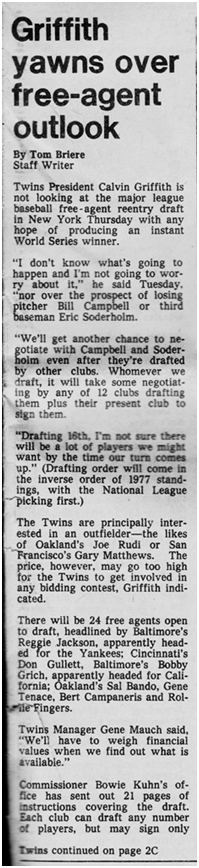
Calvin Griffith
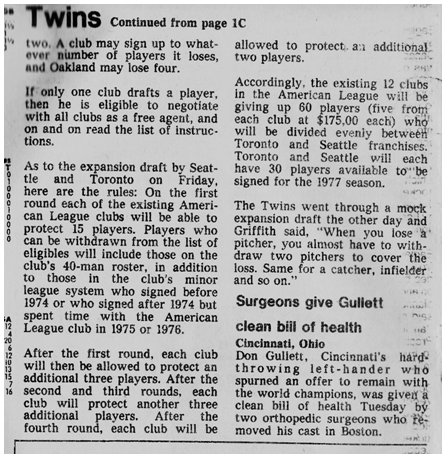
The next clip is  from the Minneapolis Tribune Sports section of the previous day (11/3/76) . Tom Briere's piece allows an insight into the mindset of then-Twins President Calvin Griffith* on the eve of that momentous draft. Cal comes across today as curiously detached, and stand-offish; you have to wonder if he truly understood the weakness of his bargaining power in this new format:

 
 *Link to my "Meeting Calvin" post. The modern psychology of players, media relations, economics...it was getting apparent to the Twins hierarchy that the game was passing Griffith by. They would appoint a 4-man management team that year, ease him out of the team presidency.


...And who would have guessed, with that laissez-faire attitude, this would result?


THE SPORTING NEWS, NOV. 20, 1976

Of course, the '76 draft proved to be highly damaging to the Twin's chances to seriously contend for the pennant in 1977, when the club fielded an offensive juggernaut (batting stats) that was bereft of quality starting pitching. The 1977 draft would deal another more serious blow to the team's depth of talent , with the defections of Lyman Bostock and Larry Hisle. Sans them, the Twins would not factor in a pennant race until another turnover of youth, the Puckett-Hrbek-Gaetti-Viola Twins of the 1980's, would surface and win it all ten years later.

For those of you interested, here are the results of that draft day as described in the Jan. 1, 1977 edition of The Sporting News (again,  Jack Lang's article):


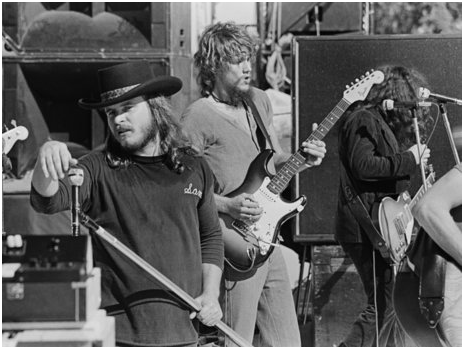
Only two day's earlier, Georgia Governor Jimmy Carter had defeated imcumbent President Gerald R. Ford in the general elections. The country was moving on after Watergate, Vietnam, the '60s, and the heartbreak that came with them. Undoubtedly, the old order of power was "gone with the wind," as Ronnie Van Zant* sang - and now, so too was The Reserve Clause in baseball that had bound players to their teams.  The freed bird flew, and the Twins had lost their uber-closer. He would go on to win the Rolaids Relief Pitcher of The Year (again) with Boston in /77, as well as the The Sporting News AL Fireman of The Year, and be selected to the AL All-Star Team.

*link: Van Zant was a big-time baseball fan, an 
enthusiastic ballplayer as a boy in Jacksonville, FLA.

Overall, this episode in team history set an organizational operating template that has lasted into the present day. More often than not, the Twins are still one of the clubs that draft, develop and then lose top-flight players long before their talents have regressed. Exits by Johan Santana, Torii Hunter, and now (possibly) Michael Cuddyer, Jason Kubel and Joe Nathan in 2011 are bitter reminders that teams in markets like Minneapolis-St. Paul have a fairly small window of time for contending. 

It's paradoxical that while baseball has changed so much in the last 35 years, one thing is still very much the same - the very democratic and rewarding institution of free agency has also made it very heartbreaking for loyal fans like ours in Minnesota to see the Twin's best and brightest move on to the Bostons and Californias of the world.

As our buddy at the mic, Herbie Carneal,
would say: "So long, everybody." - TT

P.S. - check out this newspaper pdf re: Campbell's 1977 pitching workload

1977 Topps Baseball Card.
Undoubtedly, the airbrushing
over the Twins logo was just
another way Twins fans had 
salt rubbed into their wounds..