Check Out This Post!

Harmon Killebrew On David Letterman!?

With the appearance of Joe Mauer last week on Jimmy Fallon, I was reminded of another episode of a famous Twin who appeared on late ni...

Showing posts with label Game of The Week. Show all posts

Saturday, July 23, 2016

GOTW: Vic Power, First Twin To Steal Home, July 19, 1962

It happened 54 years ago this week, July 19, 1962 (Baseball Ref Box) that Vic Power became the first Twins player to steal home. With Harmon Killebrew batting, Power streaked down the third base line to score in the 5th inning during the Twins 8-0 rout of the Cleveland Indians at Met Stadium.

Here you see Tribe catcher Johnny Romano's futile effort to apply the tag, while home plate ump Nestor Chylak is all set for action. I guess I could be upset that my Dad didn't take me to this one-yes, I was an infant at the time, granted - - but it's the principle of the thing.

Hurt feelings aside, here’s your play-by-play context, courtesy of Baseball Reference:


Jim Kaat had grounded out, first baseman Tito Francona to pitcher Bill Dailey covering. Bill Tuttle followed with a single to left. Then, Power stroked an opposite field double to rightfield, Tuttle reaching third; Rich Rollins moved both baserunners ahead with a sac fly to center, making the score 5-0 for the Twins; and, then, with Killebrew at the plate, the thief Power broke for home. He clearly touched home plate ahead of catcher Romano’s tag, as the above photo demonstrates. Sweet revenge upon his old team! Vic had had a stormy, "on-again/off-again" relationship with the Indians management dating back several years, receiving fines and reprimands that were often a result of his passionate, instinctive nature. Not your 1950s "company man" that team owners expected, especially from a Latino black man.

Vic Power batting in a June, 1963 game. Again, Harmon Killebrew is on-deck (right, by inscription).Six summers would pass before another Twins player - Rod Carew in 1969 - Would create similar excitement on the bases at Metropolitan Stadium. And then, again, with Harmon Killebrew still batting in the three hole(photo), for a nice piece of ironic, synchronized history.

Vic Power actually had quite a history of doing this (see BBRef table below), perhaps THE most exciting play in baseball. He stole home TWICE for the Cleveland Indians, for example, on August 14, 1958 (Google News Archive links) in a regular season game (BBRef Box), and then again in a spring training game on March 22, 1960*, again as an Indian. It would also be the last steal of home for Power in his career. In twelve years, he stole 45 bases - and 8 of them were steals of home...a full 17%!! By comparison, the all-time leader of steals of home, Ty Cobb did this 54 times, 6% of his lifetime 897.

* - scroll above headline to see Power photo

CAREER STEALS OF HOME FOR VIC POWER!
                           
Rk Date Tm Opp Rslt PA AB R H HR RBI SB
3 1959-04-18 CLE KCA W 13-4 5 4 3 3 1 1 1
12 1962-07-19 MIN CLE W 8-0 4 3 2 1 0 0 1
20 1961-05-19 CLE NYY W 9-7 5 4 2 3 0 1 1
Rk Date Tm Opp Rslt PA AB R H HR RBI SB
33 1959-05-03 (1) CLE WSH W 5-0 4 3 1 1 0 1 1
34 1959-04-25 CLE CHW L 6-8 5 5 2 3 0 1 2
36 1958-08-14 CLE DET W 10-9 6 6 3 3 0 1 2
39 1957-07-28 (1) KCA WSH W 6-2 4 4 1 1 0 1 1
Provided by Baseball-Reference.com
Generated 7/22/2016.
Only 1 of his steals in 1959-04-25 game was a steal of home.

Regarding his baserunning instincts, his manager from his Cleveland days, Joe Gordon offered: Vic isn’t particularly fast, but he’s got baseball instinct. He bluffed the pitchers beautifully – rushing up the line, pausing long enough to make them relax and then, poof – streaking all the way in (Cleveland Press, August 5, 1958).This was an interesting dimension (I would call it a "Negro League style") that the charismatic Puerto Rican brought to the young, conventional Twins.

###

______________________________________________________________________________________

SEE This Classic Minnesota Twins! Vic Power Post From 2013!


TRADING FOR VIC POWER - APRIL 6, 2015 - Originally published 4/2/13 In-season trades are rare occurrences for the Minnesota Twins. And even rarer are those that actually impacted the fortunes positively for the home nine.
______________________________________________________________________________________
As I think about it, Vic Power has been the focal point of at least 3 of my blog posts, an inordinately large number for a player who was a Twin for parts of only three seasons. I submit two reasons for that level of fascination with him:


*He was unique for his time (nearly became the first dark-skinned player on the Yankees!),* in that he was a multi-dimensional player in an era when first basemen were sloth-like creatures who were expected to hit the ball out of the park and field with little range. In contrast, Power, besides being a consistent offensive contributor, ran the bases well, and played his position quite unconventionally, like Adrian Beltre plays third today. That and the fact that he was a charismatic extrovert (see his obit!) in a time when players were rather drone-like.


*That honor would go to the relatively taciturn Elston Howard

*He also intrigues me for having visited my hometown sometime during that 1962-64 period, and greeting kids and other Twins fans at our local movie theatre. This affair was attended by my oldest brother (again, cue my personal envy, bitterness), who recalls it being an occasion to encourage clean living, participation in sports, besides being an autograph-signing session. As a dark-skinned man, I am certain he stood out in what was then an all-white community, perhaps prompting surprise or disappointment for some who may have come out to see if the basestealer would hock some movie candy from the lobby on his way out.


As far as that visit by Power and his teammates to the theatre...do I sense a future blog post sequel coming....?

"So long, everybody!" - Herb Carneal

Saturday, May 31, 2014

Bizzarre Fielding Video: The Metrodome's First Triple Play May 29, 1982


  • Six men in a box. Nettles retreats to 1st as Gaetti
    is arriving with ball. Lenny Faedo (12) wonders just what his
    role is in the play, while Ron Washington points at Murcer.

  • For you kids at home, score this one as a 1-2-5-3-1 triple play. "Holy Cow!," as Yankees announcer Phil Rizzuto exclaimed (though Twins oldies like to credit Halsey Hall (sound file) with originating the phrase).

    The crazy play as seen in the video occurred on May 29, 1982 at the brand new H.H.H. Metrodome (humorously cynical Deadspin review). Minnesota and the Yankees were scoreless in the 2nd inning, with righthander Terry Felton on the mound for Minnesota. The weekend series against New York was the fourth homestand for the Twins at the new facility. They were in the midst of an inglorious 14-game losing streak.

    Baserunning Comedy


    The Yankees had put runners on first (Graig Nettles) and second (Bobby Murcer) with no outs. Roy Smalley then struck out on a wide 3-2 pitch from Terry Felton, with Murcer attempting to steal third base. Rifle-armed Sal Butera (right photo) threw to Gary Gaetti so far ahead of baserunning Bobby that he tried returning to second. Problem was, former Twin Nettles was standing on the bag by then (ooops!) as part of the hit and run play. He retreated back to first. 

  • Gaetti uselessly tagged Murcer after the rundown before throwing to Kent Hrbek to catch Nettles...then, Murcer, the smart ballplayer of many great years, inexplicably went back to third! Hrbek threw to Felton at third to complete the triple play, with zany left fielder Mickey Hatcher backing up the bag. None of this would ultimately matter, as the Yankees pulled off a 6-4 win with two runs in the ninth.


Trivial Trivia

Felton (see Michael Rand 2010 story update) was 0-8 coming into the game, and got a no-decision after Brad Havens came in to blow the lead in the sixth inning. He would lose another 5 to finish his career with an 0-16 record.


Bobby Murcer (left, BD photo)was the last of the 1960’s Mickey Mantle New York Yankees remaining on the roster. He, in fact, had been tabbed as the heir apparent to the Mick - always a “great” thing that, heaping expectations on a young player. The Oklahoman was good enough to earn 3 straight top-ten MVP finishes early in his career. He had been traded even up to the Giants for Bobby Bonds in the 70’s, and had also been a Cub; New York brought him back in 1979 as a part-time player.


Craig Nettles, playing the role of Fred Astaire in his sashay back to first, would go on to several more fine seasons. He was profiled earlier at this blog (“The One That Got Away.”). Former Twin Roy Smalley had been a Yankee for less than two months, while Butch Wynegar was in pinstripes for just over two weeks after six seasons as a Twin. Of the three, only Roy would again know the joys of playing regularly on the Dome's carpeted cement pile, the lucky guy, after his 1985 trade back to the Twins.

The young Twins of 1982 represented a completely different era from the teams that had occupied Met Stadium from 1961 to 1981. Even in losing, they were thoroughly entertaining. One could see the talent in the young Gaettis, Brunanskys, Laudners, etc., and the smoke wafting out of the runway of the dugout (pregame heaters) but one knew that growing pains would be the rule for some time out. Kent Hrbek was already the star of the team, building a case (link to stats coming into that game) for inclusion on the '82 All-Star team.

"So long, everybody!" - Herb Carneal

Sunday, November 24, 2013

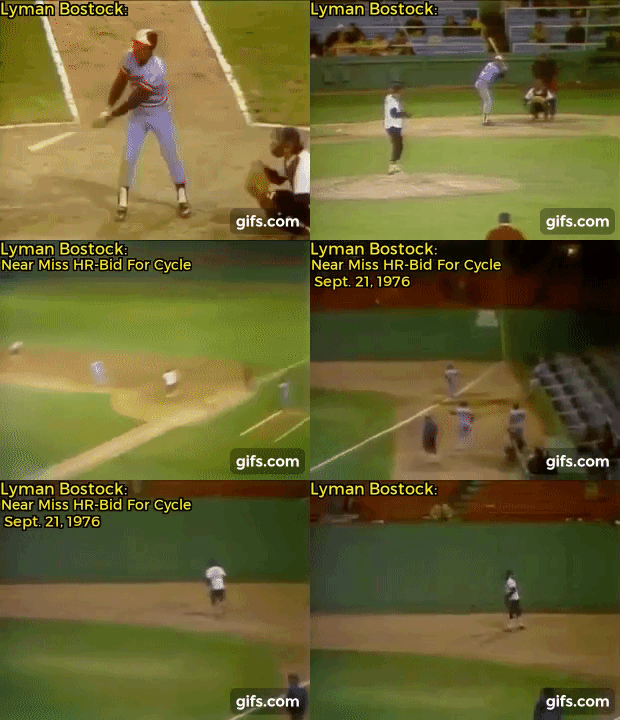
Game Of The Week (Video): Lyman Bostock's 4-4 Night Sept. 21, 1976

A video I discovered the other night, with the help of my Twitter friend Lord Of The Fries. It is the last 20 minutes of the 13-6 win against the White Sox on September 21, 1976.
Bostock, during his final at-bat
Beautiful beyond words. From seeing that uncomplicated, whippy swing of Lyman Bostock, Larry Hisle settling in under a can of corn in left field, Mike Cubbage (think John Denver in baseball hosiery), and that crazy pitching delivery of Tom Burgmeier from the first base side, to how impossibly unathletic Glenn Borgmann REALLY appeared - all on top of seeing hitless wonder Bob Randall (4 hits that night), Roy Smalley (in his first go-around with the Twins)  AND hitting wonder Rod Carew bat (hitless that night) - is too much for words. It was when my fandom was in its most innocent stage.
 "My last time up, I was definitely trying to hit a home run [for the cycle] and I almost got it." - Lyman Bostock, Winona Daily News, September 22, 1976 (VIDEO LINK: STARTING WITH BOSTOCK AT BAT)


BONUS: besides getting to see the faux, 1893-era Sox uniforms, you get to hear Harry Caray go completely incoherent at about the 5:30 minute mark, remarks about "Minnesota's proximity to Oakland versus Oakland's to Kansas City." Or some such gibberish. Oh yes - -I will be adding additions to this post on the original Minnesota Lumber Company faster than a psychotic carpenter, rest assured.

I couldn't watch this segment, and Caray's references to the leaders in the batting title race, without thinking about the controversial finish to come days later in the season finale (Oct. 3, 1976)  for Carew and Bostock against Kansas City's George Brett and Hal McRae. Brett won the title (news story pdf) by .001 of a point with a ninth inning inside-the-park home run, which McRae claimed Twins left fielder Steve Brye let drop purposely because of racial bias on the part of Twins Manager Gene Mauch. A story for another time..

Harry Caray, wiseguy: 
"Minnesota has a great shot at finishing second!" LOL! (5:00 mark)


Signing off, in the style of our old broadcasting buddy, Herb Carneal:

Wednesday, September 4, 2013

Jack Kralick & The First Twins No-Hitter, August 26, 1962

This post is the companion piece to "1962 Camera Day." It is one of my more enjoyable posts personally, and I hope you can take something away from it as well!
* * *

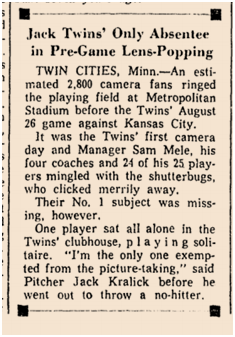
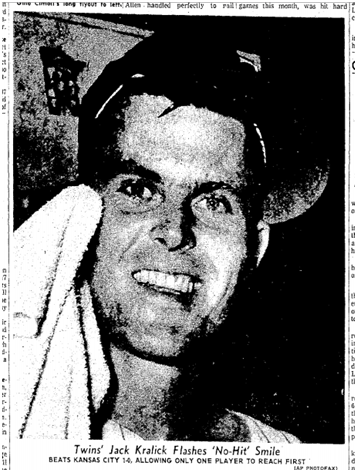
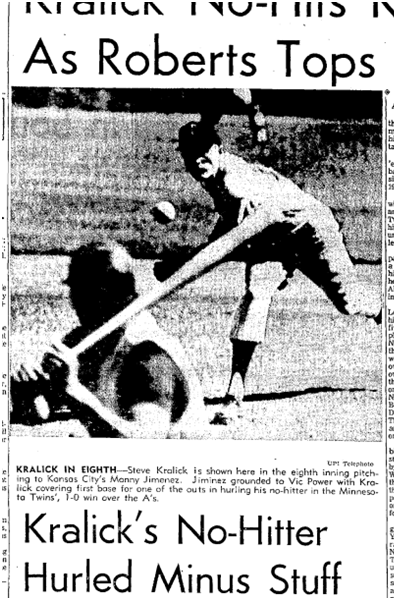
Here is my favorite photo from the whole endeavor: a picture and a piece from The Sporting News, detailing Jack Kralick's 1-0 no-hitter versus the Kansas City Athletics:


The entire Sporting News Story of "Jittery" Jack's gem can be found in PDF form here in page one and here in page 2. Make sure you read the bottom of page one, to view the description of the Allison catch to save the no-hitter. Below is his line as seen at BBReference:


Pitching IP H R ER BB SO HR ERA BF GSc IR IS WPA aLI RE24
Jack Kralick, W (10-8) 9 0 0 0 1 3 0 4.02 28 89 0.736 1.22 4.6
Team Totals 9 0 0 0 1 3 0 0.00 28 89 0.736 1.22 4.6
Provided by Baseball-Reference.com: View Original Table
Generated 9/4/2013.

Some box scores (see the August 26, 1962 near-perfect game link) flow so well that they give you a good sense of the game's rhythm. Dare I say it - this game is very eye-catching in print (or on the screen, as it were) - not as pretty as say, 1960's pin up favorites Mamie Van Doren or Brigitte Bardot, but still damn pretty in the numeric, aesthetic sense. You might not believe me, especially if you clinked on the last two links, but I'm thinking ground ball hound Tommy John when I view the innings that must have flown by frustratingly quick for the Athletics batters. We all get our kicks in different manners.

The economy and effectiveness of Jack Kralick's performance are apparent - a very worthy and signature performance for the Minnesota Twins first no-hitter in Minnesota. The time of game was a 1:57, and as Kralick and Kansas City starter Bill Fischer were tossing so many 1-2-3 innings, it had to be a challenge for the stations broadcasting the contest to fit in their ads and promos. Damn!! Not enough time to advert the Thunderbird Motel, right across the parking lot on Cedar Avenue!! 

Playing into the rapid pace of this game was the fact that the K.C. batters were actually swinging away, typical of 1960's hitters - this was over  thirty years before money ball, after all. In their average lineup in '62, only Norm Siebern demonstrated above-average plate discipline, earning 110 walks; the next-highest total, 54, belonged to Ed Charles (who would go on to achieve cult hero status with the Amazin' Mets in 1969.

It was Charles who nearly ended the no-hit bid in the fourth inning,with his opposite-field drive that forced Bob Allison to reach above the right field fence in front of the bullpen (description, PDF page one above). There went the one, serious threat.

Besides Allison, also important to Kralick's success was having, quite possibly, the best defensive first baseman in modern baseball history backing him, Vic Power. As opposed to shortstop Zoilo Versalles, who was credited with handling the baseball ONCE, on a fourth inning 6-3 groundout by Bobby Del Greco (just preceding Charles's threatening flyball), Power was involved in plays resulting in 17 of the 27 outs in the ballgame. This was spectacularly achieving the goal the Twins management had in mind to stabilize the Twins infield by trading for Power (discussed in the post "A Maestro At First: Trading For Vic Power, April 2, 1962"). See the chart below for the full rundown:

[BELOW] Plays involving Twins first baseman Power,
 inning play occurred, fielder designated on 
play (pitcher 1, catcher 2, etc.)

Groundout-unassistedthird out-1st inn
Groundout: 1-3second out-2nd inn
Groundout: 1-3third out-2nd inn
Groundout: 5-3first out-3rd inn
Groundout: 4-3third out-3rd inn
Groundout: 6-3first out-4th inn
Groundout:3-1third out-4th inn
Groundout: 4-3second out-5th inn
Groundout: 3-1third out-5th inn
Foul fly: unassistedsecond out-6th inn
Groundout: 5-3first out-7th inn
Groundout: 1-3third out-7th inn
Groundout: 4-3first out-8th inn
Groundout: 1-3third out-8th inn
Groundout: 4-3first out-9th inn
Foul fly: unassistedsecond out-9th inn
Foul fly: unassistedthird out-9th inn


It was obvious to both Battey and Kralick that he didn't have control of his curveball early in the contest, as seen in the Winona Daily News PDF. My pet theory is that Kralick focused much better, bereft of his "yellow hammer," so that he was even more on point spotting his sinking fastball and slider. Of course, none of this would have meant anything without Lenny Green's sacrifice fly, driving home Bernie Allen in the 7th inning.


As noted in the previous post "'62 Twins Camera Day," Kralick had been absent from the fan photo-taking activities, pregame. In keeping with his "lone wolf" persona...


This game somewhat parallels the Francisco Liriano no-hitter on May 3, 2011:  the same score, & each were thought to be either sub-par or VERY sub-par in their performance of late prior to their classics. 


Hope you enjoyed this look at the first great pitching performance in Minnesota Twins history!!

As the great broadcaster ended his post-game shows, I also say: