Check Out This Post!

Harmon Killebrew On David Letterman!?

With the appearance of Joe Mauer last week on Jimmy Fallon, I was reminded of another episode of a famous Twin who appeared on late ni...

Showing posts with label Jim Lemon. Show all posts

Monday, August 1, 2016

Max Kepler's Game For The Ages

"Gute Hitter"

Move over, David Hassellhoff. Those Germans & Amerikaners just LOVE Max Kepler.

In the first of a four game series against the Cleveland Indians, German-born Max Kepler established his place in team history by hitting his third homerun of the night, a perfect illustration of gluttonous bashing as he hit line drive shots in the first, third, and sixth innings. Each was a two-run shot, if you like disgustingly repetitive and symmetrical homerun videos. Not to mention the disgustingly repetitive German cliches and stereotypes that sports bloggers just can't help themselves from repeating ad infinitum! I'm sure glad I steer clear of that goofy business.


 "Heben sie ein stein!! 
Wunderbar, Maximilian!!"
In doing so, the Berliner (who somehow speaks better English than me) joined some interesting company (see chart below, including Washington Senators), and had a chance to hit a fourth in the eighth (grounded out 3-1 against new Indian relief ace Andrew Miller), and again with the game in the ninth inning, the score 12-5 for Minnesota. He singled [SIGH]. Greed and avarice do, indeed, have their boundaries..
THREE HOME RUN TWINS GAMES

Rk Player Date Tm Opp Rslt PA AB H HR RBI
1 Max Kepler 2016-08-01 MIN CLE W 12-5 6 6 4 3 6
2 Justin Morneau 2007-07-06 (2) MIN CHW W 12-0 5 5 3 3 6
3 Tony Oliva 1973-07-03 MIN KCR L 6-7 5 5 3 3 3
4 Harmon Killebrew 1963-09-21 (1) MIN BOS W 13-4 5 5 3 3 5
5 Bob Allison 1963-05-17 MIN CLE W 11-4 5 5 3 3 6
6 Jim Lemon 1956-08-31 WSH NYY L 4-6 4 4 3 3 4
7 Goose Goslin 1925-06-19 WSH CLE W 7-5 6 5 3 3 4
Provided by Baseball-Reference.com: View Play Index Tool Used
Generated 8/3/2016.

Kepler looked to be in way too big of a hurry to exit the
postgame interview with FSN North's Audra Martin, IMHO.
One other thing I missed the other night, but was remarked upon by others in the media...a telling insight into Kepler's makeup and confidence as a young player was his response to FSN's Audra Martin she asked, to paraphrase, "What does a game like this do to your confidence level, Max, is it at an all-time high?

Max, not wanting to seem immodest, looked down, smiled, and merely responded "It's maintaining...I don't want to get too high or too low." 

POSTSCRIPT: In this same game, Twins second baseman Jorge Polanco hit two triples, and had a chance to tie the Twins / Senators mark. That hill was too high for him to crest, however. 

RkPlayerDateTmOppRsltPAABH3BRBI
1Denard Span2010-06-29MINDETW 11-454435
2Ken Landreaux1980-07-03MINTEXW 10-355331
3Joe Kuhel1937-05-13WSHCHWW 10-255433
4Joe Judge1921-08-09WSHSLBL 6-897332
Generated 8/1/2016.


As it is, this post could become a separate "Game Of The Week" posting on its own merit, with emphasis on the contest as being a window into the Twins future. That just may happen. But for now...

"So Long, everybody" - Herb Carneal


The frauleins dig the long ball. But don't expect this every night!

Tuesday, April 2, 2013

A Maestro At First: Trading For Vic Power, April 2, 1962


LAST UPDATED: June 26, 2017 - Originally published 4/2/13 


In-season trades are rare occurrences for the Minnesota Twins. And even rarer are those that actually impacted the fortunes positively for the home nine. For Twins fans born around and after 1987, used to low-risk / low-dollar acquisitions* that numb the mind (see "Chris Speier, 1984, Bret Boone, 2005), the in-season pickups of Shannon Stewart (2003) and Kendrys Morales (2014) stood out as the exceptions. They captured the imaginations of Twins fans in terms of their audacity and potential, even if their outcome didn't exactly live up to the hype.
*Trade, waiver, and free-agent acquisitions are thrown into the same kettle for the purposes of this post

But rarities like these haven't always been the case in Twins Territory.


The Twins in the 1960s had at their disposal an astute gaggle of bird dog scouts, and long-time employees like Director of Minor League Operations man Sherry Robertson to assist President Calvin Griffith and his merry band of nepotists and drinking cronies in upgrading the Major League roster. They did this nearly every season in those early years. Which brings us to today's subject, the first major trade in Twins history.

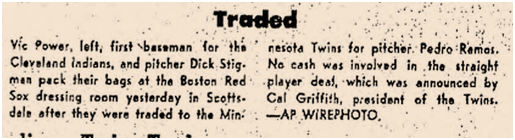
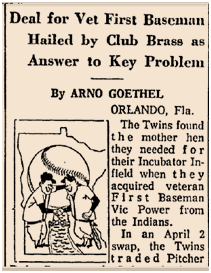
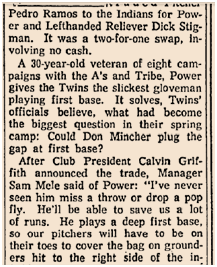
Vic Power was traded along with young reliever Dick Stigman to the Twins from the Cleveland Indians for right hander Pedro Ramos 53 years ago this week, on April 2, 1962. This happened as the team was winding down the '62 spring training schedule, and seemed to address the needs of both teams. At the time, parting with the talented Ramos, a fixture in the '61 starting rotation, was a significant event. He was their second starter, after staff ace Camilo Pascual, and is the trivia answer to "What Twins pitcher is credited with the first regular season win in team history?Jim Kaat was just coming into his own that season, and would win 18 games. They also had the enigmatic lefty Jack Kralick in house. In Stigman, the Twins were glad to get a promising, young arm. But the "sexy" part of this transaction was obvious...


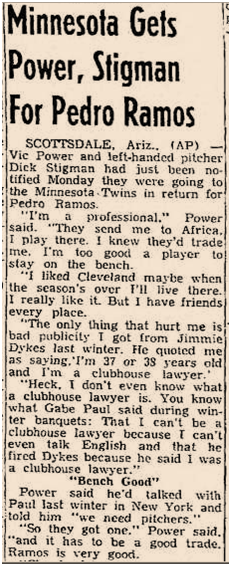
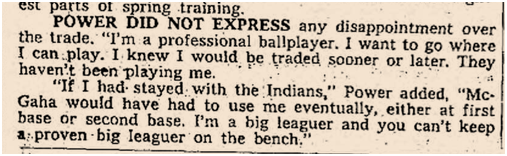
The news piece below from the 4/3/62 Jefferson City Daily summed up the trade, besides giving a very detailed, honest set of responses from Power himself (born Victor Power Pellot). Power was the key acquisition for the Twins , and at age 33, was joining his third organization. The Twins organization, going back TEN YEARS to their Washington Senator days (Google news item link) had coveted Power as a player. In another lifetime, as a Yankee in the early 1950s, he was in line to become the first black player for that organization. But the Bronx Bombers instead tapped Elston Howard for that role, for reasons that are now obvious. Some very transparent racism can be inferred from the Yankee brass responses, in The Sporting News piece linked here, from August 19, 1953


He had a reputation for marching to the beat of his own drummer, and was not necessarily the "company man" preferred by management. He was flashy in his dress, as well as the automobiles he drove. He was glib and candid, much to the consternation of his employees. He was conspicuous for enjoying the company of white women. And, maybe worst of all, he [GASP] made putouts at first with a sweeping, one-handed stab - unorthodoxy and panache frowned upon by the baseball lords of the day. 

Each of the above infractions were decided liabilities for dark-skinned players who desired stable employment before Civil Rights legislation came into effect.


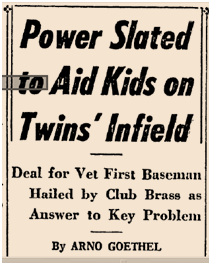
Twins Manager Sam Mele, on the other hand, stated the case for acquiring Power (to whom I devoted a "Remembering Vic Power" post some time back) in this piece:


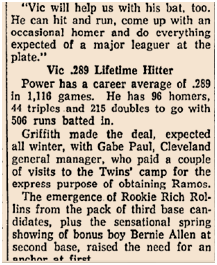
There was a youth movement (Brainerd Daily Dispatch, 4/2/62) underway at The Met. Besides now having the green-as-a-pea kids third baseman Rich Rollins and second baseman Bernie Allen on the roster to start the season, Minnesota also had the mercurial Zoilo Versalles returning at short. Manager Sam Mele went on in the article to say "Power should be a steadying influence on the kids. They won't have to worry about making perfect throws. If it's within Power's reach, he'll come up with the ball." Griffith's concerns about his infield defense were legit, as the team ranked 8th (ten team AL) in defense in 1961; in Power, he now had his "Mother Hen" to corral those youthful slings to first. 

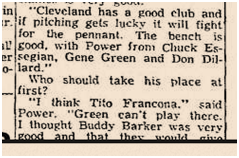
Power himself had a little extra to add in this account, which sums up the pride and inner confidence he held for his talents:


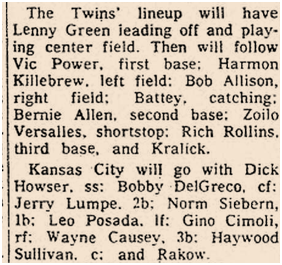
The Brainerd Daily Dispatch revealed the Twins new mindset for what would constitute their daily lineup to begin the 1962 season. Anybody surprised at who's slotted for left field, replacing Jim Lemon? Some big, ox-strong kid, name of Harmon Killebrew:


The trade would indeed benefit the Twins in their infield defense that year, besides elevating their place in the standings. They went on to post a 91-71 record, second in the league, moving them a step closer to respectability. Power would win his fifth Gold Glove Award, and rate 21st in the 1962 MVP voting. He would also play a pivotal role in the first Twins no-hitter by Jack Kralick (story at link) on August 26 that year. 

But that was just another day at the office for Victor Pellot Power. For his part, he seemed to enjoy his time in Minnesota, judging by his comments in a Baltimore Afro-American piece from March 31, 1964.

More insight about Power and his role as a MLB trailblazer can be gleaned at this very cool Baseball Hall Of Fame article.  
As the old professional at the mic, Herb Carneal, would end his broadcasts, I also say:
"So long, everybody!"


No, please don't go there....ohhhhhhh(!)....okay...
....what man wouldn't be proud of that assertion?


Thursday, February 23, 2012

Game Of The Week: Second-Guessing Harmon Killebrew, Aug. 6,1961

This is the latest in a series honoring the late, great Harmon Killebrew, who died on May 17, 2011.

NOTE: eventually, all killers
end up with their mug shot
on the post office wall, or
in the newspaper sports section .
I recently came upon this 51 year-old clipping, found in the subterranean archives at Classic Twins. Though incomplete, it was found on the back of an AP photo and news story of Warren Spahn, celebrating his 300th win. Its central figure is the dominant icon in Minnesota Twins history, and it's scant detail allows a glimpse at one of the few instances in which he was the receiver of something besides glowing endorsement. That it occured as it did could be attributed to the fact that he had only two full seasons under his belt, and was earning his stripes as a 25 year-old star for the fledgling '61Twins. Of course, it's happening in the media capital of the world helped make it water cooler fodder around the country. That criticism alone made it absorbing for me - a lifelong citizen of Twins Territory.

It was the last time the Twins would play in New York during the 1961 season. In a deflating series, the Twins lost four games that weekend to the eventual World Champs; the last three were by one run. The game in focus was the first of a Sunday doubleheader, which the Twins lost in extra innings on a fielding decision by Harmon Killebrew.

The Game

The Aug. 6, 1961 box at BBRef is a fine stop to catch the sequence of events. In short: right hander Ray “Old Blue” Moore was pitching for the Twins in the bottom of the 15th inning, the game tied at 6 each. The Yankees had loaded the bases for Yogi Berra with one out, following a walk to Mickey Mantle. The eventual Hall of Fame catcher slapped a grounder at fellow future Hall inductee Killebrew at first. The conventional play would have had him throwing home to cut off the winning run (Bobby Richardson).


The game record at BBRef says Killebrew, instead, chose to go for the inning-ending double play. It is likely he factored the old-timer Berra into the split-second decision;  the left fielder that day was playing his 1,927th game since 1946, the majority of which he played as a catcher. But The Baseball Gods made Killebrew pay for that...his throw to shortstop Zoilo Versalles forced out Mickey Mantle, but the gamer Berra wrested every bit of energy he could from his 36 year-old legs to beat the return throw. Richardson scored the winning run. The Bombers basked in their accustomed glow while the upstarts from Minnesota limped down the coast to begin a weekday series in Boston.

Killebrew with The Mick, Jim Lemon and Roger Maris at Yankee Stadium,
in August of 1961. I'm getting a Mount Rushmore effect!
In the process, it unleashed the Monday morning quarterbacks of the press, questioning Killebrew’s “wrong play.” The game and series helped propel New York to its winningest month that season, and dropped Minnesota to 25 games back of the Evil Empire. It was the “TC” boys sixth straight loss. Yes, for Twins fans accustomed to the Yankees seemingly endless domination in the 2000s, nothing much has changed under the sun in 50 years (1987 and 1991 notwithstanding...). The discussion lasted into the next weekend, at least, when the Spahn photo was published in the Minneapolis Star.


In Case You Were Wondering...

Killebrew's 1961 Fielding / Lifetime Statistics As First Baseman

YearTmLgAgePosGGSCGInnChPOAEDPFld%RtotRtot/yrRF/9RF/GlgFld%lgRF9lgRFGAwards
1961MINAL251B119115102997.11053972671491.987119.388.73.9909.459.34AS,MVP-11
14 Seasons1B9699296267810.28145752155569678.992-6-19.318.33.9919.719.57
Generated 2/18/2012. Rtot: total zone fielding above average; RF/9: range factor per 9 innings RF/G: range factor per game. You are encouraged to match like-colored columns for comparison. Big chart! Try clicking on "original table" if partially obscured.

The "lg" prefixes  denote league averages for the same sets of criterion. These stats seem to suggest the idea that while Killebrew had average to poor range; on the other hand, he also made relatively few errors, was sure handed with the balls he could reach, and probably compensated for his deficits with good positioning the longer he was in the league.

The statistics show what we already knew by the eyeball test: Killebrew’s record as a fielder in 1961 and for his career confirms he was sub par in range (as compared to the league’s other first basemen) and foot speed. BBref and Fangraph's are in accord in assigning him a TZ (total zone) of 1 in 1961, which places him in the "extremely average/low average" in that oh-so-convoluted-yet-encompassing fielding construct. And I while I wasn’t around in ’61 (only being familiar with the Harmon of the late ‘60s and early ‘70s), it’s hard to imagine he’d been Juan Pierre-like in foot speed ten years earlier. Quite the opposite; think of a latter-day  Benjie Molina (whom, it has been said, runs “like he’s got a bear on his back”). I recall seeing Harmon with binoculars, during a game in the early '70s; the image of him sitting on the dugout steps, eating potato chips is etched upon my mind. That and that vicious swing of his.

Suffice it to say, while he was an exceptional athlete with superior throwing arm strength, he was sub par in those other, essential attributes.

Doing what comes naturally: Harmon being harmful on the Senators and catcher Gene Green, 1961 (Sports Illustrated Archive Photo). I can watch video of him regularly from the '60s and still feel awe at how hard he swung. Paul Bunyan indeed.
OK, I'm A Homer, But...

While there was no mistaking Harmon’s role as Minnesota's slugger extraordinaire, there is that other issue which has been part of the Killebrew story – his defensive position in the field. Killebrew played 119 games at first and 65 at third in 1961. Then, he was shuttled, more or less continuously during the 1960’s, between third, first, and left field. The only exception to this was 1967, when he played160 games at first.  After ’61, Harmon didn’t play first at all (save for 4 games in ’62) until 1965, when Manager Sam Mele penciled him in for 72 at first, and 44 at third. The presence of slick fielding Vic Power on those early Twins teams, Don Mincher in mid-decade, and Rich Reese at the end of the 1960’s made it incumbent on Killebrew to move over to help other teammates find a defensive position, a stronger glove, or to add another strong bat to the lineup. 

The point of this filibuster, you ask? The constant jockeying between positions had to affect his fielding instincts for the worse. Whether it’s licking envelopes, yelling at office subordinates, or driving a fork truck, it’s hard to gain the rhythm and instincts to be effective at what you do without the constant reps, the daily security of routine. Little things aren't so automatic, like positioning for certain game situations, or, say, choosing the best percentage play to get a putout.

Athletes are notorious creatures of habit. The Nick Puntos of the world, who can thrive defensively without positional security, are rare animals. Here was Harmon Killebrew, the dominant power hitter of his team and of the entire decade of the 1960’s moving around the diamond for the betterment of his team – It would be unthinkable to ask Albert Pujols to find another slot out of respect for Kendrys Morales and his glovework now in 2012. Not that Pujols has ever been compared to a Dick "Dr. Strangeglove" Stuart as a fielder.

No debate here. Harmon gets a posthumous pardon for his error in judgment.

If it was good enough for Herb Carneal, so it goes for me:
"So long, everybody." - TT