Check Out This Post!

Harmon Killebrew On David Letterman!?

With the appearance of Joe Mauer last week on Jimmy Fallon, I was reminded of another episode of a famous Twin who appeared on late ni...

Showing posts with label Pedro Ramos. Show all posts

Monday, June 9, 2014

Earl Battey 1961 Baseball Digest Feature


Do yourself a favor and check out this link to June 1961 Baseball Digest at my Google Docs with a superb Earl Battey article. Battey was the first Twins player ever to appear on the cover of that magazine, as the Twins first season had just begun in Minnesota just a few weeks earlier.A great piece on the first, great catcher of the Twins, who was named the top catcher on the Twins 40th Anniversary in 2000.

It's from a fantastic, mint edition which I just recently bought off Amazon. I rather fancy it as a historical document, partly because it was published just a month or so into the beginning of the first expansion era in baseball. Besides that, it really is telling as an illustration of sports journalism, circa 1961.

To wit: I truly doubt that any major sports publication today, or any magazine really, would give a damn what I thought about anything, much less pay me for ideas submitted:


[Blurb at left from "Greatest Catches" story - see table of contents in the Google scanned Table Of Contents - I wouldn't mind the money, if the offer from Baseball Digest is still valid..]

You'll notice the date stamp, "MAY 4 - 1961" on the back page, probably denoting when it was received by the store of sale. The story references the Twins first game on April 11, 1961 (BBRef box), which means the interview for the June issue was conducted very shortly after that game before it went to press.

Battey really shows himself to be an incredibly well-spoken young guy (he was 26 in 1961). I mean, this story is really chock full of intelligent, cogent, and insightful responses. The BD staff writer, Charles Dexter, included quite a few long, thoughtful quotes which made it seem at times as if Battey himself wrote the article in the first person.

My favorite sections were his insights into Twins pitchers like Camilo Pascual, Jack Kralick and Pedro Ramos, and how they comported themselves in the lockerroom. I'm only a little surprised not seeing any references to Jim Kaat. Probably indicates where the big lefty was in the staff's pecking order as the season was beginning.

An ironic section on page 15 mentions that Earl had John Roseboro as a neighbor in Compton, California at the time. Of course, all good Twins fans know that Roseboro eventually replaced Earl as the Twins everyday catcher, in 1968, after Earl and Ron Perranoski came in the Versalles/Grant trade. You can read about Earl's post-career at this SABR bio article from 2009.

I included the table of contents in the scan, plus the revised Twins and Yankees rosters as of '61 May, in addition to those for the first two expansion teams in MLB history, the California Angels and the new Washington Senators. I kid you not! If you see any articles you would like pdf scans to read, just let me know. I can try to email you a copy.

There are some nice pluses in the magazine.
See if you can recognize some of the names
of the Twins coaches (or others)
in the chart below! Yeah, just a tad jumbo, but it wasn't 
displaying well at large size!


NOTE: Check out the back side of the magazine at the end of the scan: a full-color advertisement. Rather cool!

You can get a short sample of the older Earl, at this
You Tube video from 1986 I posted a while ago. You get
some idea of the understated, but warm manner
of the man. Fairly engrossing, if I might say so.

I conclude in my best Herb Carneal-ese: "So long everybody!"

Friday, May 9, 2014

Twins Killers: Diamond Jim Gentile's Two Grandslams At The Met, May 9, 1961


"I was just trying to get a hit both times as I hate to leave a man on third base." - Diamond" Jim Gentile 


On today's date, Tuesday, May 9, 1961 (BBRef.), Gentile hit two grand slams versus the Twins in a 13-5 shellacking at Metropolitan Stadium, in Bloomington, Minnesota. This game marked the very first game ever for the Baltimore Orioles in Minnesota after the Washington franchise moved to The North Star State. In the world of pop music, Del Shannon's Runaway was Number 1 in the U.S. Hit Parade. Three days previous, Mercury astronaut Alan Shepard had become the first American to travel into space, to an altitude of 116 statute miles, at a landing point 302 statute miles down the Atlantic Missile Range. And perhaps equally fascinating to baseball fans was the legendary home run race between Yankees Roger Maris and Mickey Mantle, who would finish first (61) and second (54), respectively, in the first year of expansion in Major League Baseball. A good trivia question: can you name who finished (tied) for third place in that race?

BACKSTORY
Jim Gentile had been buried in the Brooklyn/L.A. Dodger farm system for an unbelievable EIGHT seasons (1952-59), during which time he hit 208 home runs! His minor league totals have to be seen to be believed! The only thing blocking his path to the majors was the presence of long-time, beloved Dodger first baseman slugger and All-Star, Gil Hodges. His late arrival at age 25 (March, 1960) in Baltimore to finally become a regular player is the primary reason his place in Major League Baseball history is not more prominent. His background as a Dodger gets some treatment in this fine article "Mickey Mantle, Roger Maris, Jim Gentile: The Story of Baseball's 1961 Sensation." It goes into detail about his delayed start that goes beyond the scope of this post. One of the story's revelations is that Roger Maris was mistakenly credited for one extra RBI in a July 5th game - significant because without it, it meant he and Gentile had actually tied for the AL RBI lead at season's end.

As it was he only hit 179 homers in 9 seasons, with a 162 game average of 31. He hit 20 HR, and had 51 BB in 342 plate appearances, while collecting 59 RBI versus the Twins for his career; that was good for a .257/ .365 /.507 /.872 line in 91 games.

 The game marked the appearance of four future baseball Hall of Fame players and managers, and was played before 4,514 fans. With 18 runs, 21 hits, 12 walks, and 6 relief pitchers the game clocked in at 3:10 under sunny, cool, 47 degree skies.

Minnesota fans at this post's publishing date most assuredly can relate to such maddening disconnects and variability of spring weather.

Regardless, I had never heard of this game, (being the young and spry spring chicken I am) until about 8 years ago, when a coworker of mine asked me if I had ever heard of Gentile's feat; the same friend had attended that game while on an outing as a school patroller. It was just a little bit before my time began as a Twins fan, and I had to know more about it. I couldn't locate any records to corroborate his story; I was evidently not aware of the existence of on-line sites such as Baseball Ref. and Retrosheet. What an ignorant, savage world I lived in...

THE GAME
Baltimore right fielder and future Hall of Fame manager Whitey Herzog had walked to lead off the game; he advanced to third by center fielder Jackie Brandt's double. Then, another future Hall of Famer, third baseman Brooks Robinson, took first on Ramos's second walk of the inning. It was then that Diamond Jim smoked a fastball for bomb number one over the center field fence off right hander Pedro Ramos, 410 feet just to the right of center. To this day, Gentile maintains he didn't hit it very well, implying that the wind helped the ball carry.

[Click schedule above for larger size] Herb Carneal was in the broadcasting booth that day - calling the game for the Orioles.  He'd joined their team in '57, wouldn't arrive in Minnesota until 1962. 


"Taking a healthy, home run cut!" - Racine Journal
May 10, 1961. Very Jim Thome-like in its violence.


Gentile's #4 would later be worn by another,
noteworthy Oriole - Hall of Fame Manager 

See above Gentile photo with story at Brownsville Herald, May 10, 1961

After Ramos allowed a single to Oriole starter Chuck Estrada with one out in the second, he walked Herzog again, and was removed in favor of reliever and Winona (Minn.) native, Paul Giel. Jackie Brandt topped one, which Giel fielded and threw wildly for an error at second, attempting to force out Herzog, allowing Estrada to score on the play. Giel had to have been completely aware who was coming up, but despite that he still gave Robinson his second free pass in as many innings to bring up the Diamond Man. Same result: on his very next swing, Gentile caught Giel's high change up, and cleared the bases with another cannon shot - this time 410 feet, deep into the right field bleachers (the right field line was 329 feet in 1961; the power alley in right center was 365 - it must have had looked gargantuan to the 4,514 in attendance). And just as they had in the first, the same quartet scored to put the game away! His 8th inning sac-fly scored Brandt - the third time Gentile had driven him home - giving him nine RBI on the day. His slams drew him even with Mantle in the early home run race at nine.

Curiously following Gentile at number 5 in the Baltimore batting order was yet another Hall of Famer and former Dodger. Dick Williams was no all-star as a player; he would make The Hall purely on the strength of his managing acumen. To wit, he did not reach base once in that ballgame. In fact, he was doing his darnedest to stay above the Mendoza Line; he entered play that day batting .203. Meanwhile, Gentile had been lighting it up in the first 22 games of the season, with a .338/.476/.738 line - good for a whopping OPS of 1.215 (see stats link). Oriole Manager Paul Richards (fascinating SABR bio link) didn't even bother to protect Gentile in the lineup with other, better choices like catcher Gus Triandos (perennial MVP candidate), or shortstop Ron Hansen (1960 AL All-Star/Rookie of The Year). Richards was regardly universally as the genius baseball mind in that era, much like Gene Mauch would be a few years later; in this isolated instance, at least, his lineup sequence just didn't add up for me. Now, as if I haven't deadened your mind already with links to stats and news accounts, here's another one: a funny little piece about Gentile and Manager Richards in this Sporting News short, from July 19, 1961. 


Kingsport (TN) Times, May 10, 1961, Would have been nice if
the UPI photographer had actually gotten Brooks Robinson and
Whitey Herzog (run-scorers with Gentile and Brandt) into the frame, instead of Ron Hanson. Coulda-shoulda-woulda, I guess.

Also of interest was yet another Hall of Famer playing in that game - Harmon Killebrew. The Killer, obviously not wanting to be left out of the fun, went deep in his last at bat in the ninth to deep left field. As it was his sixth blast ever wearing a Twins uniform, he was continuing his own blistering pace (BBRef popup stats) since coming back from an injury. He and Gentile would end up in a tie in the 1961 homer race with 46. Twins right fielder Bob Allison also went deep twice - but he only had a paltry 3 RBI's for his 3 for 4 afternoon, in contrast to Mr. Gentile (San Antonio Express news PDF) .

POSTSCRIPT
If you check Diamond Jim's splits in that 1961 season (BBRef popup stats) against the Twins and the other AL teams, you'll note he took the ugly stick to nearly everyone that year. His favorite victim was the L.A. Angels pitching staff; his 1.441 OPS came on the strength of 9 homers, 3 doubles, 15 singles, 25 rbi's, and an amazing .409 BAbip! His line against Minnesota was a still-whopping .327/.426/.691 for a 1.117 OPS, with 6 home runs, and 23 rbi's.  Overall, he had 46 homers, 141 rbi's, 96 walks, batted .302, and only struck out 106 times. So, I don't expect I'll knock you over with a feather with surprise if I say 1961 was his career year.

1961 Topps Gentile card

An online article from summer, 2013, at MASN Sports Network shows Gentile in gracious form, discussing his great 1961 season, in addition to praising current Oriole first baseman Chris Davis for his home run exploits. He sounds thoroughly at peace with his career and place in Oriole history. 

After 1963, he would go on to play for several more American and National League clubs, adding value wherever he went, though never coming close to equaling that magical 1961 season. As if anyone could. But for legions of Twins fans, he is known today as the very first Twins Killer.

To quote the great Twins broadcaster:
"So long, everybody!" - Herb Carneal

Post Script: One of my fellow members, Jim Huber from The Society For American Baseball Research, has used this post as source material for his very fine article about Jim Gentile's game - linked here:

May 9, 1961: Orioles' Jim Gentile blasts two grand slams on consecutive pitches

On Tuesday, May 9, 1961, before a crowd of 4,514 fans at Minnesota's Metropolitan Stadium, the Baltimore Orioles played an afternoon game against the Twins. Baltimore's record was 12-10, while Minnesota's was 11-11. This game was Baltimore's first in Minnesota, as the Twins franchise moved from Washington after the 1960 season.

Tuesday, April 2, 2013

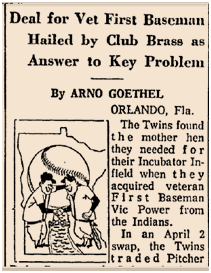
A Maestro At First: Trading For Vic Power, April 2, 1962


LAST UPDATED: June 26, 2017 - Originally published 4/2/13 


In-season trades are rare occurrences for the Minnesota Twins. And even rarer are those that actually impacted the fortunes positively for the home nine. For Twins fans born around and after 1987, used to low-risk / low-dollar acquisitions* that numb the mind (see "Chris Speier, 1984, Bret Boone, 2005), the in-season pickups of Shannon Stewart (2003) and Kendrys Morales (2014) stood out as the exceptions. They captured the imaginations of Twins fans in terms of their audacity and potential, even if their outcome didn't exactly live up to the hype.
*Trade, waiver, and free-agent acquisitions are thrown into the same kettle for the purposes of this post

But rarities like these haven't always been the case in Twins Territory.


The Twins in the 1960s had at their disposal an astute gaggle of bird dog scouts, and long-time employees like Director of Minor League Operations man Sherry Robertson to assist President Calvin Griffith and his merry band of nepotists and drinking cronies in upgrading the Major League roster. They did this nearly every season in those early years. Which brings us to today's subject, the first major trade in Twins history.

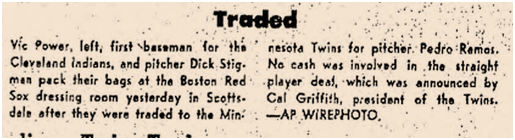
Vic Power was traded along with young reliever Dick Stigman to the Twins from the Cleveland Indians for right hander Pedro Ramos 53 years ago this week, on April 2, 1962. This happened as the team was winding down the '62 spring training schedule, and seemed to address the needs of both teams. At the time, parting with the talented Ramos, a fixture in the '61 starting rotation, was a significant event. He was their second starter, after staff ace Camilo Pascual, and is the trivia answer to "What Twins pitcher is credited with the first regular season win in team history?Jim Kaat was just coming into his own that season, and would win 18 games. They also had the enigmatic lefty Jack Kralick in house. In Stigman, the Twins were glad to get a promising, young arm. But the "sexy" part of this transaction was obvious...


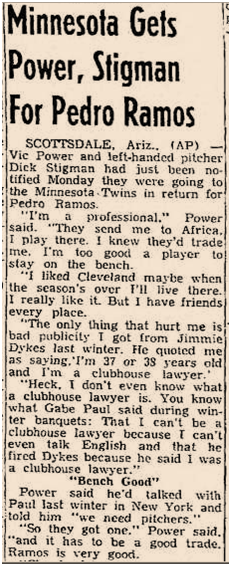
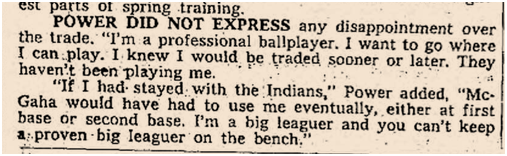
The news piece below from the 4/3/62 Jefferson City Daily summed up the trade, besides giving a very detailed, honest set of responses from Power himself (born Victor Power Pellot). Power was the key acquisition for the Twins , and at age 33, was joining his third organization. The Twins organization, going back TEN YEARS to their Washington Senator days (Google news item link) had coveted Power as a player. In another lifetime, as a Yankee in the early 1950s, he was in line to become the first black player for that organization. But the Bronx Bombers instead tapped Elston Howard for that role, for reasons that are now obvious. Some very transparent racism can be inferred from the Yankee brass responses, in The Sporting News piece linked here, from August 19, 1953


He had a reputation for marching to the beat of his own drummer, and was not necessarily the "company man" preferred by management. He was flashy in his dress, as well as the automobiles he drove. He was glib and candid, much to the consternation of his employees. He was conspicuous for enjoying the company of white women. And, maybe worst of all, he [GASP] made putouts at first with a sweeping, one-handed stab - unorthodoxy and panache frowned upon by the baseball lords of the day. 

Each of the above infractions were decided liabilities for dark-skinned players who desired stable employment before Civil Rights legislation came into effect.


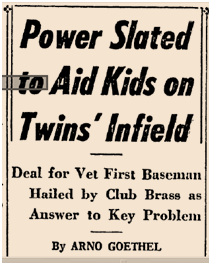
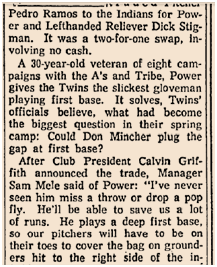
Twins Manager Sam Mele, on the other hand, stated the case for acquiring Power (to whom I devoted a "Remembering Vic Power" post some time back) in this piece:


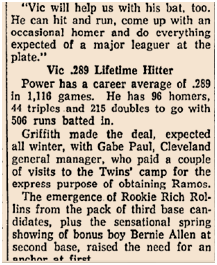
There was a youth movement (Brainerd Daily Dispatch, 4/2/62) underway at The Met. Besides now having the green-as-a-pea kids third baseman Rich Rollins and second baseman Bernie Allen on the roster to start the season, Minnesota also had the mercurial Zoilo Versalles returning at short. Manager Sam Mele went on in the article to say "Power should be a steadying influence on the kids. They won't have to worry about making perfect throws. If it's within Power's reach, he'll come up with the ball." Griffith's concerns about his infield defense were legit, as the team ranked 8th (ten team AL) in defense in 1961; in Power, he now had his "Mother Hen" to corral those youthful slings to first. 

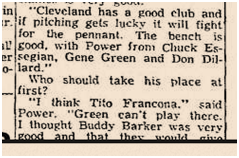
Power himself had a little extra to add in this account, which sums up the pride and inner confidence he held for his talents:


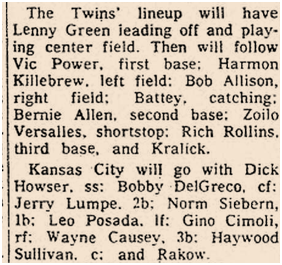
The Brainerd Daily Dispatch revealed the Twins new mindset for what would constitute their daily lineup to begin the 1962 season. Anybody surprised at who's slotted for left field, replacing Jim Lemon? Some big, ox-strong kid, name of Harmon Killebrew:


The trade would indeed benefit the Twins in their infield defense that year, besides elevating their place in the standings. They went on to post a 91-71 record, second in the league, moving them a step closer to respectability. Power would win his fifth Gold Glove Award, and rate 21st in the 1962 MVP voting. He would also play a pivotal role in the first Twins no-hitter by Jack Kralick (story at link) on August 26 that year. 

But that was just another day at the office for Victor Pellot Power. For his part, he seemed to enjoy his time in Minnesota, judging by his comments in a Baltimore Afro-American piece from March 31, 1964.

More insight about Power and his role as a MLB trailblazer can be gleaned at this very cool Baseball Hall Of Fame article.  
As the old professional at the mic, Herb Carneal, would end his broadcasts, I also say:
"So long, everybody!"


No, please don't go there....ohhhhhhh(!)....okay...
....what man wouldn't be proud of that assertion?


Monday, April 25, 2011

Twins Card Spotlight: The 1961 Peters Meats Set

Normally, I don't like to go all materialistic.

I'd like to think I've moved away from the instinct of hoarding and never being satisfied with my lot. 

But if a little, old man approached me in the street with a handful of these for free, I wouldn't turn him down. 
(See this Page Link for a description of this set's origins)


As may be inferred, the copy writers for this 1961 Twins set took liberal literary license in their player profiles. The de facto staff ace, "Pete" Ramos here is hung with a nickname that is a pure reflection of a less worrisome time, where using ethnic references from TV shows like "Zorro" were commonplace.  I, for one, have a hard time seeing Pedro arriving in the Twins locker room on the team's very first Opening Day in 1961(Fergus Falls MN Daily Journal April 12, 1961 newspaper pdf link), and announcing "Boys, go right ahead and jump on my back - The Gay Caballero's bringin' it home for ya today!" ( a la Kirby Puckett before Game 6 in 1991). But that's just me.

*Twins 1961 Opening day box score at Baseball Reference

It may be argued that such insertions make this perhaps the most interesting and compelling Twins card set of all time. Pedro did in fact, pitch the new North Star heroes to victory over the mighty Yankees and Whitey Ford that day.  That Pedro served prison time after being caught running contraband over the border should in no way cover up the fact that this bird was, along with Pistol Packin' Dave Boswell, easily the most all-round goofy and interesting character in Twins history. Actually, that would only add to his legend. Maybe the whole mishap could have been avoided if the winner of the first Twins game (Sporting News pdf)* had asserted himself thusly with the border police: "Don't you guys know who I am?"

The Gay Caballero, indeed.
*Page 2 of that same Twins related coverage, 4/19/61 TSN


Just as obvious is the need of the Twins resident Bill Shakespeare to paint Ray "Old Blue" Moore as a character right out of the children's classic "Where The Red Fern Grows." It's rather ambiguous for me, from the folksy "Moore is no stranger to these parts" (what...did he just wander in from an episode of "Gunsmoke"?) to the nebulous meaning of this clause in the final paragraph: "Although a right hander, he is very tough on liking to pitch." Is this in some way equating "Farmer Ray" with left handers of dubious morality, like an ambidextrous Bill "Spaceman" Lee? Or is it an implication that he'd just as soon chuck this baseball thing for a go at a-pickin' and a-grinnin' on the back porch down in old Virginny? 

Fact of the matter, "Old Blue" gave stability and professionalism to the Twins 'pen at a time in its history when it needed it most.  You can put that one in your corncob pipe an' smoke it.

More prettiness:


Would have loved to hear good ol' Herb Carneal describe the pitching of the above two hurlers, from back in the day.
"...And the count rides along."
TT